Audiovisual Switzerland: Trends and Services for 2026


TL;DR:
The Swiss audiovisual production scene is rapidly evolving, emphasizing local, multilingual content and AI-driven efficiencies. Companies now combine in-house social media teams with specialized agencies, using cost-effective UGC and generative AI tools to produce diverse, authentic content across platforms. The most successful brands build internal skills, partner with capable production firms, and tailor content to each linguistic region for maximum engagement.
Audiovisual production in Switzerland is defined as the full spectrum of multimedia services covering video, film, broadcast, and digital media created to communicate, inform, or engage an audience. Switzerland’s multilingual market, with German, French, Italian, and Romansh-speaking regions, makes this field more complex and more rewarding than in most European countries. With over 7.5 million social media users spending more than an hour and 45 minutes daily on social platforms, the demand for quality visual content has never been higher. Tulipfilms operates at the center of this market, producing corporate videos, event coverage, drone footage, and more for Swiss clients who need content that actually connects.
What are the main audiovisual Switzerland trends in 2026?
The Swiss audiovisual sector is shifting fast. Three forces are reshaping how businesses produce and distribute video content: the move toward in-house production, the rise of user-generated content (UGC), and the growing role of generative AI.
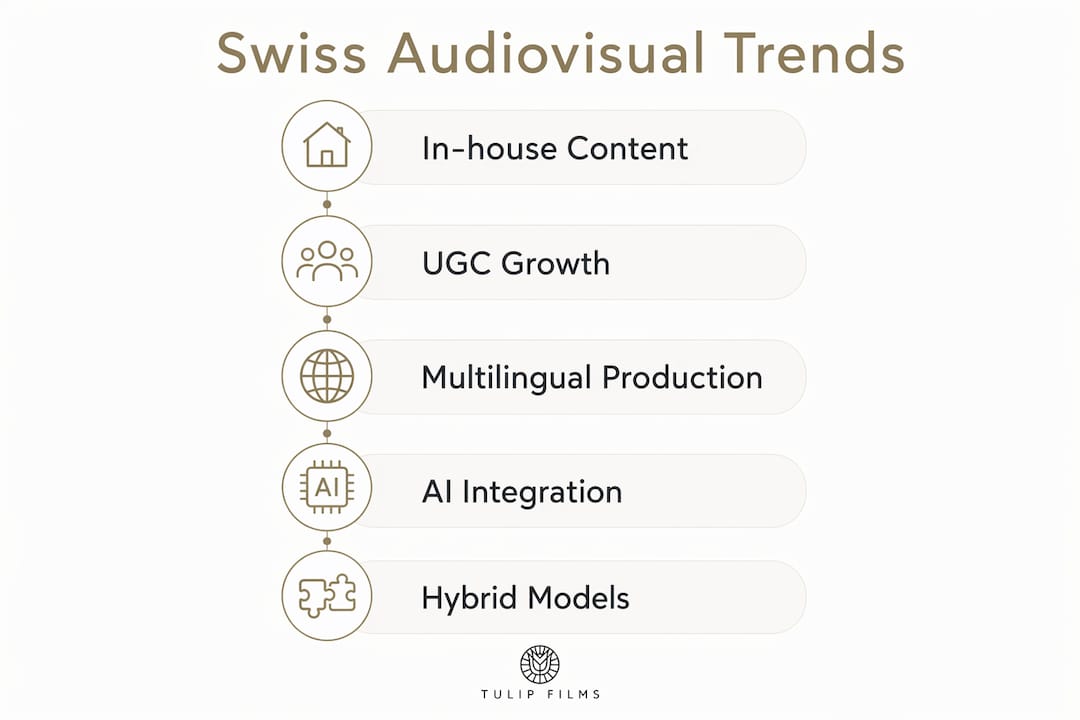
Most Swiss companies now produce social media video content in-house and rely on external agencies for high-end strategic production and training. This split model is practical. Everyday social content gets made quickly and cheaply by internal teams, while brand-defining productions go to specialists.

UGC has become a serious budget line. Specialized creators in Switzerland typically charge between 300 CHF and 500 CHF per video, with brands securing full usage rights for unlimited digital reuse. That price point makes UGC one of the most cost-efficient formats for building authentic brand presence at scale.
Generative AI is the third major force. AI’s primary value lies in stabilizing production processes and enabling multiple content variants to meet social media frequency demands, not in replacing human creativity. Think of AI as a production multiplier, not a director.
Key trends shaping Swiss audiovisual production right now:
In-house video teams handle routine social content while agencies focus on strategy and high-end execution.
UGC at 300–500 CHF per video gives brands authentic, rights-cleared content without full production budgets.
Generative AI tools with multilingual voice support allow rapid content variants across German, French, and Italian regions.
Localization beyond translation means adapting tone, references, and visual style to each linguistic community.
Pro Tip: When briefing a UGC creator, specify the platform format upfront. A 9:16 vertical cut for Instagram Reels and a 16:9 horizontal version for YouTube require different framing decisions during the shoot, not in post-production.
How do audiovisual services support brand engagement in Switzerland?
Brand engagement through video works because it triggers emotion before it delivers information. Swiss businesses focus on emotional storytelling, authentic social proof, and unfiltered authenticity as the three key factors for effective audiovisual lead generation. That finding matters because it tells you what Swiss audiences actually respond to: real people, real situations, and honest communication.
Platform choice determines reach. For Swiss B2B brands, LinkedIn is the primary channel for video distribution. Instagram and TikTok dominate among younger demographics, while YouTube serves audiences looking for longer, more detailed content. A multichannel approach that places the right video format on the right platform consistently outperforms single-channel strategies.
The practical steps for building a video-driven brand engagement strategy in Switzerland:
Define your audience by region and language. A German-speaking audience in Zurich and a French-speaking audience in Geneva have different content expectations, even for the same product.
Choose emotional storytelling as your lead format. Customer testimonials, behind-the-scenes footage, and founder stories outperform product demos in engagement metrics.
Distribute across LinkedIn, Instagram, and YouTube based on your audience profile. B2B brands should prioritize LinkedIn first.
Measure engagement, not just views. Watch time, comment quality, and click-through rate reveal whether your content is actually connecting.
Repurpose strategically. A single corporate video shoot can yield a full-length YouTube piece, a 60-second LinkedIn cut, and three 15-second Instagram clips.
Pro Tip: For B2B video on LinkedIn, keep the first three seconds text-free and visually compelling. LinkedIn autoplays video without sound, so your opening frame must communicate the story before the viewer turns the audio on.
Switzerland’s internet penetration above 95% means your video content reaches virtually every adult in the country with a smartphone. The bottleneck is not reach. It is relevance. Localized, authentic content wins that battle. You can read more about specific tactics in this guide on engaging Swiss audiences with video.
What are the unique challenges of audiovisual production in Switzerland?
Switzerland’s four linguistic regions create a production challenge that most European markets do not face. Moving beyond simple translation to fully localize audiovisual content to the distinct preferences of each region is the standard that serious Swiss brands now apply. A French-dubbed version of a German-language video rarely performs as well as content conceived and shot in French from the start.
Legal compliance adds another layer. Switzerland’s revised Federal Act on Data Protection (nFADP) enforces a privacy-by-design requirement, meaning audiovisual marketing campaigns must use transparent data practices and first-party data strategies. Collecting viewer data through gated video content or email-linked campaigns requires clear consent mechanisms built into the campaign architecture from day one.
The table below maps the main challenges Swiss businesses face in audiovisual production against the practical responses that work.
Challenge | Practical response |
Multilingual content creation | Produce region-specific versions, not dubbed translations |
nFADP privacy compliance | Build consent flows into every data-collecting campaign |
High production costs for SMEs | Blend in-house social content with outsourced flagship productions |
Audience trust and authenticity | Use Swiss nano- and micro-influencers with regional credibility |
Consistent content volume | Use AI tools to generate variants from a single core production |
Swiss nano- and micro-influencers outperform foreign influencers because they understand the cultural and linguistic nuances of their specific Swiss region. A micro-influencer based in Lausanne speaks to a French-Swiss audience with a credibility that no international creator can replicate. That local trust is a genuine competitive asset for brands willing to invest in it.
How can businesses effectively engage audiovisual production services in Switzerland?
Choosing the right production partner starts with matching the service type to the business goal. Corporate video, drone footage, event coverage, and promotional advertising each require different equipment, crew skills, and post-production workflows. A company that excels at corporate event videography may not be the right fit for a real estate aerial shoot.
The agency landscape is also changing. Successful agencies are transitioning from full-service production to strategic consultants and trainers who enable in-house content teams to meet high-quality standards. This shift means you can now hire a production company not just to make a video, but to train your marketing team to produce better content independently.
Key factors to evaluate when selecting an audiovisual production partner in Switzerland:
Service range. Does the company cover the formats you need, including drone, event, corporate, and social media content?
Multilingual capability. Can they produce or adapt content for German, French, and Italian-speaking audiences without outsourcing the localization?
Pricing transparency. Clear pricing for UGC, corporate video, and usage rights avoids budget surprises. UGC rates of 300–500 CHF per video are a useful market benchmark.
AI integration. Does the agency use AI tools for rapid iteration and multilingual voice-over, or are they still working with fully manual workflows?
Portfolio depth. Review completed projects across multiple categories. A strong video production portfolio shows consistent quality across different formats and industries.
AI video generation tools with multilingual voice support now allow Swiss businesses to produce culturally relevant content across all three main linguistic regions from a single production session. That capability cuts both time and cost for brands that need consistent messaging in multiple languages.
Key Takeaways
Audiovisual production in Switzerland requires localized content, multilingual capability, and a clear strategy that blends in-house efficiency with professional production quality.
Point | Details |
Localization over translation | Produce region-specific content for German, French, and Italian audiences rather than dubbing one version. |
UGC is cost-efficient | Swiss UGC creators charge 300–500 CHF per video with full digital usage rights included. |
AI multiplies output | Use generative AI to create content variants across platforms and languages from a single shoot. |
Platform strategy matters | LinkedIn leads for B2B, Instagram and TikTok for younger audiences, YouTube for long-form content. |
Choose partners by capability | Evaluate production companies on multilingual skills, portfolio depth, and pricing transparency. |
The hybrid model is the only model that makes sense now
The debate about whether to outsource video production or build it in-house is over. The answer is both, and the split depends on what you are making. I have watched Swiss businesses waste significant budgets trying to fully outsource their social media content to agencies. The turnaround times are too slow, the costs stack up fast, and the content often lacks the spontaneous feel that social audiences reward.
What actually works is a hybrid approach. Your internal team handles the day-to-day social content, the quick product updates, the behind-the-scenes clips. A production partner handles the flagship content: the brand film, the event aftermovie, the drone sequence that opens your annual report. That division of labor is not a compromise. It is the most efficient structure available.
The part most businesses underestimate is the training investment. The best production agencies now offer creative direction and technical training alongside their production services. That means your in-house team gets better over time, not more dependent on outside help. AI tools accelerate this. When your marketing coordinator can generate a French-language voice-over variant in 20 minutes instead of booking a studio session, your content calendar becomes genuinely manageable.
The future of audiovisual production in Switzerland belongs to brands that treat content as an ongoing capability, not a one-time project. Build the internal skills. Invest in the right external partnerships. Use AI where it saves time without sacrificing authenticity. That combination produces content that Swiss audiences actually trust.
— Pieter
Tulipfilms: Swiss audiovisual production built for your market
Swiss businesses need more than a camera crew. They need a production partner who understands the cultural and linguistic complexity of the Swiss market and can deliver content that works across all three major regions.
[
Tulipfilms produces corporate videos, event coverage, drone footage, promotional content, and more for Swiss clients who need quality without the guesswork of managing multiple vendors. Every project starts with a clear brief and ends with content you can use across all your channels. Pricing is transparent, usage rights are included, and the team speaks your market’s language, literally and culturally. Explore the full range of professional video services or book a free consultation to discuss your next production.
FAQ
What does audiovisual production include in Switzerland?
Audiovisual production in Switzerland covers video, film, broadcast, event coverage, drone footage, corporate content, and digital media. Services range from single-format shoots to full multichannel content strategies.
How much does UGC video content cost in Switzerland?
Specialized UGC creators in Switzerland typically charge between 300 CHF and 500 CHF per video, with brands receiving full usage rights for unlimited digital distribution.
How does Switzerland’s multilingual market affect video production?
Each linguistic region, German, French, and Italian, requires content adapted to local tone, references, and audience expectations. Simple translation underperforms compared to region-specific production.
What role does AI play in Swiss video marketing?
Generative AI stabilizes production workflows and enables multiple content variants across platforms and languages. It functions as a production multiplier rather than a replacement for human creative direction.
Which platforms matter most for video content in Switzerland?
LinkedIn is the primary platform for B2B video distribution. Instagram and TikTok reach younger Swiss audiences, while YouTube serves viewers looking for longer, more detailed content.
Recommended
