How to Hire a Film Production Agency in Switzerland

TL;DR:
Hiring a full-service Swiss video producer ensures permits, logistics, and postproduction are managed professionally.
Choosing an agency with proven permit experience, creative capability, and reliable delivery minimizes project risks in Switzerland.
Shortlist a local, full-service Swiss video production company that manages permits, logistics, and postproduction — then request a scoped quote with itemized deliverables. That single step eliminates most of the risk in hiring for a Swiss project.
Three things to do right now:
Define your brief and deliverables. Know your format (corporate film, event coverage, real estate video, social short), your target audience, and your distribution channels before you contact anyone.
Ask about permits and drone insurance upfront. Any agency worth hiring will have a clear answer. If they hesitate, that tells you something.
Request a timeline and itemized budget. A professional agency gives you a production schedule broken into pre-production, shoot days, and post. Vague “all-in” quotes are a red flag.
Tulipfilms handles all three for Swiss clients. Their corporate and event video work covers everything from discovery call to final delivery, and a free consultation is available to scope your project before any commitment.
Table of Contents
What does a Swiss film production agency actually deliver?
The scope runs from the first creative conversation to the final export file. Understanding what a full-service agency covers helps you write a tighter brief and spot gaps in a competitor’s proposal.
Core services you should expect:
Creative development, scripting, and storyboarding
Production management: scheduling, crew coordination, location scouting
Permit acquisition for public spaces, private locations, and aerial operations
Crew and equipment: cameras, lighting, sound, grip
Aerial and drone operations, including FPV footage for dynamic shots
On-set production direction and client liaison
Postproduction: editing, color grading, sound design, and music licensing
Deliverable packaging: broadcast masters, social formats, web-optimized variants
Agency vs. client responsibilities matter more than most clients realize. The agency owns crew, equipment, permits, and postproduction. The client owns brand assets, approval timelines, and access to locations on private property. Delays in client approvals are the single most common cause of budget overruns.
Switzerland adds specific complexity. Productions regularly move between Zurich, Geneva, Lausanne, and alpine locations in a single shoot week. Multilingual crews covering French, German, English, and Italian are often necessary, and audiovisual production in Switzerland carries regulatory context under the Federal Act on Film Production and Film Culture (FiA), which sets investment obligations for on-demand services operating in the Swiss market.
How do you choose the right film production agency in Switzerland?
Creative fit, technical capability, and delivery reliability — in that order. An agency with a beautiful reel that misses deadlines costs more than a technically solid one that communicates clearly.
Checklist: what to compare across agencies
Portfolio relevance: does their reel include work similar to your brief?
Case studies with named clients and measurable outcomes
Documented permit and logistics experience in your target locations
Crew depth: do they have a named local crew lead, or do they subcontract everything?
Equipment list: owned gear vs. rented, and whether that affects your quote
Insurance: production liability and drone-specific coverage
Sample budgets and payment milestone structure
Revision policy: how many rounds are included, and at what cost?
Communication plan: who is your point of contact during the shoot?
Contract terms: IP ownership, usage rights, cancellation policy
Interview questions worth asking:
Have you filmed in [specific location]? What permits did that require?
Do you hold your own drone operating license and insurance, or do you subcontract aerial work?
Who is the on-set crew lead, and have they worked together before?
What happens if weather or a permit delay pushes the shoot date?
How do you handle a dispute over deliverables?
Red flags to watch for:
Budget quoted as a single lump sum with no line items
No documented permit experience for public or alpine locations
Deliverables described vaguely (“a finished video”)
No mention of production liability insurance
Crew described as “network of freelancers” with no named lead
Pro Tip: Ask for a project run sheet or sample production schedule from a recent comparable shoot. A realistic schedule shows travel times between locations, setup windows, and buffer time for permits. If the schedule looks impossibly tight, the budget probably is too.
What do Swiss film productions typically cost, and how long do they take?

Budget ranges vary widely by project type, location complexity, and postproduction scope. The table below gives realistic starting points for common project categories in Switzerland.
Project type | Typical budget range (CHF) | Typical lead time |
Social media short (1 shoot day) | budget varies | typical lead time is a few weeks |
Corporate film (2 shoot days) | budget varies | typical lead time is several weeks |
Real estate video + drone | budget varies | typical lead time is about a week or two |
Event coverage (half to full day) | budget varies | typical lead time is up to a few weeks |
Commercial / brand film | budget varies widely | lead time can extend over multiple weeks |
Documentary short | budget varies widely | lead time can be several weeks |
Tulipfilms publishes pricing guidance for Lausanne and Geneva that gives concrete package starting points for scoping conversations.
What drives costs up in Switzerland specifically:
Multi-region shoots (Zurich to Geneva to alpine location in one week)
Mountain or restricted-access locations requiring vehicle permits and guides
Multilingual crew or on-camera talent
Drone operations with complex airspace or altitude approvals
Tight postproduction turnarounds with multiple revision rounds
Lead times are often longer than clients expect because permit applications, location agreements, and crew scheduling all run in parallel. A six-week lead time for a two-day corporate shoot is not unusual when alpine or public-space locations are involved.
What permits and logistics does a Swiss agency handle for you?
The “permit-free” assumption is one of the most expensive mistakes a client can make. Swiss fixer guidance is consistent on this: any shoot involving significant equipment, public spaces, or drones requires permits and early route planning. Small, low-profile shoots with minimal kit can sometimes proceed without formal permits, but that threshold is lower than most clients assume.
What a competent agency manages on your behalf:
Municipal filming permits for public spaces in Zurich, Geneva, Bern, and other cities
Private location agreements and landowner releases
Drone operating approvals, including airspace coordination with FOCA (Federal Office of Civil Aviation)
Alpine and national park access permits where applicable
Vehicle permits for restricted mountain roads
Time-of-day restrictions in residential or protected zones
Local crew accommodation and logistics between regions
Drone rules in Switzerland are governed by FOCA and align with European Union Aviation Safety Agency (EASA) regulations. Commercial drone operations require a licensed operator, appropriate insurance, and in many cases prior airspace authorization. Agencies that own their drone equipment and hold their own FOCA approvals are faster and cheaper to work with than those who subcontract aerial work.
Pro Tip: Define your location list and route priorities in the first production meeting. Swiss geography means a three-location shoot across two cantons can add a full day of travel. Agencies that recce locations before the shoot day catch access problems, lighting issues, and permit gaps that would otherwise surface on the morning of the shoot.
For drone-specific planning, Tulipfilms maintains practical drone videography guidance covering permissions and technical considerations for aerial work in Switzerland.
How do you read a reel and spot real trust signals?
A strong showreel tells you three things in the first 60 seconds: whether the agency can tell a story, whether their production values hold up across different conditions, and whether they’ve done work similar to yours.
What to look for in a reel:
Consistent color grading and audio quality across different projects (not just one hero piece)
Pacing that serves the story, not just the music
Lighting that works in real locations, not just controlled studio environments
Evidence of similar briefs: corporate, event, real estate, aerial, or documentary
Trust signals beyond the reel:
Named client case studies with a brief, deliverables, and outcome described
Production credits listing crew roles (not just “produced by”)
Explicit mention of permits handled and insurance held
Recognition from Swiss Films, Switzerland’s national agency for promoting Swiss filmmaking, or festival selections where relevant to the project type
Real estate video examples with property-specific deliverables (walkthrough, aerial, social cut) show category depth
Ask any agency to walk you through one recent project from brief to delivery. A confident agency does this without hesitation. One that deflects or gives vague answers probably can’t.
How Tulipfilms works: process, packages, and next steps
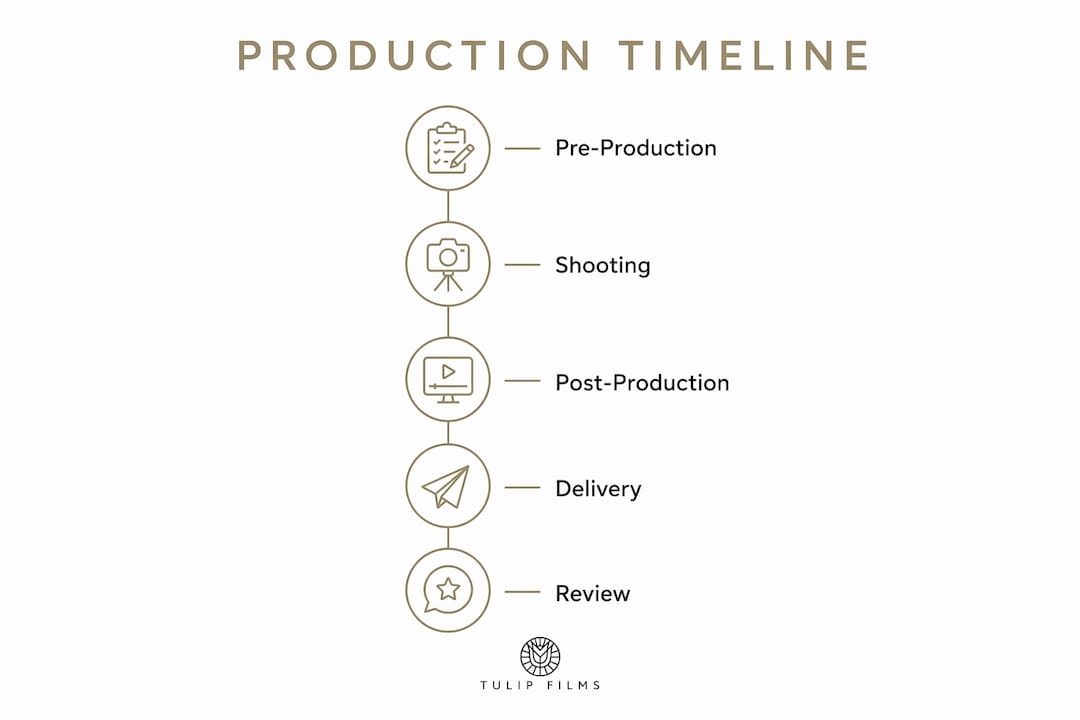
Tulipfilms runs a transparent, five-stage process: discovery call → scoping and quote → pre-production (script, recce, permits) → shoot → postproduction and delivery. Every stage has defined client touchpoints and approval gates, so nothing moves forward without sign-off.
Typical package shapes:
Social short: one shoot day, one location, editing and one social-optimized cut
Corporate film (2-day): pre-production, two shoot days, full editing, color, sound, and two format variants
Real estate + drone: single shoot day with aerial, property walkthrough cut, and social format
Client responsibilities are clear from day one: brand assets, location access on private property, and approval turnarounds. Tulipfilms handles crew, equipment, permits, and all postproduction deliverables.
View the full production portfolio to assess creative fit, or request a free scoping call to get a quote matched to your brief.
Key Takeaways
Choosing the right Swiss film production agency comes down to permit experience, delivery reliability, and creative fit — not just the reel.
Point | Details |
Define the brief first | Know your format, audience, and distribution before contacting any agency. |
Permits are non-negotiable | Public spaces, alpine locations, and drone work all require documented approvals — verify this before signing. |
Budget for Swiss geography | Multi-region shoots add travel days and costs; get an itemized schedule, not a lump-sum quote. |
Read the reel critically | Look for consistent quality across projects and ask for a brief-to-delivery case study. |
Tulipfilms as a local partner | Tulipfilms manages permits, crew, and postproduction for Swiss projects, with a free consult to scope your brief. |
What Swiss producers know that most clients don’t
Route planning sounds administrative. On a Swiss production, it’s the difference between a shoot that runs on schedule and one that loses half a day to a mountain road closure or a permit that wasn’t cleared for the right canton.
The agencies that consistently deliver on budget are the ones that treat pre-production as the real work. A two-day shoot with a week of solid pre-production almost always outperforms a three-day shoot that was under-prepared. Swiss Films exists partly to support this kind of professional infrastructure, and productions that engage with national promotion bodies and local fixers early tend to have fewer surprises on the day.
The practical advice: don’t hire an agency based on their best project. Hire them based on how they describe their worst one — what went wrong, what they did about it, and what changed afterward. That answer tells you more than any reel.
Tulipfilms: a direct route to a scoped Swiss production
Tulipfilms is a full-service Swiss video production company covering corporate films, event coverage, real estate videos, drone footage, and social content, with permits and logistics managed in-house for projects across Switzerland.
[
Getting started is straightforward. Send a brief, request a free consultation, or browse the production portfolio to evaluate creative fit before any conversation. For clients ready to discuss scope and pricing, the video production pricing page outlines package starting points for Lausanne, Geneva, and beyond. Free consults are available, and there’s no obligation until a quote is agreed and signed.
Official resources for filming in Switzerland
Fedlex — SR 443.14 (FQIO): The Ordinance on the Quota for European Films and Investment in Swiss Film Production. Relevant for on-demand services with investment obligations in Switzerland.
FiA — Federal Act on Film Production and Film Culture: Sets investment and reporting requirements for companies offering on-demand services in the Swiss market.
Swiss Fixer — Filming in Switzerland: Practical guidance on permits, crew, locations, and logistics from local production specialists.
Swiss Films: Switzerland’s national agency for promoting Swiss filmmaking. A useful reference for understanding the local production ecosystem and finding industry contacts.
Tulipfilms — Drone Videography Guide: Practical tips on drone permissions and aerial planning for Swiss productions.
Tulipfilms — Audiovisual Production Guide: Market context and service norms for audiovisual production in Switzerland.
Recommended
