How to create product demo videos that win corporate buyers


TL;DR:
Effective product demo videos require thorough planning, including clear concepts, scripts, storyboards, and branding assets, before production begins.
Choosing the right format—traditional, interactive, or hybrid—depends on your buyer’s stage, with interactive demos offering higher conversion rates for decision-makers.
Corporate marketing teams in Switzerland know the frustration well: you invest significant budget and weeks of effort into a product demo video, only to watch analytics reveal a 40% drop-off before the halfway point. Engagement is low, conversion is lower, and leadership wants answers. The problem is rarely the production quality. It’s almost always the strategy behind it. This guide walks you through exactly how to plan, produce, and deploy product demo videos that resonate with B2B buyers, drive real engagement, and deliver measurable business outcomes.
Table of Contents
Key Takeaways
Point | Details |
Keep demos concise | Aim for 30 seconds to 2 minutes to maximize engagement for B2B buyers. |
Script and storyboard first | Develop and approve your video’s script and storyboard early to avoid costly revisions. |
Choose the right format | Decide between traditional, interactive, or hybrid demos based on campaign goals and audience. |
Optimize CTA placement | Enhance conversions with embedded calls to action at key moments in your demo. |
Measure what matters | Track drop-offs, engagement, and conversions—not just video views—for real ROI. |
What you need to create effective product demo videos
Before a single camera rolls, your team needs to have several foundational elements locked in. Skipping the preparation phase is the most common reason corporate demo videos miss their targets. Think of it the way a Swiss watchmaker approaches assembly: every component must be present and verified before you begin.
Here is a core checklist of what you need before production starts:
Clear concept and defined audience segment (technical buyer, executive decision-maker, end user)
Approved script with conversational, benefit-led language
Storyboard mapping visuals to each scripted moment
Corporate branding assets: logo files, brand colors, approved fonts, and tone-of-voice guidelines
Product access or a stable demo environment that won’t change mid-shoot
Equipment plan: camera setup, lighting, microphone(s), screen capture tools if needed
Approval workflow with named stakeholders to avoid revision bottlenecks
Script and storyboarding are foundational production steps, not optional add-ons you can revisit after filming. Teams that rush past these stages almost always face expensive reshoots. Investing an extra week here saves you three weeks later. You can go deeper on this with our guides to storyboarding for video success and planning corporate videos.
One area worth planning for from the start is content longevity. Product UIs change, pricing updates, features get renamed. If you build your demo in modular segments, each focused on a single feature or benefit, you can update one section without reshooting the entire video. This is especially important for Swiss software and fintech firms whose products evolve on quarterly release cycles.
Factor | Traditional video demo | Interactive demo |
Technical setup | Standard camera/editing software | Authoring platform required |
Update cycle | Full or partial reshoot needed | In-platform edits, faster |
Distribution | YouTube, LinkedIn, landing pages | Sales emails, web embeds, demos |
Upfront cost | Moderate to high | Moderate (platform licensing) |
Engagement type | Passive viewing | Active, self-guided exploration |
Both formats have clear use cases, and the right choice depends on your buyer’s stage in the funnel. We’ll cover that distinction in detail shortly.
Step-by-step: Planning and producing your product demo video
With your checklist complete, you’re ready to move into actual production. The following process is designed to minimize revision loops and keep the project aligned with your original brief.
Write the script around your buyer’s problem, not your product’s features. Start with the pain, demonstrate the fix, close with a clear outcome.
Build the storyboard frame by frame, matching each visual to the scripted narration. This step forces clarity and catches structural problems before filming. Learn how to storyboard engaging video content for client-facing projects.
Get stakeholder sign-off on script and storyboard before production begins. This single checkpoint eliminates the majority of post-production revision requests.
Film in a controlled environment with consistent lighting and clean audio. For screen-capture segments, record at 1080p minimum and ensure all notifications and unrelated windows are hidden.
Edit with structure in mind: hook in the first five seconds, problem context in seconds six to fifteen, product solution demonstrated, and CTA in the final ten seconds.
Internal review round: share an unlisted version with two to three internal stakeholders who were not involved in production. Fresh eyes catch what the production team misses.
Client or external review: one round with final sign-off authority to consolidate feedback and close the loop.
Final export and distribution: deliver in the correct format for each channel (vertical for Instagram Stories, horizontal for LinkedIn and YouTube, embedded MP4 for landing pages).
A detail that consistently affects performance: keeping video length appropriate for B2B audiences is not just a stylistic preference, it directly affects completion rates. Shorter, well-structured videos perform better across almost every corporate B2B context.
Pro Tip: Time your script out loud before filming. A well-paced script for a 90-second video should take exactly 90 seconds to read aloud at a natural speaking pace. If it runs long, cut features, not words. Fewer, sharper points land harder than a thorough catalog of everything your product does.
Storyboarding also has a direct effect on how quickly you can move through production. Teams that speed up production with storyboarding consistently report fewer shoot days and fewer revision rounds.
Video length | Average completion rate | CTA click-through rate |
Under 60 seconds | ~68% | 4.2% |
60 to 120 seconds | ~52% | 3.7% |
2 to 3 minutes | ~34% | 2.9% |
Over 3 minutes | ~18% | 1.8% |
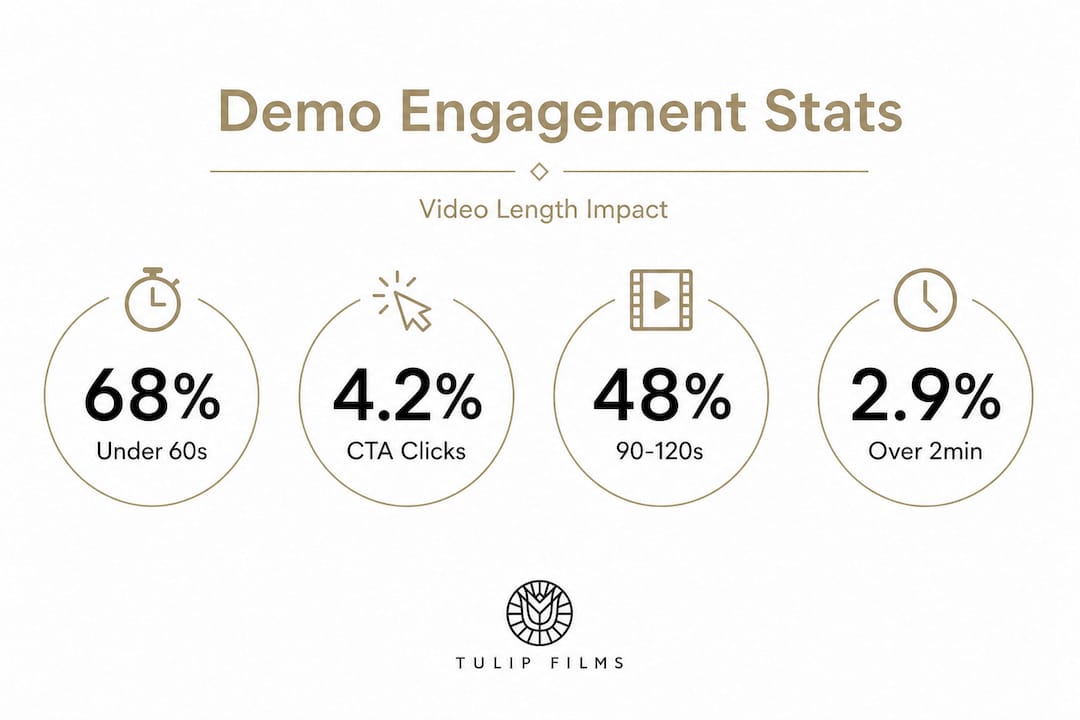
These benchmarks confirm what experienced production teams already know: the longer your video, the fewer buyers complete it, and the lower your CTA response becomes. Build tight, or build for a specific long-form use case only.

Choosing between traditional, interactive, and hybrid demos
Once production is complete, your format strategy determines how buyers experience your content. The choice between traditional video, interactive demos, and hybrid approaches isn’t just technical. It shapes your buyer’s journey.
Interactive demos average roughly 32% higher conversion compared to traditional passive video formats. That’s a significant performance gap for B2B teams with long sales cycles. However, interactive demos aren’t appropriate for every use case.
Format | Best audience fit | Complexity | Performance strengths |
Traditional video | Awareness, broad reach | Low to moderate | High shareability, easy distribution |
Interactive demo | Decision-stage, evaluation | Moderate to high | Higher conversion, self-qualified leads |
Hybrid (video + interactive) | Mid-funnel, nurturing | Moderate | Flexible, adaptable to channel |
Hybrid approaches are becoming increasingly common among Swiss B2B marketing teams managing both broad awareness campaigns and targeted sales enablement. Here’s where hybrid demos add clear value:
YouTube and LinkedIn distribution: use the video component for reach and brand awareness
Sales email sequences: embed the interactive layer so prospects self-guide through the product
Tradeshow follow-up: send a personalized hybrid demo link after an event encounter
Onboarding sequences: combine video walkthroughs with clickable feature exploration
Pro Tip: Every product demo has an invisible shelf life. If your product’s UI, pricing page, or core feature set changes and your demo video doesn’t reflect it, you’re actively creating buyer confusion. Plan a quarterly review of all published demos and flag segments that will need updating when your product roadmap hits specific milestones. Modular video structure makes this a 30-minute task rather than a full-day reshoot.
If your demos are consistently underperforming despite strong production values, it’s worth diagnosing the root cause. Our guide on why product demos fail breaks down the most common structural and strategic reasons.
Maximizing engagement and measuring your demo’s success
Producing a strong demo video is only half the equation. Where and how you deploy it, and how you track buyer behavior, determines whether it contributes to revenue or just fills a content calendar.
Here are the key engagement and measurement levers your team should be using:
CTA placement: include a CTA at the end of the video, a secondary CTA after your strongest feature moment, and a third CTA in a follow-up email triggered by a completed view
Embed on high-intent landing pages: a product page with an embedded demo converts at a significantly higher rate than text-only pages
Track the right KPIs: play count is vanity. Focus on completion rate, CTA click-through, demo-to-meeting conversion, and post-demo funnel movement
A/B test thumbnails and opening frames: the first frame determines whether someone presses play at all
Use heat maps and engagement analytics to identify exact drop-off points and iterate on the weak segments
Play count tells you how many people started your video. Engagement tells you how many people it actually worked on. Build your reporting around the second number.
Tracking demo engagement at the moment a viewer decides to continue or leave is where the real optimization data lives. Clicks, time spent, feature interaction, and drop-off steps are your signal. Most corporate teams measure views and move on. The teams that consistently improve their demo performance are the ones mapping engagement data back to specific funnel stages and adjusting content accordingly.
Pro Tip: Don’t rely solely on play counts to report demo performance to leadership. Instead, build a simple dashboard that maps demo completion to subsequent actions: did viewers book a meeting, request a trial, or click through to pricing? That correlation is far more persuasive evidence of ROI than raw view numbers. See how stronger brand video engagement strategies connect content to measurable outcomes.
The surprising truth: Why most corporate demo videos don’t convert (and how to fix it)
After working on dozens of corporate video projects across Switzerland, one pattern stands out clearly: most underperforming demo videos have a production quality problem on paper but a narrative clarity problem in reality.
Teams pour budget into motion graphics, sleek UI animations, and polished voiceovers, and still see low conversion. The reason is almost always the same. The video is built around what the product does, not around what the buyer needs to believe before they take action. These are two fundamentally different stories, and mixing them up is a costly mistake.
The most effective demo videos we’ve seen treat the format as a sales and onboarding tool, not just a marketing asset. The demo earns its budget when it shortens the sales cycle, reduces the number of live demo calls, and helps prospects answer their own objections. That framing changes everything: your script, your feature selection, your CTA, and your distribution strategy.
Here’s the contrarian insight most “best practices” articles won’t tell you: a slightly less polished video with a sharper story will almost always outperform a beautifully produced video with a muddled message. Swiss corporate buyers are sophisticated. They notice when a demo is all style and no substance just as quickly as they notice poor production.
The other persistent mistake is ignoring the post-view journey. A great demo with no follow-up system is like a great sales call that ends without a next step. Pair every demo deployment with a triggered email sequence, a clear CTA destination, and a way for your team to see when a prospect watched the full video.
Our resource on fixing demo video failures goes deeper into the structural and strategic reasons demos miss their mark, and how to reverse them.
Pro Tip: Run every draft of your demo script by one stakeholder who is completely unfamiliar with your product. If they can’t explain the core value proposition back to you after watching, your narrative needs work before you spend a single franc on production.
Ready to elevate your next product demo video?
Making demo videos that convert consistently is far more achievable when your production partner understands both the craft and the commercial objectives behind every shot.
[
Tulip Films brings deep Swiss corporate experience to every project, from concept and scripting through filming, editing, and delivery on tight timelines. Whether you’re producing your first product demo or rebuilding a full library of sales enablement content, our team is built for exactly this kind of work. Explore our corporate video portfolio to see the quality and range we deliver. When you’re ready to discuss your project, our production pricing and packages page gives you a clear starting point. And for a full picture of what we offer, visit our creative video services overview to find the right fit for your campaign goals.
Frequently asked questions
What’s the ideal length for a corporate product demo video?
Aim for 30 seconds to 2 minutes for most corporate demos; keeping length audience-appropriate is critical for completion rates, and you should rarely exceed 3 minutes unless your audience is deeply technical and already invested.
How do I keep my demo video current if my product evolves?
Create demo videos in modular segments that can be updated independently, since video demos can silently become outdated when product UIs or features change, and aligning your reshoot schedule to your product release cycle minimizes disruption.
What engagement metrics matter most for demo videos?
Track where viewers drop off and convert rather than focusing on play counts, because completion rates, drop-off points, and post-view funnel actions give you the actionable data you need to improve performance.
Should we choose video or interactive demos for B2B buyers?
Use interactive demos for decision-stage buyers who need to explore features independently, since interactive demos average roughly 32% higher conversion than passive video, while traditional video demos remain stronger for initial awareness and broad distribution.
Where should we place CTAs in a corporate product demo video?
Place CTAs at the end of the video, after your strongest feature moment mid-demo, and in a follow-up email triggered by completion, as CTA placement at key benefit moments consistently outperforms end-only placement for B2B audiences.
Recommended
