How to Script Brand Videos for Audience Engagement Success


Standing out in the Swiss market takes more than a beautiful brand logo or clever tagline. Marketing managers in Geneva are discovering that video content with clear strategic objectives and focused audience definition delivers measurable engagement and stronger client conversions. If your company wants to connect with viewers and spark real interest, this guide reveals proven steps for building videos that capture attention and drive action.
Table of Contents
Quick Summary
Key Point | Explanation |
1. Define clear objectives and audience | Establish measurable goals and understand your target audience to create engaging videos. |
2. Research trends and brand voice | Stay updated on video marketing trends while maintaining a consistent brand identity. |
3. Craft a compelling narrative | Develop an emotional storyline that connects viewers with your brand message effectively. |
4. Structure scripts for clarity | Create a detailed script that guides narrative flow and visual execution thoughtfully. |
5. Review and refine the script | Use feedback and analysis to enhance your script, ensuring it meets audience expectations. |
Step 1: Define strategic objectives and target audience
Defining strategic objectives and target audience forms the critical foundation for creating compelling brand videos that resonate with viewers. By establishing clear goals and understanding your ideal customer, you can craft messaging that cuts through the noise and drives meaningful engagement.
To develop a robust video strategy, start by outlining specific, measurable objectives aligned with your broader business goals. Are you aiming to increase brand awareness through storytelling, generate leads, or showcase product features? Each objective requires a different approach and messaging style.
Building effective audience personas involves collecting detailed demographic and behavioral data. Consider these key elements when defining your target audience:
Age range and generational characteristics
Professional background and industry
Geographic location and cultural context
Specific challenges and pain points
Media consumption habits
Personal and professional aspirations
Companies that invest time in understanding their audience can create more personalized, impactful video content. By mapping out precise audience segments, you ensure your video speaks directly to viewers’ needs and motivations.
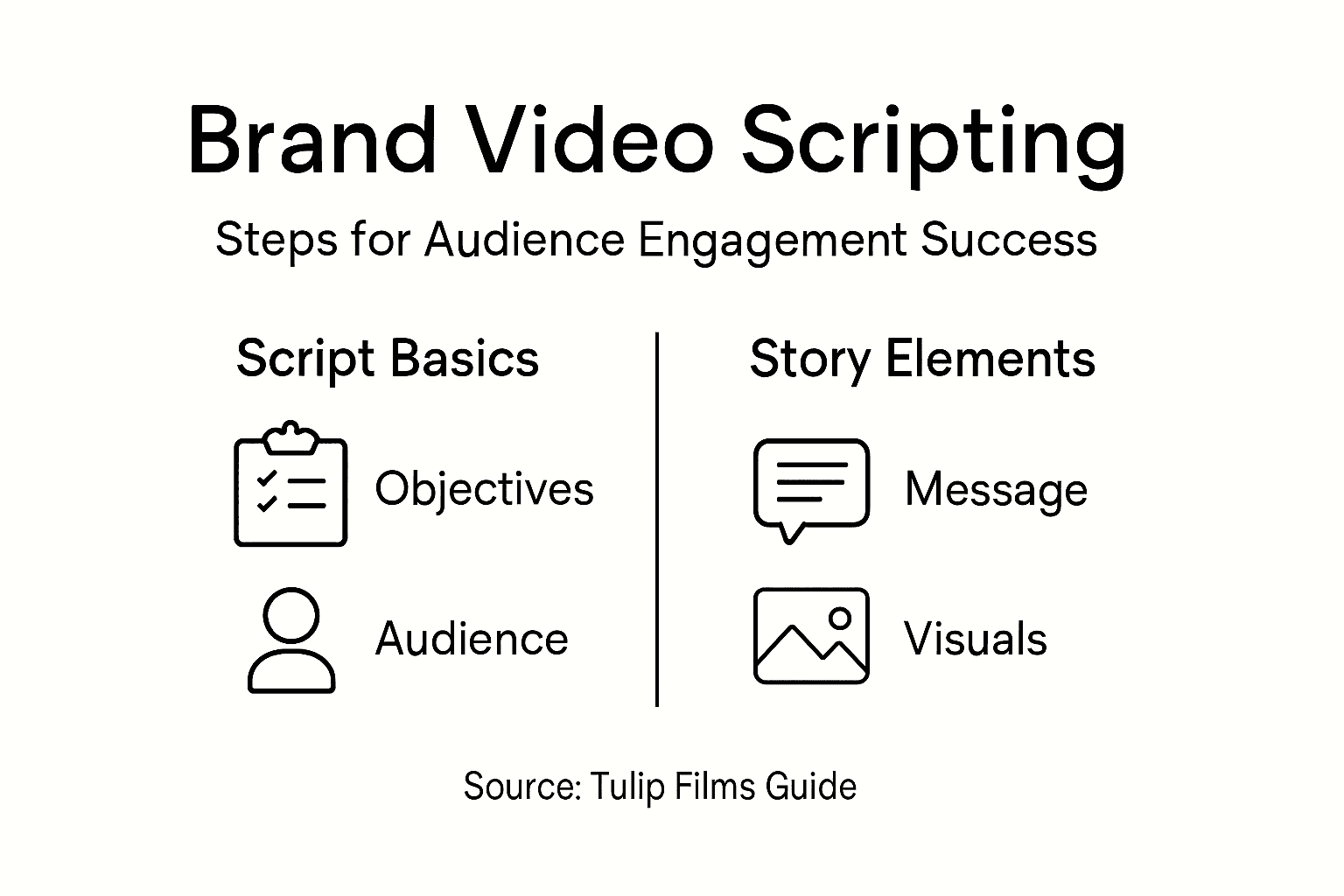
Here’s a summary of strategic objectives and their impact on brand video production:
Objective Type | Expected Outcome | Video Approach |
Increase brand awareness | Build recognition and trust | Story-driven, emotive |
Generate leads | Grow qualified audiences | Educational, persuasive |
Showcase product features | Highlight capabilities | Demonstrative, informative |
This comparison outlines how script refinement strategies boost video quality:
Script Refinement Method | Improvement Focus | Team Involvement |
Objective review | Message clarity | Scriptwriters, marketers |
Audience alignment assessment | Better targeting | Creative, analysts |
Pacing and engagement checks | Viewer retention | Editors, producers |
Effective video marketing begins with crystal-clear objectives and a deep understanding of who you’re communicating with.
Pro tip: Develop a one-page audience persona document that your entire creative team can reference during video scripting and production.
Step 2: Research market trends and brand voice
Researching current market trends and understanding your brand’s unique voice are critical steps in creating video content that truly connects with your audience. By staying informed about the latest digital marketing landscape and carefully defining your communication style, you can develop videos that feel both timely and authentic.
Start by exploring emerging video marketing trends that are reshaping audience engagement. Key trends to consider include:
Short-form vertical video content
Mobile-first video strategies
Personalized storytelling approaches
Integration of social media challenges
Emphasis on authenticity and relatability
Use of AI and automation technologies
Your brand voice should reflect these trends while maintaining your unique personality. This means adapting your messaging to be more conversational, inclusive, and platform-specific. Consider the nuances of different social media channels and how your tone might subtly shift across platforms without losing core brand consistency.
Modern video marketing demands a flexible yet authentic approach that speaks directly to audience expectations and preferences.
Pro tip: Create a detailed brand voice guide that outlines your communication style, key messaging pillars, and platform-specific tone variations to ensure consistency across all video content.
Step 3: Craft a powerful message and video storyline
Crafting a compelling video storyline transforms ordinary content into a memorable brand experience that resonates deeply with your audience. Your goal is to create a narrative that not only communicates your message but also forms an emotional connection with viewers.
Begin by developing compelling video storytelling techniques that engage your target audience. Your storyline should include several critical elements:
A strong opening hook that captures attention within the first 3 seconds
Clear narrative arc with identifiable beginning, middle, and end
Authentic representation of your brand’s core values
Relatable characters or scenarios
Emotional triggers that inspire action
Concise, impactful messaging
Effective video storytelling requires balancing informative content with emotional appeal. Your narrative should address viewer challenges while showcasing how your brand provides unique solutions. This approach transforms your video from a simple marketing tool into a powerful communication platform that builds genuine connections.
Great brand videos don’t just sell a product. They tell a story that viewers can see themselves in.
Pro tip: Draft your video script using the classic storytelling structure: introduce a problem, present your solution, and conclude with a compelling call to action.

Step 4: Structure script for clarity and visual impact
Crafting a well-structured video script is like building a compelling architectural blueprint for your brand’s visual storytelling. Your goal is to create a document that guides both the narrative flow and visual execution with precision and creativity.
Learn to create effective video script structures by following these essential components:
Detailed scene descriptions that paint a clear visual picture
Time-coded dialogue matching exact visual elements
Clear visual direction for camera angles and movements
Transition notes between scenes
Spoken word and visual narrative alignment
Specific emotional tone indicators
A strategic script breakdown helps your production team understand exactly how each moment should unfold. This means providing enough detail to guide the creative process without stifling spontaneity. Your script should serve as a flexible roadmap that allows room for creative interpretation while maintaining a clear narrative trajectory.
A great video script transforms abstract ideas into a visual journey that captivates and communicates.
Pro tip: Create a two-column script format with dialogue on one side and corresponding visual descriptions on the other to ensure perfect narrative and visual synchronization.
Step 5: Review, refine, and test brand video script
Reviewing and refining your video script is a critical process that transforms a good concept into an exceptional brand narrative. This stage ensures your video meets strategic objectives and resonates authentically with your target audience.
AI-powered script analysis tools can dramatically improve your script’s effectiveness through systematic evaluation. Consider these key refinement strategies:
Objective review of narrative structure
Language precision and emotional resonance
Audience alignment assessment
Pacing and engagement analysis
Visual storytelling coherence
Potential audience reaction prediction
Multiple rounds of review are essential. Involve team members from different perspectives to identify potential gaps or improvements. Your goal is to create a script that feels both strategically crafted and naturally compelling.
Exceptional video scripts are not written. They are carefully sculpted through rigorous refinement and collaborative insight.
Pro tip: Create a structured feedback template with specific scoring criteria to standardize and objectify your script review process.
Master Your Brand Storytelling with Tulip Films
Struggling to craft a brand video script that truly connects with your audience and drives engagement? This article highlights crucial challenges such as defining clear objectives, understanding your target audience, and structuring your message for maximum impact. Key goals like increasing brand awareness and creating emotionally compelling narratives require expertise that blends strategic insight with creative execution. Tulip Films specializes in turning these concepts into powerful visual stories that resonate with viewers and reflect your brand’s unique voice.
Why face the complexities alone when professionals can help you script and produce videos that capture attention from the first second and sustain viewer engagement? From concise script refinement to dynamic visual storytelling, our Swiss-based team is dedicated to delivering personalized, high-quality video solutions that deliver results quickly and efficiently.
Take the next step toward creating unforgettable brand videos by exploring how Tulip Films elevates your messaging. Learn more about our video production services and see inspiring examples in our project portfolio. Ready to transform your video strategy into captivating stories that truly engage your audience?
Are you prepared to elevate your brand’s video storytelling and captivate your audience from start to finish
Contact Tulip Films today at https://tulipfilms.ch for a free consultation and fast, custom video production that aligns perfectly with your strategic objectives and audience needs.
Frequently Asked Questions
How do I define strategic objectives for my brand video?
To define strategic objectives, first identify what you want your video to achieve, such as increasing brand awareness or generating leads. Write down specific, measurable goals to guide your video scripting process.
What elements should I include to craft a powerful message in my video script?
Include a strong opening hook, a clear narrative arc, and relatable characters or scenarios. Structure your story to evoke emotional triggers, inspiring viewers to take action.
How can I ensure my video script aligns with my target audience?
Create detailed audience personas by analyzing demographic and behavioral data relevant to your viewers. Use this information to tailor your messaging and tone, making sure it resonates with your audience’s needs and challenges.
What are the best practices for structuring my video script?
Use a two-column format with dialogue on one side and corresponding visual descriptions on the other. This approach ensures clarity and helps synchronize the narrative with visual elements effectively.
How can I test and refine my video script before production?
Conduct multiple rounds of review by sharing your script with team members from various departments. Gather feedback focused on narrative clarity, emotional impact, and audience alignment to enhance the overall quality of your video content.
What are some common pitfalls to avoid when scripting brand videos for audience engagement?
Avoid vague messaging and overly complex narratives that can confuse viewers. Stay focused on your core message and keep it concise, aiming for clarity and emotional connection to maintain your audience’s attention.
Recommended
