Master the role of editing in storytelling for filmmakers

Most filmmakers believe editing is simply cutting footage together, but research shows that editing shapes emotional impact through rhythm and sequence in ways that transform raw footage into compelling narratives. The difference between forgettable content and memorable storytelling often lies in the editing room, where decisions about pacing, juxtaposition, and perspective create meaning that wasn’t visible during production. This guide reveals how editing controls audience emotion, constructs narrative clarity, and guides viewer focus, giving you concrete techniques to elevate your filmmaking craft and create videos that resonate deeply with Swiss and international audiences.
Table of Contents
Key takeaways
Point | Details |
Editing controls emotional rhythm | Shot duration and pacing directly influence viewer heart rate, attention, and emotional engagement throughout your film. |
Juxtaposition creates meaning | The order and relationship between shots constructs narrative significance that individual images cannot convey alone. |
Perspective shapes viewer connection | Strategic cutting between viewpoints controls audience sympathy and reveals story information at precisely the right moments. |
Editing integrates creative stages | Professional editing functions as a final rewrite that unifies screenwriting and directing into cohesive storytelling. |
Technical choices affect immersion | Seamless transitions enhance emotional coherence while abrupt cuts can strategically disrupt engagement for narrative impact. |
How editing establishes rhythm and emotional flow
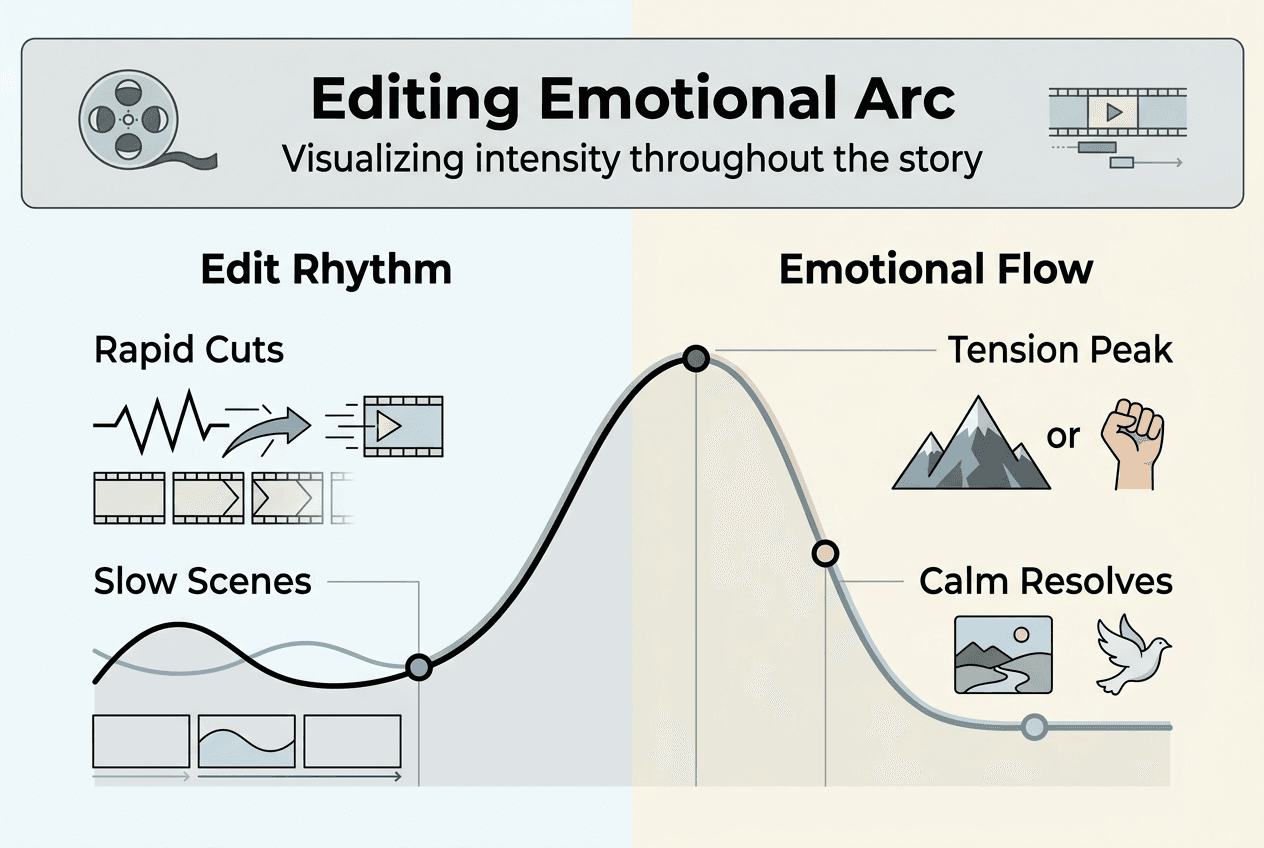
The invisible art of editing operates through precise control of rhythm and pacing, directly affecting how audiences experience your story. Rapid cuts create urgency while longer shots build suspense, keeping viewers immersed without consciously recognizing the editor’s hand. This invisibility represents the highest achievement in editing craft, where technical decisions disappear into pure emotional experience.
Research demonstrates that fast editing affects heart rate and sharpens viewer focus, creating physiological responses that mirror on-screen intensity. Action sequences benefit from rapid cutting that matches the adrenaline of chase scenes or confrontations. Conversely, slow editing relaxes audiences and deepens emotional response, allowing contemplative moments to resonate fully. Swiss filmmakers working on corporate videos or wedding content can apply these principles to match editing rhythm with intended emotional outcomes.
The relationship between cutting rhythm and audience attention operates on both conscious and subconscious levels. Fast-paced editing in promotional videos captures attention quickly, ideal for social media content where viewer patience spans seconds. Longer takes in video production editing allow audiences to absorb complex information or appreciate visual beauty, particularly effective in real estate showcases or event documentation.
Editors shape flow by varying shot duration strategically throughout a piece. A wedding video might begin with rapid cuts during preparation excitement, transition to longer takes during ceremony solemnity, then return to energetic pacing for reception celebration. This rhythmic variation prevents monotony while guiding emotional journey.
Pro Tip: Map your intended emotional arc before editing by sketching a simple graph showing intensity levels across your timeline. Use this visual guide to inform cutting rhythm, ensuring your pacing choices actively support storytelling goals rather than falling into habitual patterns.
Understanding rhythm as a storytelling tool rather than technical necessity transforms how you approach every project. The beats between cuts function like musical rests, giving audiences space to process information and emotional content. Swiss video editors can differentiate their work by mastering this invisible language of rhythm, creating content that feels instinctively right to viewers without revealing the careful craft behind each decision.
Creating meaning and guiding perspective through shot selection and sequencing
Editing constructs narrative meaning through deliberate image arrangement, transforming disconnected shots into coherent stories. Reordering shots changes story meaning fundamentally, as the famous Kuleshov effect demonstrates: identical footage of an actor’s neutral expression reads as hunger, grief, or desire depending on whether it follows shots of soup, a coffin, or an attractive person. This principle applies directly to corporate videos, event coverage, and promotional content where sequencing choices determine audience interpretation.
The power of juxtaposition extends beyond simple cause and effect relationships. Editors create thematic connections by placing visually or conceptually related shots in sequence, building layers of meaning that individual images cannot convey. A corporate video might cut from a close-up of focused hands working to a wide shot of the finished product, implying craftsmanship and attention to detail without explicit narration. Swiss filmmakers can leverage these editing relationships to communicate brand values and flattering angles that enhance subject presentation.
Cutting between perspectives changes audience sympathy and controls information revelation strategically. Point-of-view editing places viewers inside character experience, creating identification and emotional investment. Objective angles maintain distance, useful for documentary-style corporate content or informational videos. The choice between these approaches shapes how audiences relate to on-screen subjects and absorb your message.

Editors guide viewer gaze through composition and movement continuity across cuts. Eye-trace editing ensures that visual attention flows naturally from one shot to the next, preventing disorientation. Cinematic technique storytelling relies on this principle to maintain spatial coherence, particularly important in event videos where location and action relationships must remain clear despite coverage gaps.
Editing approach | Emotional effect | Best use cases |
Seamless transitions | Enhances emotional coherence and immersion | Corporate narratives, wedding films, brand stories |
Jump cuts | Creates energy and compresses time efficiently | Social media content, testimonials, dynamic promos |
Cross-cutting | Builds tension through parallel action | Event highlights, before/after sequences |
Match cuts | Establishes thematic or visual connections | Conceptual corporate videos, artistic projects |
Research confirms that seamless editing enhances emotional coherence while abrupt cuts can strategically disrupt engagement. Understanding this spectrum allows intentional choices rather than defaulting to invisible editing in all contexts. Sometimes disruption serves the story, particularly when representing confusion, surprise, or dramatic revelation.
Perspective control through editing determines what information audiences receive and when they receive it. Revealing a corporate product through carefully sequenced detail shots before showing the complete item builds anticipation and focuses attention on key features. Narration video impact multiplies when editing and voiceover work in concert, with visual cuts emphasizing spoken points at precisely the right moments.
Pro Tip: Create a shot relationship map for complex sequences by sketching thumbnail images and drawing arrows between shots that create meaning through juxtaposition. This visual planning tool reveals whether your sequencing choices actively construct the narrative you intend or simply follow chronological order without adding interpretive value.
The editor’s creative role: integrating editing with screenwriting and directing
Editing represents a creative rewriting stage rather than mere technical assembly, fundamentally altering how filmmakers approach storytelling from conception through completion. Screenwriting, directing, and editing are interconnected aspects of a unified creative process, with editing serving as the final opportunity to shape tone, rhythm, and emotional trajectory. This integrated perspective transforms production planning and shooting strategies for Swiss filmmakers working across corporate, event, and promotional video categories.
The concept of the “total filmmaker” recognizes that editing decisions influence how directors approach coverage and how writers structure scenes. When you understand editing’s narrative power during pre-production, you shoot differently. You capture the cutaway details, reaction shots, and alternate angles that provide creative options in post-production rather than limiting yourself to predetermined sequences.
Sean Baker treated editing as final rewrite, describing it as a high-stress but crucial phase that shaped tone and coherence in his Oscar-nominated work. This approach acknowledges that footage contains multiple potential stories, with editing choices determining which narrative emerges. The same principle applies to corporate videos, where raw interview footage and b-roll can support different messaging depending on sequencing and pacing decisions.
Integrating editing perspective throughout production offers specific advantages:
Pre-production planning considers editing requirements, ensuring adequate coverage for various narrative approaches and pacing options.
Shooting strategy captures transitional moments, reaction shots, and alternative angles that provide editorial flexibility.
Direction choices account for performance nuances that gain significance through juxtaposition and sequencing in post-production.
Script development anticipates how written scenes will transform through editing rhythm and visual storytelling rather than relying solely on dialogue.
This integrated approach particularly benefits professional film production in Switzerland, where efficient workflows and clear communication between production stages ensure quality results within client timelines and budgets. Understanding editing as creative rewriting rather than technical finishing allows more accurate project scoping and realistic schedule planning.
The editing room becomes a space for discovery and problem-solving, where script issues reveal themselves and solutions emerge through rearrangement, pacing adjustments, or strategic omissions. A corporate message that felt unclear during shooting might crystallize through careful sequencing that builds understanding progressively. An event video that seemed to lack emotional peaks might discover them through rhythm manipulation and strategic music placement.
“Editing is where you discover the film you actually made, as opposed to the film you thought you were making. The footage reveals possibilities and problems that weren’t visible on set, making editing the final and most crucial stage of storytelling.”
Pro Tip: Approach editing with fresh perspective by waiting at least 24 hours after reviewing footage before making significant structural decisions. This mental distance allows you to see what the footage actually communicates rather than what you remember intending during production, leading to more objective and effective editorial choices.
Practical editing techniques to enhance storytelling in your films
Applying editing theory to practical filmmaking requires specific techniques that control rhythm, emotion, perspective, and narrative clarity in measurable ways. These actionable strategies work across video categories from corporate content to wedding films, giving Swiss filmmakers concrete tools for elevating storytelling craft.
Choose editing rhythms deliberately to match desired emotional responses rather than defaulting to habitual pacing. Fast cutting with shots lasting one to three seconds creates urgency and excitement, ideal for product launches, event highlights, or action sequences. Medium pacing with four to eight second shots allows information absorption while maintaining engagement, suitable for corporate explanations or testimonial content. Slow editing with shots exceeding eight seconds builds contemplation and emotional depth, effective for brand storytelling or wedding ceremony coverage.
Technique | Cognitive effect | Emotional impact | Trade-offs |
Rapid cutting | Increases attention and cognitive load | Excitement, urgency, energy | Can exhaust viewers if sustained too long |
Extended takes | Reduces cognitive load, allows absorption | Contemplation, intimacy, realism | Risks losing attention if visuals lack interest |
Rhythmic variation | Maintains engagement through contrast | Dynamic emotional journey | Requires careful planning to avoid chaos |
Match on action | Seamless spatial continuity | Smooth, invisible storytelling | Limits creative juxtaposition options |
Research shows that editing influences time perception and cognitive load significantly. Viewers perceive rapidly edited sequences as shorter in duration than actual runtime, while slow editing makes time feel extended. Use this phenomenon strategically: compress perceived duration in informational sections to maintain pace, or extend emotional moments through sustained shots that allow feelings to develop fully.
Perspective cuts require careful consideration of viewer focus and sympathy. Cutting to a subject’s point of view creates identification and emotional investment, placing audiences inside the experience. This technique works powerfully in storyboarding client videos where you want viewers to imagine themselves using a product or service. Objective angles maintain analytical distance, useful when presenting information that requires rational evaluation rather than emotional response.
Balance seamless and abrupt cuts based on narrative needs rather than assuming invisible editing always serves the story best. Seamless transitions using match cuts, J-cuts, and L-cuts enhance emotional coherence and spatial understanding. Edited movies reduce cognitive load compared to unedited content, improving emotional immersion and attention. However, strategic jump cuts or hard transitions can effectively represent surprise, confusion, or temporal shifts when the story requires disruption.
Sound design integration amplifies editing’s emotional impact exponentially. Audio bridges smooth visual transitions, while sound cuts can emphasize visual changes. Music placement relative to picture cuts determines whether emotional beats land effectively or feel mistimed. Swiss filmmakers should consider sound editing as inseparable from picture editing rather than a separate post-production phase.
Practical workflow strategies enhance storytelling outcomes:
Create multiple sequence versions exploring different pacing and order options before committing to a final structure.
Watch sequences without sound to evaluate whether visual storytelling communicates clearly before audio support.
Test emotional impact by showing rough cuts to objective viewers and noting where their attention or engagement shifts.
Use cinematic visual techniques like color grading and composition adjustments to enhance editorial choices.
Pro Tip: Build a personal reference library of editing techniques by noting specific sequences from films, commercials, or online content that achieve effects you want to recreate. Analyze these examples frame by frame to understand exactly how cuts, pacing, and transitions create their impact, then adapt these proven approaches to your own projects.
The relationship between editing technique and storytelling outcome becomes intuitive with practice and intentional experimentation. Each project offers opportunities to test approaches, evaluate results, and refine your editorial instincts. Swiss video editors who master these practical techniques differentiate their work through storytelling sophistication that clients recognize even if they cannot articulate the specific editorial choices that create it.
Enhance your storytelling with professional editing services
Mastering editing techniques transforms good footage into compelling stories, but professional expertise accelerates this process while ensuring consistent quality across all projects. Tulip Films brings specialized editing and production knowledge to Swiss filmmakers and businesses seeking to elevate their video content through sophisticated storytelling craft.
Our team applies the rhythm control, perspective guidance, and narrative sequencing principles discussed throughout this guide to every project, from corporate communications to wedding films. Whether you need dynamic promotional content with rapid pacing or contemplative brand stories with extended emotional beats, professional editing services ensure your message resonates with target audiences.
[
Explore our portfolio production video showcase to see how expert editing transforms raw footage into polished narratives across multiple video categories. Our creative video production Switzerland approach integrates editing perspective from initial concept through final delivery, ensuring efficient workflows and compelling results. Transparent video production pricing makes professional editing accessible for projects of all scales, with personalized consultations helping you determine the right approach for your specific storytelling goals and budget parameters.
Frequently asked questions
What is the most important aspect of editing in storytelling?
Rhythm control stands as editing’s most crucial storytelling element because pacing directly influences audience emotional response and attention throughout your film. The duration and sequence of cuts shape how viewers experience every moment, making rhythm the foundation upon which all other editorial decisions build.
How does shot order change narrative meaning?
Juxtaposing different images creates interpretive relationships that individual shots cannot convey alone, with viewers instinctively constructing cause-effect or thematic connections between sequential images. The same footage produces completely different narrative meanings depending on arrangement, giving editors tremendous power to shape story interpretation.
Should I always use seamless editing transitions?
Seamless editing enhances emotional coherence and immersion in most contexts, but strategic disruption through jump cuts or hard transitions effectively represents surprise, confusion, or temporal shifts when the narrative requires it. Choose transition style based on intended audience experience rather than defaulting to invisible editing universally.
How does editing work with screenwriting and directing?
Editing functions as a final creative rewriting stage that unifies earlier production phases, with editorial decisions shaping tone, rhythm, and emotional trajectory in ways that transform scripted and directed content. Understanding editing as integrated storytelling rather than technical finishing improves planning and shooting strategies throughout production.
What editing techniques improve viewer engagement?
Rhythmic variation maintains attention through contrast between fast and slow pacing, while perspective cuts control focus and build character connection strategically. Research confirms that edited content reduces cognitive load compared to unedited footage, improving emotional immersion and sustained viewer attention across all video categories.
Recommended
