Post Production in Geneva: Who to Hire and What to Ask


If you need post production in Geneva, contact a local partner who can show a real portfolio, a documented review process, and a firm turnaround estimate before you sign anything. Tulip Films handles editing, color, sound, and delivery for Geneva businesses from a single team, which cuts out the back and forth of managing three vendors. Request a free consultation and get a scoped quote before your next shoot wraps.
Key Takeaways
The most reliable Geneva post production partner is one who documents every workflow stage, commits to a written turnaround, and handles editing, color, and sound under a single contract.
Point | Details |
Confirm the six-stage workflow | Ingest, edit, color, sound, VFX, and delivery should each be a distinct, documented step. |
Agree on formats before shooting | Camera codec and color space decisions made on set affect grading time and cost later. |
Separate audio as its own service | Sound design, ADR, and mixing often carry their own timeline and should be quoted separately. |
Get contract terms in writing | IP ownership, revision limits, and payment milestones prevent disputes mid-project. |
Ask about backups before signing | Central storage and automated backups protect footage during an active edit. |
Tulip Films handles the full cycle | Editing, color, sound, and delivery run through one team with a single point of contact. |
Table of Contents
What Post Production Services Should You Be Able To Request?
What Facilities and Technical Capabilities Should a Geneva Post House Have?
What Drives Timeline and Cost for a Post Production Project?
What Legal Terms Should Your Post Production Contract Cover?
How Does Post Production Connect With Other Local Media Services?
What Trends Are Shaping Post Production in Geneva Right Now?
What Does the Post Production Workflow Actually Include?
A post house worth hiring handles six stages: ingest and organization, editing, color correction and grading, sound design and mixing, VFX or motion graphics, and final delivery. That’s the standard structure most professional workflows follow, and any Geneva vendor quoting you a project should be able to walk through each phase without hand waving.
Here’s how the work actually moves from raw footage to finished file:
Ingest and organization. Footage gets pulled from cards, backed up in two places minimum, and labeled with consistent file names and metadata so nothing gets lost in a folder six weeks later.
Editing. An editor builds the story first in a rough cut, usually on proxy files, then locks picture before anything downstream begins.
Color correction and grading. A colorist balances exposure and skin tones, then pushes the look further to match your brand or the mood you asked for.
Sound design and mixing. A sound engineer cleans dialogue, adds music and effects, and mixes levels for the final playback environment.
VFX and motion graphics. Titles, lower thirds, logo animations, or heavier visual effects get built and composited once the edit is locked.
Finishing and delivery. Final files get exported in the codecs and formats your platforms actually require.
Pro Tip: The camera, codec, and color space chosen on set ripple through every later stage. Agreeing on file formats with your colorist before you shoot avoids expensive reconforms and saves days of rework once you’re already on deadline.
For a short corporate video, expect editing and grading to take a few weeks. Medium-length explainers with custom motion graphics usually require several weeks including review rounds. Heavier VFX work or projects with slow client feedback can extend the timeline considerably.
What Post Production Services Should You Be Able To Request?
A capable vendor should offer each of these as a discrete line item, not a vague bundle:
Offline and online editing — the rough cut on proxy files, then the final conform to full-resolution camera media.
Color correction and grading — basic balancing plus a stylized look, delivered as a graded master.
Motion graphics and VFX or compositing — titles, animated graphics, or visual effects removal and integration.
Sound editing, ADR, and foley — dialogue cleanup, replacement voice recording, and custom sound effects when the original audio falls short.
Mixing and mastering — final audio balance delivered to broadcast or streaming loudness standards.
Captioning and versioning — subtitle files and cut-down versions for different platforms or languages.
DCP and platform-specific exports — cinema packages or delivery files matched to YouTube, Instagram, or a client’s internal system.
Audio deserves its own conversation. Sound design, ADR, and mastering are often billed and scheduled separately from picture editing, since they need their own monitoring setup and can extend your timeline if custom music or voice work gets added late. Not every project needs Dolby Atmos or full surround mixing. Ask if it’s on the vendor’s checklist only if your delivery platform actually calls for it.
What Technical Specs Should You Confirm Before Signing?
Verify codec compatibility, color space and monitoring standards, audio sample rate and bit depth, and delivery containers before you sign anything. A vendor who can’t answer these clearly in the first meeting will cost you time later.
Technical Check | What To Confirm |
Camera formats and codecs | Which formats they ingest natively (ProRes, RAW) without added conversion fees |
File transfer method | Managed large-file transfer support or physical hard drive handoff |
Monitoring and grading reference | Calibration to Rec.709 for web or DCI-P3 for cinema delivery |
Backup and archive policy | Redundant storage during the project and archive terms after delivery |
Ask these four questions during vendor vetting:
Which NLE and grading software does your team use day to day?
How do you handle large file transfers for remote review?
What’s your backup protocol during an active edit?
How long do you retain project files after final delivery?
How Do You Choose a Post Production Partner in Geneva?
Prioritize technical fit, a portfolio you can actually watch, a documented review process, and clear turnaround commitments. Price matters, but it should be the fourth question, not the first.
Confirm they work in the software and formats your footage was shot on.
Ask for two or three finished projects similar in scope to yours, not just a highlight reel.
Get a written turnaround estimate tied to specific milestones.
Ask how backups and file security are handled during the edit.
Get the revision policy in writing before you sign.
Ten questions worth asking every Geneva vendor before you commit:
Which file formats and codecs do you accept natively?
How do you deliver samples for review, and how fast?
How many revision rounds are included in the quote?
What’s your backup and disaster recovery process?
What’s the realistic timeline for a project like mine?
Who is my direct point of contact during the edit?
Walk me through your internal quality control process.
How is cost structured, hourly or per deliverable?
Do you ever subcontract work, and to whom?
Do you sign an NDA and clarify IP ownership up front?
Watch for red flags: a quote far below market with no format specifics, zero portfolio or references, or a vendor who can’t describe how they check their own work before sending it to you. If you’re vetting several options at once, a guide to choosing a video partner walks through the same checklist in more depth.
How Tulip Films Handles Post Production for Geneva Clients
Tulip Films delivers full-cycle editing, color grading, sound mixing, and platform-ready exports from one team, which means one point of contact from rough cut to final file. That single-team structure is the practical difference between a smooth handoff and a project where footage bounces between three vendors before anyone sees a finished cut.
The scope typically covers:
Offline and online editing with proxy workflows for faster turnaround
Color correction and grading matched to your brand
Sound design, mixing, and voiceover integration
Platform-specific delivery for web, social, and broadcast
A recent corporate event project moved efficiently from raw footage to a delivered highlight video in a typical short timeframe, including color grading matched to the client’s existing brand palette. Browse the portfolio for comparable work, then request a quote to scope your own project timeline.
What Facilities and Technical Capabilities Should a Geneva Post House Have?
A serious post house runs on more than a laptop and a subscription. Look for dedicated edit suites with calibrated monitors, a control room for client review sessions, and shared storage that keeps a whole team working off the same media without duplicate copies scattered across drives.
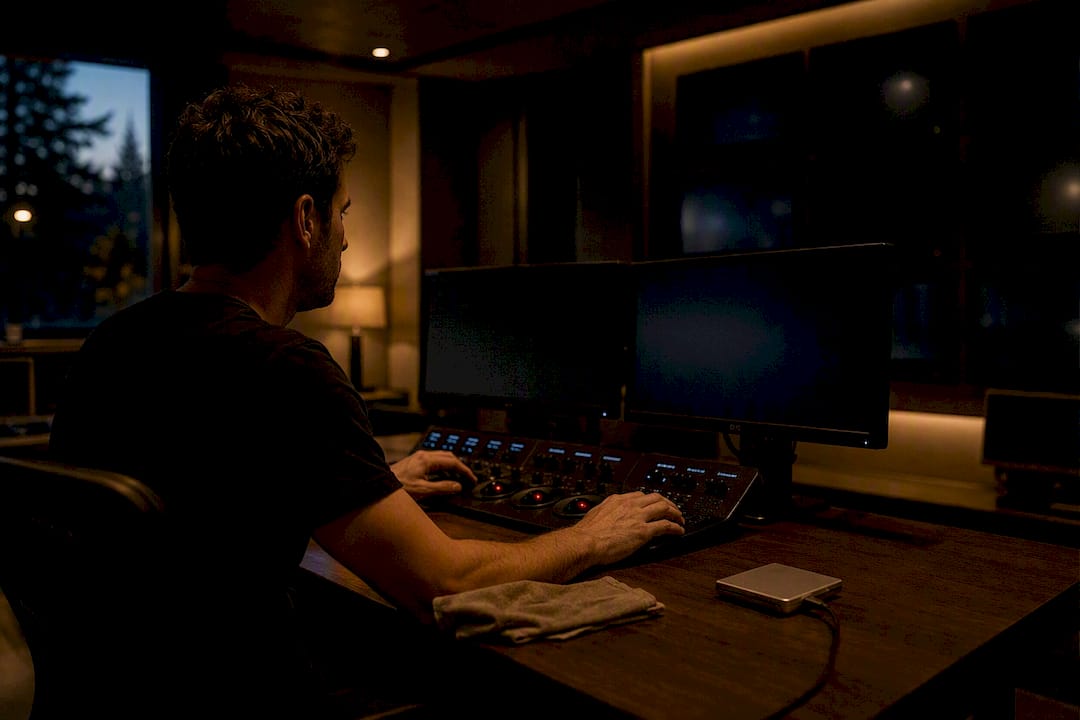
Codec support matters as much as the room itself. Most professional teams work in Avid Media Composer, DaVinci Resolve, Adobe Premiere Pro, or Final Cut Pro, often running offline edits on lightweight proxy files before reconforming to full camera resolution once picture is locked. That two-step approach keeps editing fast even on modest hardware, then restores full quality only when it counts.
Storage architecture is where a lot of smaller operations fall short. Central shared storage with consistent file naming and automated backups isn’t a nice extra. It’s what prevents the nightmare scenario where a hard drive fails mid-project and nobody has a current copy. Ask any vendor directly how footage is backed up during an active edit, not just after delivery.
Camera format compatibility rounds out the checklist. A studio that can ingest RAW footage from a range of camera systems, alongside standard H.264 or ProRes files, saves you a conversion step and the fees that often come with it.
What Drives Timeline and Cost for a Post Production Project?
Timeline and cost both track back to two things: the volume of footage and the number of client review rounds. A straightforward corporate promo with a single interview and B-roll often wraps in a week or two. A longer-form or VFX-heavy project can take weeks to months, and heavy visual effects work or slow client feedback is usually what stretches a schedule the most.
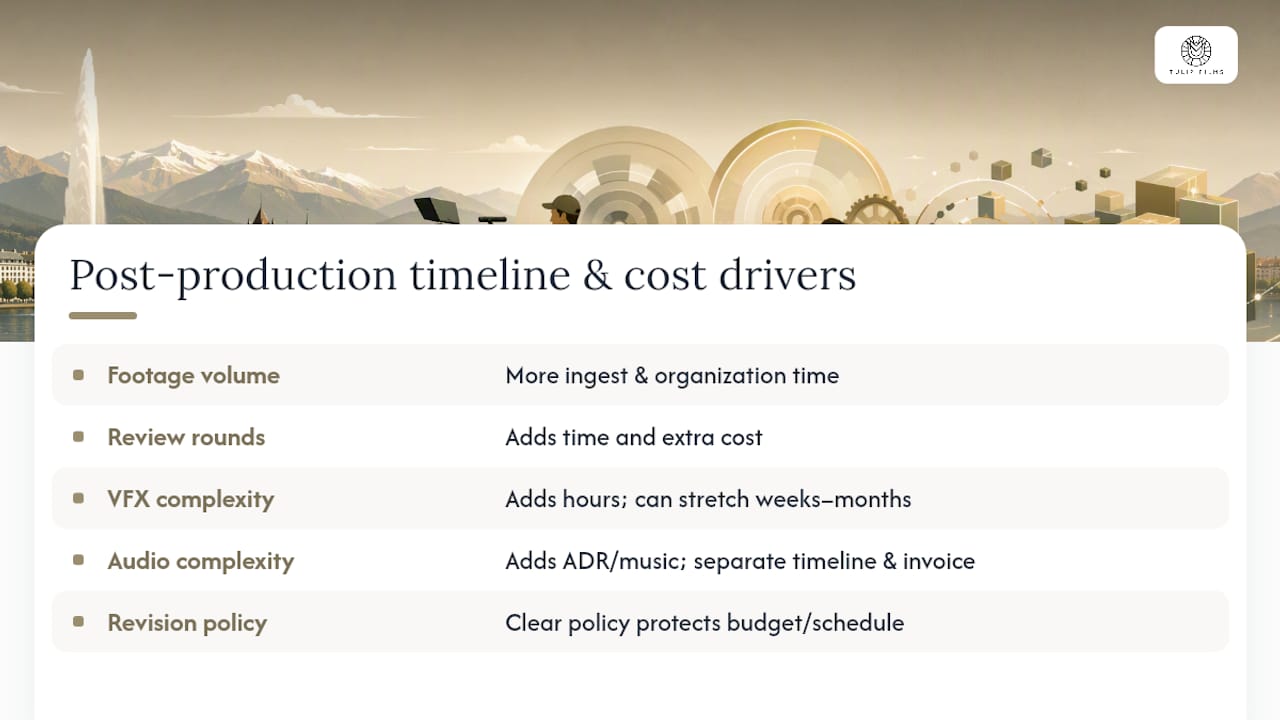
Cost factors follow a similar logic. Raw footage volume affects ingest and organization time. Custom motion graphics or VFX compositing add hours that a straight cut-and-color job doesn’t need. Audio complexity, especially ADR or original music composition, adds its own separate timeline and invoice line. Revision rounds beyond what’s quoted also add cost, which is why a clear revision policy upfront protects your budget as much as your schedule.
Ask for a cost breakdown by stage rather than one lump figure. A vendor who can show you what editing costs versus what grading or sound design costs gives you room to trim scope on one stage without renegotiating the entire project. If your timeline is tight, say so early. Compressed schedules sometimes mean fewer revision rounds or a smaller VFX scope, and it’s better to know that tradeoff before the contract than after.
Where Can You Find Post Production Studios in Geneva?
Geneva’s audiovisual scene runs on a mix of independent editors, boutique studios, and full-service production houses that handle both filming and post work under one roof. The Geneva Film Commission’s production guide is a useful starting point for anyone scouting local crews, equipment rental houses, and post facilities, since it’s maintained specifically to support producers working in the canton.
Full-service houses like Tulip Films handle the entire cycle from filming through final delivery, which suits businesses that want one contract and one point of contact rather than coordinating a production company and a separate editing studio. That structure tends to work best for corporate videos, event coverage, and marketing content where the shoot and the edit need to stay tightly coordinated.
Smaller boutique editors and colorists also operate around Geneva, often specializing in a narrower niche like commercial color grading or documentary editing. They can be a good fit if you already have raw footage and just need the finishing stages handled. The tradeoff is that you become the project manager coordinating between your production team and your post team, which adds coordination overhead a full-service vendor absorbs for you.
Whichever route you choose, ask for a physical address or studio location if on-site review sessions matter to your team, and confirm whether the vendor works primarily in French, English, or both, since Geneva’s business environment runs bilingual more often than not.
What Legal Terms Should Your Post Production Contract Cover?
Every post production contract should spell out intellectual property ownership, revision limits, and payment milestones before any footage changes hands. IP ownership is the one clients skip most often, and it’s the one that causes the most disputes later. Confirm in writing whether the final files, raw footage, and any custom music or graphics belong to you outright or whether the vendor retains rights to reuse elements in their own reel.
A non-disclosure agreement matters more in corporate and product video work than most clients assume, especially when unreleased products or internal footage are involved. Ask for one upfront rather than after you’ve already shared sensitive material.
Payment structure should tie to milestones, not just a deposit and a final invoice. A typical structure splits payment across signing, rough cut approval, and final delivery, which protects both sides if a project stalls partway through. Revision limits belong in the contract too. A vague “reasonable number of revisions” clause is a common source of scope creep. Get a specific number of included rounds and a stated rate for anything beyond that.
Swiss contract law generally treats these as standard service agreements, but the specifics of IP transfer and liability should still be reviewed against your own situation rather than assumed. A written contract, even a short one, protects you far more than a verbal agreement or an email thread ever will.
How Does Post Production Connect With Other Local Media Services?
Post production rarely happens in isolation. Most Geneva projects involve some combination of a production house handling the shoot, an advertising agency directing the creative strategy, and a post team finishing the edit. How well these pieces communicate determines how smooth your project actually feels.
When an agency briefs a production house and a separate post facility, the biggest risk is misalignment on the creative direction between filming and editing. A shot list built for one creative concept can fall apart if the edit takes the story in a different direction. That’s part of why full-service providers who handle production and post under one roof, like Tulip Films, tend to reduce friction for event and corporate video projects where timeline pressure is already tight.
If you’re working with an outside agency, make sure your post vendor gets looped into creative briefings early rather than receiving footage cold. A colorist who understands the campaign’s brand guidelines from day one will match the look far faster than one working from a style guide handed over after the shoot. The same goes for motion graphics, where brand fonts, colors, and animation style need to be locked before anyone starts building assets.
What Trends Are Shaping Post Production in Geneva Right Now?
Cloud-based collaboration has changed how Geneva teams handle review cycles. Clients now expect to review cuts remotely through shared links rather than scheduling an in-person screening for every round, which has pushed local vendors toward faster, more asynchronous feedback loops.
AI-assisted tools are showing up in rough cut assembly, automated transcription for captions, and even early-stage color matching, though the finishing touches, especially grading and sound mixing, still rest with a human colorist or sound engineer for anything client-facing. Automated tools speed up the repetitive parts of the process without replacing the judgment calls that make a video actually feel finished.
Managed file transfer has also become standard rather than optional. Fast, secure transfer portals now handle the bulk file movement that used to mean physically shipping hard drives between a production crew and an edit suite, which matters for Geneva’s international client base working across time zones. Vertical and square delivery formats for social platforms have also become a default request rather than an afterthought, meaning most quotes now include multiple aspect ratio exports as a standard line item rather than an add-on.
A Note From the Tulip Films Team
We recommend a straightforward approach: lock your creative brief before the shoot, agree on file formats with your editor early, and build in one clear review round before final delivery. That structure keeps timelines honest and avoids the back and forth that stretches a two-week project into two months. Our team stays in direct contact throughout, so you’re never guessing where a project stands or waiting days for a status update.
Get a Post Production Quote for Your Next Geneva Project
Tulip Films is the alternative to juggling a separate production company, editing freelancer, and colorist for every project. One team handles the shoot and the finish, so you get a single quote, one point of contact, and a faster path from raw footage to a delivered file.
[
If cost is your first question, the pricing page breaks down packages by project scope so you can compare options before committing. Request a free consultation and get a scoped timeline for your specific project this week.
Frequently Asked Questions
What does post production actually include? It covers ingest and organization, editing, color correction and grading, sound design and mixing, VFX or motion graphics, and final delivery. Each stage typically involves a different specialist, from editor to colorist to sound engineer.
How long does post production take in Geneva? A short corporate video often takes one to two weeks. Medium-length projects with graphics or heavier review cycles usually run three to five weeks, and VFX-heavy work can stretch to several months.
What should I ask a post production vendor before hiring them? Ask about their software and codec compatibility, backup practices, revision policy, and turnaround estimate. A vendor who answers these clearly and specifically is a stronger bet than one who speaks in generalities.
Does audio post production cost extra? Often, yes. Sound design, ADR, and custom mixing are frequently billed and scheduled as a separate service from picture editing, especially when original voice recording or custom music is involved.
Is it better to hire one full-service vendor or separate specialists? A full-service vendor who handles production and post together reduces coordination overhead and keeps creative direction consistent from shoot to final cut. Separate specialists can work well if you already have strong raw footage and just need finishing services.
Sources
Recommended
