Get Social Ad Videos That Get Watched, Swiss Prices CHF 1,700–4,500

Make a 5 to 15 second vertical video that hooks viewers in the first 3 seconds, carries burned-in captions, and ends on one clear call to action. That combination consistently outperforms longer, sound-dependent, single-format ads, and it costs far less to produce than most marketers assume. A basic version runs as low as CHF 1,700 to CHF 4,500 in Switzerland, which puts a tested, professional-grade ad within reach of almost any small business budget.
TL;DR:
Creating short, vertical social ads with a strong hook and captions costs as little as CHF 1,700 to CHF 4,500 in Switzerland for small businesses.
Shooting multiple formats and repurposing a single campaign reduces costs and ensures consistent delivery across platforms like TikTok, Instagram, and LinkedIn.
Batch shooting several concepts in one session and planning early can significantly lower per-asset costs and enhance workflow efficiency.
A professional production shoot typically produces multiple high-quality ad variations, replacing months of piecemeal DIY efforts and saving time.
DIY tools are suitable for testing ideas and small-scale content, but scaling requires professional production to maintain quality, consistency, and multiple format outputs.
Table of Contents
What makes social ads video erstellen actually work?
Creating social ads video content that performs isn’t about production polish. It’s about respecting how people actually scroll: fast, sound off, and one thumb-flick away from skipping you entirely. A handful of rules separate ads that get watched from ads that get swiped past.
The 3-second hook. You have roughly three seconds before someone decides whether to keep watching, and in-stream video ads perform best when they run 5 to 15 seconds total. Three formulas work consistently:
In media res: open mid-action, mid-sentence, or mid-result. Skip the setup entirely.
Surprising stat or claim: lead with the number or fact that stops the scroll.
Result first: show the finished product, the transformation, or the outcome before explaining how you got there.
Length matches intent. Use 5 to 6 seconds for pure brand awareness or retargeting bumpers, 15 seconds for most standard ad placements, and reserve 30 seconds for warmer audiences already familiar with your brand who need more persuasion, not more introduction.
Format for the feed, not the screen. Shoot or crop to 9:16 for Reels, TikTok, and Stories; 1:1 or 4:5 for Meta in-feed; and 16:9 only for YouTube pre-roll or LinkedIn desktop placements. Vertical-first is the safe default, since it’s what most short-form platforms now prioritize in distribution.
Captions aren’t optional. More than 80% of social users watch video with the sound off, and short-form video already generates roughly 2.5 times more engagement than static images when it’s built for that behavior. Burned-in captions, not platform auto-captions, protect your message regardless of settings.
One CTA, stated once, shown twice. Pick a single action: shop now, book a call, download, sign up. Say it out loud near the end and repeat it as on-screen text in the final two seconds.
Pro Tip: Write your caption text before you shoot anything. If the ad’s core message can’t fit in one punchy sentence, the video will ramble too.
How do you plan and shoot a social ad efficiently?
A tight three-phase workflow keeps costs down and quality consistent, whether you’re shooting on a phone or booking a crew for a full content day.
Pre-production. Nail down one goal per ad (awareness, leads, or sales), write the message in a single sentence, and sketch a simple storyboard: hook, core scene, CTA. If you’re producing several ads, plan the batch now, not on set. Decide which shots feed which platform before anyone picks up a camera.
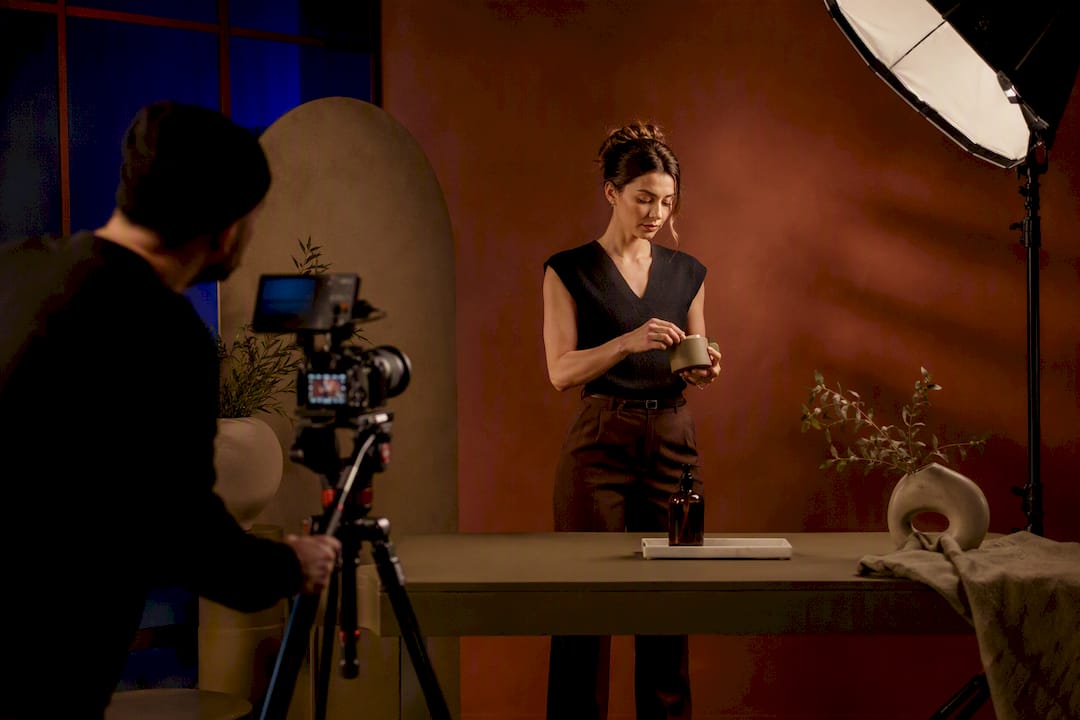
Production. Build a shot list that covers a master take plus supporting footage: a few hook-focused openers, close-ups of the product or service, general cutaway footage (B-roll), and any reaction or testimonial moments. A practical content shoot can produce a master edit plus multiple ad cuts within a limited time frame if planned efficiently. Smartphones handle most social ad footage fine; reach for a proper camera when you need shallow depth of field, low-light performance, or footage that needs to double as brand or web content. Lighting and clean audio matter more than resolution. Record every key line three or four times, since options in the edit are cheaper than reshoots.
Post-production. Cut aggressively. Remove every pause that isn’t doing work. Add burned-in captions, choose music that’s properly licensed (never pull a track from a streaming playlist), and export to your platform specs with a quality check before anything goes live.
Pro Tip: Create your export presets once and reuse them forever: a full-resolution 9:16 file, a 4:5 version, a 16:9 version, and a web-optimized MP4 for landing pages. Burn captions into all four so nothing needs redoing later.
This structure, plan then batch then repurpose, is what makes a video ad creation workflow scale without scaling cost at the same rate.
Which DIY tools are worth using?
Not every social ad needs a production company behind it, especially for testing concepts or running low-stakes campaigns. The right tool depends on how much control you need versus how fast you need to move.
Template-first editors like Canva and Adobe Express are best when you’re starting from a brand kit and need consistent colors, fonts, and logo placement across dozens of quick ads.
Mobile-first editors like CapCut and InShot suit fast turnaround, trend-driven content, and creators comfortable cutting directly on a phone.
Advanced free editors like DaVinci Resolve give you color grading and multi-track audio control without a subscription, at the cost of a steeper learning curve.
When picking a template, swap in your actual brand colors and fonts immediately, keep your logo in a consistent corner across every asset, and avoid stock music beds that scream “template” the moment your competitor uses the same one.
DIY makes sense for testing messages, small budgets, and organic content. It stops making sense once you’re producing at scale across multiple products or campaigns, once brand consistency starts slipping across a growing team, or once you need the same shoot delivered in five formats without redoing the work five times. That’s usually the point where a professional production partner pays for itself in saved hours alone.
What does a social ad video actually cost?
Budgets for social ad video production land in fairly predictable bands, and knowing them upfront prevents both overpaying and underbudgeting a campaign.
Tier | Typical Range | What It Usually Covers |
Low-budget | CHF 1,700–4,500 | Single concept, 1 to 2 minutes of raw footage, basic edit, one format |
Standard | CHF 1,700 to CHF 4,500 | Scripted concept, 1 to 4 minutes of footage, multi-format edit, captions, music licensing |
High-end | CHF 20,000+ | Full campaign, multiple locations or talent, advanced post, TV-grade output |
These figures track closely with what Swiss production sources report more broadly: social media video work often starts around CHF 2,000, while full TV-style spots start closer to CHF 20,000. Strategy and idea development alone typically runs CHF 1,000 to 3,000 when it’s scoped separately from production.
The single biggest lever for lowering cost per asset is batching. Shooting multiple ad concepts in one session rather than commissioning separate shoots can substantially reduce the cost per finished video, as resources are shared across multiple deliverables.
Ask for fixed-price packages when you know your scope; they protect your budget better than hourly billing.
Request two or three quotes before committing, and compare what’s actually included, not just the headline number.
Exclude anything vague from a brief (“some social content”) and specify exact formats, lengths, and deadlines.
A detailed breakdown of what drives Swiss production pricing is worth reading before you request quotes, since scope creep is where most budgets actually blow past their band.
How do you turn one shoot into every ad you need?
The most efficient social video advertising strategy treats every shoot as raw material for several finished ads, not one. Shoot once, cut many times.
The workflow runs master footage into short vertical cuts, then crops or re-edits those cuts into whatever each platform actually wants. A single 60-second shoot can reasonably yield five to eight distinct platform-native assets without returning to set.
Quick specs worth pinning to your desk:
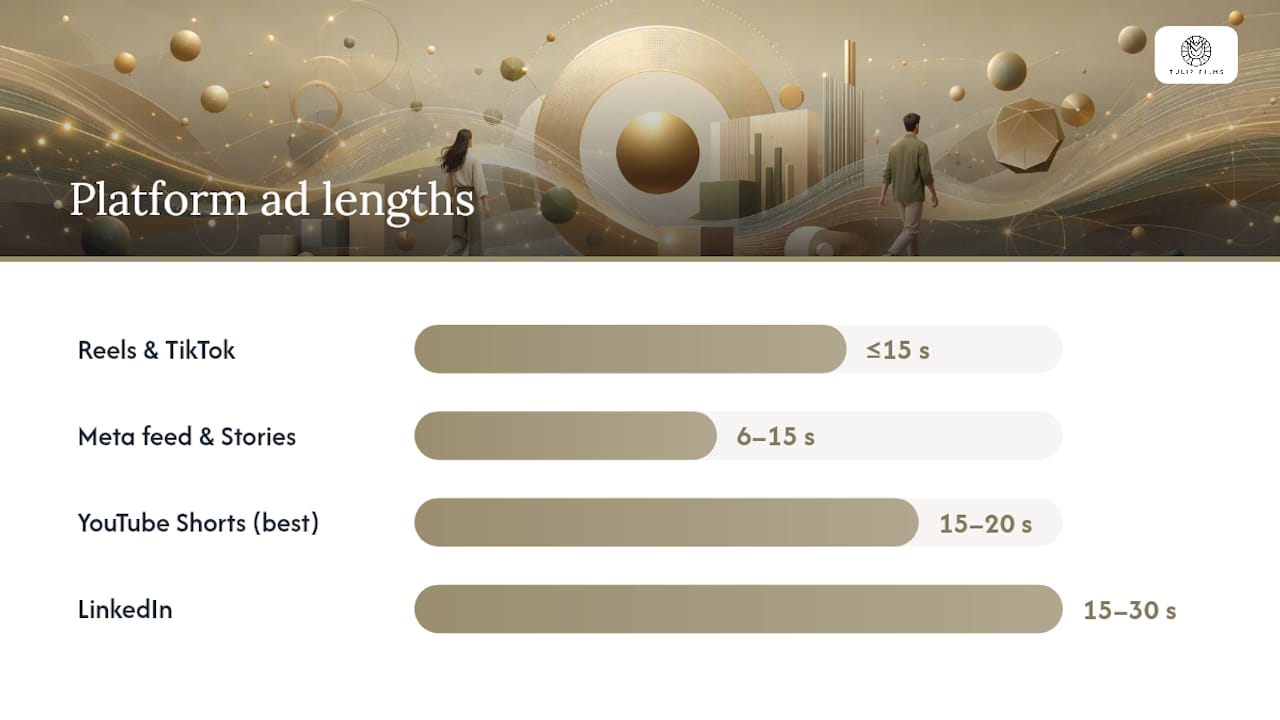
Reels and TikTok: 9:16, aim for 15 seconds or under, hook, in the first, frame.
Meta in-feed and Stories: 4:5 or 9:16, 6 to 15 seconds, captions mandatory.
YouTube Shorts: 9:16, under 60 seconds, though 15 to 20 seconds performs best for ads.
LinkedIn: 1:1 or 16:9, slightly longer copy tolerance, 15 to 30 seconds.
Retargeting gets sharper when you segment by watch time rather than just clicks. Building both audiences from a single video is one of the cheapest wins in paid social, since it costs nothing extra to set up and often outperforms cold prospecting on cost per result.
When does hiring a professional producer pay off?
DIY tools close the gap for testing and small budgets, but they hit a ceiling fast once a brand needs volume, consistency, and multi-format delivery on a deadline. That’s the gap professional production fills.
A single content day, planned around a clear shot list, master takes, and platform-specific exports, routinely produces a master edit plus four or more finished ad cuts. That output ratio is what separates a professional shoot from an ad hoc one: the same time investment, several times the usable creative.
Tulip Films runs that exact model across Swiss client work, from concept and scripting through shooting, editing, and multi-format delivery. Portfolio work spans corporate and brand video, events, real estate, and promotional campaigns, with turnaround built around rapid delivery rather than open-ended timelines. For businesses running ongoing paid social, a single well-planned shoot with a professional crew typically replaces months of piecemeal DIY output, at a cost per finished asset that batching brings down further.
The overlooked truth about social ad video production
Most advice on this topic treats DIY and professional production as a binary choice, and that framing does readers a disservice. The real decision isn’t DIY versus pro. It’s knowing which stage of your campaign each approach actually serves.
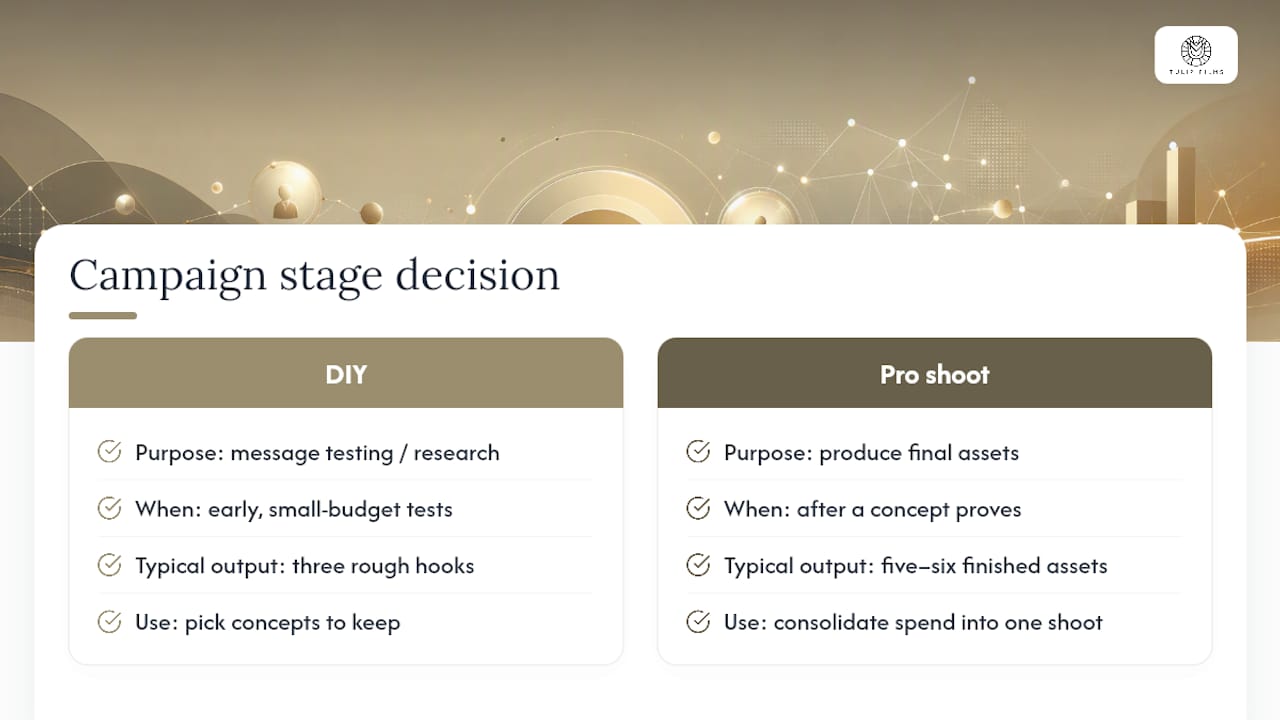
DIY tools are excellent for testing a message before you spend real money on it. Cut three rough versions of a hook in CapCut, run them as small-budget tests, and let the data tell you which concept deserves a proper shoot. What conventional advice gets wrong is treating DIY as a permanent budget solution rather than a research phase. Once a concept proves itself, the smartest move is consolidating spend into one well-planned professional shoot that produces five or six finished assets instead of five separate scrappy attempts.
The other overrated variable is production value itself. Lighting, sound, and a tight edit matter more than camera quality. A phone-shot ad with a strong hook and burned-in captions will beat a beautifully lit ad that opens slowly, every time. Prioritize the first three seconds over everything else in your budget and your attention.
— Pieter
How Tulip Films turns one shoot into your social ad library
Tulip Films works as the direct alternative to piecing together DIY clips one campaign at a time: one planned shoot, delivered across every format your paid social strategy actually needs, without the back-and-forth of managing freelancers separately for filming, editing, and captions.
[
Starter packages cover strategy and scripting, a single shoot day built around a real shot list, and multi-format editing so you leave with vertical, square, and widescreen versions ready to upload the same week. Full pricing detail and package breakdowns are on the video production pricing page, and the portfolio shows recent brand and promotional work at the quality level you can expect. Requesting a quote takes a short consultation call to confirm goals, formats, and timeline, then a scoped fixed-price offer follows within days. If your next campaign needs more than one ad, that’s exactly where a planned shoot earns back its cost fastest.
Sources
Swiss pricing bands referenced in this guide draw from a general Swiss video production cost search and Gryps’ published cost breakdown. Hook and length guidance comes from Coinis’ first-3-seconds research, and engagement and sound-off viewing stats come from Firework’s short-form video data. Platform specs and workflow structure follow SEO-Küche’s video ads guide and Social Media Piraten’s video marketing guide.
Recommended
