Swiss Regional Video Strategy: What Marketers Need to Know


TL;DR:
Swiss regional video strategy involves producing culturally adapted content for Switzerland’s four linguistic regions to maximize engagement. Using the 3H model, AI tools, and platform-specific distribution, brands create targeted, high-quality videos that resonate locally and drive results. Proper planning, native speaker validation, and batching production are essential for effective, scalable regional video marketing.
Swiss regional video strategy is defined as the deliberate production and localization of video content for Switzerland’s distinct linguistic and cultural regions, including German, French, Italian, and Romansh-speaking communities, to maximize engagement and market penetration. This approach goes far beyond translation. It requires cultural adaptation, platform-specific distribution, and a structured content framework to connect with audiences who hold genuinely different expectations across cantons. For marketing professionals and business leaders operating in Switzerland, understanding this strategy is the foundation of any video marketing effort that actually performs. The 3H model (Hero, Hub, Hygiene), AI-assisted production, and multilingual localization are the three pillars that define how leading Swiss brands execute this work in 2026.
What is Swiss regional video strategy and why does it matter?
Swiss regional video strategy is the practice of creating video content that speaks to each of Switzerland’s four linguistic communities on their own terms, not as a single homogenized audience. Switzerland has four official languages: German, French, Italian, and Romansh. Each region carries distinct cultural norms, humor registers, and communication expectations that affect how video content lands with viewers.

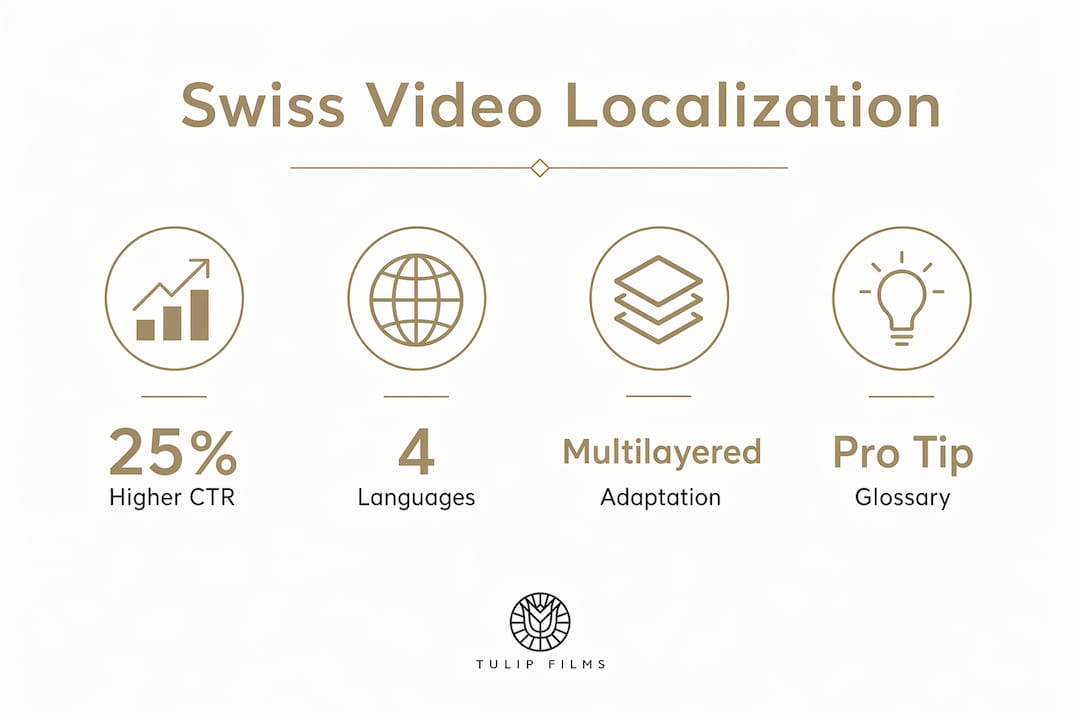
Localized video ad campaigns in Switzerland achieve a 25% higher click-through rate than static image ads in 2026. That gap exists because video, when properly localized, creates an emotional connection that static content cannot replicate at scale.
The standard industry term for this discipline is multilingual video localization strategy, though Swiss practitioners increasingly use “regional video strategy” to emphasize the cultural dimension beyond language alone. Both terms describe the same core practice: building video content systems that serve multiple distinct audiences within one national market. For Swiss brands, this means treating Zurich and Geneva not as two cities in the same country, but as two separate audience segments with different content needs.
You can explore how Swiss brands engage audiences through video to see how this plays out across real campaigns.
Why is regional video localization crucial in the Swiss market?
Switzerland’s linguistic diversity creates a localization challenge that most European markets do not face. A brand operating in Germany produces one language version. A brand operating in Switzerland must consider at least three, and often four, distinct language variants, each with regional dialects that carry social weight.
Swiss German, for example, is not standard German. Zurich German, Bernese German, and Basel German differ enough that a voiceover recorded in Hochdeutsch (standard German) can feel foreign to Swiss German speakers. French-speaking Romands have cultural expectations shaped by proximity to France but a distinct Swiss identity. Italian-speaking Ticino has its own regional pride. Treating localization as “add subtitles and call it done” is the most common and most costly mistake Swiss marketers make.
The consequences of superficial localization include:
Reduced comprehension and engagement from audiences who sense the content was not made for them
Brand perception damage in regions where cultural tone mismatches signal disrespect or indifference
Compliance risks in regulated industries where terminology must meet regional legal standards
Missed reach in Romansh-speaking communities, which, while small, represent an underserved and loyal audience segment
Successful Swiss video localization requires multi-layered adaptation including voiceover, subtitles, on-screen text, embedded UI elements, and timing adjustments to meet linguistic and compliance standards. This is not a post-production task. It must be built into the production design from the start.
Pro Tip: Build a regional glossary and style guide before scripting begins. Swiss regional video strategies that include compliance terminology and brand voice guidelines per language variant avoid costly re-edits and maintain consistency across all versions.
How does the 3H content model optimize Swiss regional video strategy?
The 3H model, standing for Hero, Hub, and Hygiene, is the most practical framework for organizing a Swiss content strategy across multiple regions and platforms. Switzerland Tourism employs this 3H model for regional video marketing, balancing emotional campaigns with search-optimized helpful content. The result is a YouTube channel that earned a Gold Play Button and serves as a benchmark for Swiss video marketing.
Here is how each tier functions in a regional Swiss context:
Hero content is high-production, emotionally driven video designed for broad awareness. A Swiss financial services firm might produce a cinematic brand film in all three major languages, each version adapted for regional cultural tone rather than simply dubbed.
Hub content builds community through recurring series. A manufacturing company in the Mittelland could run a monthly “behind the process” series in Swiss German that speaks directly to local industrial pride.
Hygiene content addresses specific search queries and practical needs. A healthcare provider in Ticino produces short Italian-language explainer videos answering common patient questions, capturing organic search traffic that a German-language video would never reach.
Content type | Primary purpose | Regional application |
Hero | Broad emotional awareness | Cinematic brand films localized per language region |
Hub | Recurring engagement and community | Regional series tied to local culture or industry |
Hygiene | Search-driven utility | FAQ videos in each official language |
The 3H model works in Switzerland because it forces marketers to plan content at three different production scales simultaneously. Hero content justifies high investment. Hygiene content can be produced efficiently in volume. Hub content builds the audience relationship that makes both of the others more effective over time. You can read more about applying content frameworks for Swiss brands to see how this model translates into campaign planning.
What role does AI play in Swiss regional video production?
AI has changed the economics of multilingual video production in Switzerland. Tasks that previously required separate production runs for each language region, including voiceover recording, subtitle generation, and on-screen text adaptation, can now be completed faster and at lower cost using AI-assisted workflows.
Short-form AI-generated videos under 60 seconds, localized for Swiss German and French regions, have proven highly effective for engagement on TikTok and Instagram Reels. This matters because short-form content production at regional scale was previously cost-prohibitive for mid-size Swiss companies.
The most effective AI applications in Swiss regional video production include:
AI voice synthesis that generates voiceovers in Swiss German, French, and Italian with regional accent calibration, reducing studio recording costs
Automated subtitle generation with human review, cutting localization turnaround from days to hours
AI-driven script drafting that produces language variants from a single source script, which human editors then refine for cultural accuracy
Faceless video formats using AI-generated visuals and narration, suited for hygiene content and product explainers
Swiss B2B audiences expect high-quality content, and over-reliance on unverified AI-generated content risks brand trust erosion. This is the critical constraint. AI accelerates production, but human cultural validation is not optional in the Swiss market. A hybrid workflow, where AI generates the draft and a native speaker validates the final output, is the standard that serious Swiss brands follow.
Pro Tip: Never publish AI-generated voiceover or subtitles without native speaker review. Swiss audiences, particularly in B2B contexts, notice tonal and idiomatic errors that automated systems miss, and those errors signal low investment in the audience.
Which platforms maximize Swiss regional video content?
Platform selection in Switzerland is not a matter of preference. It is a function of audience behavior and content type. Swiss B2B firms use LinkedIn as the primary channel for native video content and YouTube as an SEO archive rather than the main social distribution channel. This distinction shapes how you allocate production budget and content format.
The platform breakdown for Swiss regional video content looks like this:
LinkedIn is the primary B2B distribution channel. Native video uploaded directly to LinkedIn generates higher organic reach than external links. Corporate video, thought leadership content, and regional case studies perform well here, particularly in Swiss German and French.
YouTube functions as a structured media archive. Switzerland Tourism treats YouTube as a media channel requiring structured content production and scheduling, not simply an ad platform. For Swiss brands, YouTube is where hygiene and hub content lives permanently, indexed by search engines in each language.
Instagram Reels and TikTok serve younger demographics and consumer-facing brands. Short-form localized content under 60 seconds performs well here, particularly for brands targeting French-speaking and Italian-speaking audiences under 35.
Paid video on Meta (Facebook and Instagram) remains effective for regional targeting when combined with language-specific creative. Swiss Meta campaigns that use separate ad sets per language region consistently outperform single-language campaigns.
The multi-channel approach is not about being everywhere. It is about placing the right content format on the platform where each regional audience actually spends time.
How to develop and implement a Swiss regional video strategy
Building a Swiss regional video strategy requires structured planning before a single frame is shot. The following sequence reflects how experienced Swiss video marketers approach this work.
Conduct a language and audience audit. Map your existing customer base by language region. Identify which cantons generate the most revenue and which are underserved by your current content. This determines where localization investment delivers the highest return.
Write scripts with localization in mind. Effective localization requires planning for 30 to 40% longer text when translating from English to German. Design video layouts with flexible text zones so that longer German or French translations do not require re-editing the entire video.
Use batch production to manage cost and consistency. Batch shooting 10 to 15 videos monthly with consistent brand identity elements is the production model that Swiss companies use to maintain content output without proportional cost increases.
Build a QA workflow with native speakers. Every language version must pass through a native speaker review before publication. This review covers idiomatic accuracy, cultural tone, and compliance terminology.
Track metrics by language region separately. Aggregate analytics hide regional performance differences. A video that performs well in Zurich may underperform in Geneva for reasons that only region-specific data reveals.
Iterate based on regional data. Treat each language region as a separate market with its own content calendar, performance benchmarks, and optimization cycle.
Pro Tip: Swiss companies that leverage the precision stereotype by showcasing manufacturing details or process micro-content generate disproportionate organic reach. A 30-second clip of a watchmaker’s hands or a precision component being assembled carries viral potential that generic brand content does not.
Key takeaways
A Swiss regional video strategy succeeds when it combines multilingual localization, a structured content framework like the 3H model, and platform-specific distribution, all validated by native speakers before publication.
Point | Details |
Localization drives results | Localized video ads achieve 25% higher click-through rates than static image ads in Switzerland. |
3H model structures content | Hero, Hub, and Hygiene content tiers serve different audience needs and production scales simultaneously. |
AI requires human validation | Hybrid workflows combining AI speed with native speaker review protect brand trust in Swiss B2B markets. |
Platform choice is audience-driven | LinkedIn serves B2B video; YouTube archives hygiene content; short-form platforms target younger regional audiences. |
Batch production controls cost | Shooting 10 to 15 videos per month with consistent brand templates maintains output without budget overruns. |
What I’ve learned from watching Swiss video strategies succeed and fail
The most common mistake I see from Swiss marketing teams is treating regional video strategy as a production problem rather than a planning problem. They invest in high-quality cameras and editing, then realize at the end of the process that their French-speaking audience received a dubbed version of a Swiss German script that was never written for them. The cultural gap is not in the pixels. It is in the brief.
The second mistake is waiting for perfection. Switzerland’s precision reputation creates a cultural pressure to over-polish content before release. I have watched brands spend three months refining a hero video while their competitors published 12 hygiene videos that captured all the organic search traffic in the category. Timely, culturally accurate content outperforms late, technically perfect content every time.
AI is changing the speed equation significantly. The brands I see winning in 2026 are not the ones with the biggest production budgets. They are the ones that built hybrid workflows early, trained their teams to brief AI tools correctly, and invested the time saved into more native speaker review cycles. The output quality is higher and the volume is three to four times what traditional workflows produced.
My honest recommendation: start with hygiene content in your highest-revenue language region, measure what works, then scale the model to the next region. Do not try to launch a full 3H strategy across all four language regions simultaneously. That path leads to diluted quality and exhausted teams.
— Pieter
How Tulipfilms can support your regional video production
If you are ready to move from strategy to production, Tulipfilms brings direct experience in Swiss corporate and brand video production across multiple language regions.
[
Tulipfilms produces corporate and brand videos designed for Swiss audiences, with a production process built around clear communication, fast turnaround, and content that works across platforms. Whether you need a hero campaign for a product launch or a batch of hygiene videos for your French-speaking market, the team structures each project around your regional audience and distribution goals. You can review production pricing for Lausanne and Geneva to understand what a regional video project costs before booking a consultation.
FAQ
What is Swiss regional video strategy?
Swiss regional video strategy is the practice of producing and localizing video content for Switzerland’s distinct German, French, Italian, and Romansh-speaking regions to maximize engagement and effectiveness. It combines multilingual localization, cultural adaptation, and platform-specific distribution into a single coordinated approach.
How many language versions does a Swiss video campaign need?
Most Swiss B2B campaigns require at minimum three versions: Swiss German, French, and Italian. Romansh is relevant for brands targeting Graubünden specifically. Each version requires cultural adaptation beyond translation, not just dubbed audio over the same script.
Does AI replace human localization in Swiss video production?
AI accelerates localization but does not replace human review. Swiss B2B audiences expect culturally accurate content, and AI-generated voiceovers and subtitles require native speaker validation to catch idiomatic errors and tonal mismatches before publication.
Which platform is best for Swiss B2B video content?
LinkedIn is the primary channel for Swiss B2B native video, offering higher organic reach for directly uploaded content. YouTube serves as an SEO-optimized archive for hygiene and hub content that needs to be discoverable over time.
How does the 3H model apply to Swiss video marketing?
The 3H model organizes Swiss video content into Hero (emotional brand awareness), Hub (recurring regional series), and Hygiene (search-driven FAQ content). Switzerland Tourism’s YouTube strategy, which earned a Gold Play Button, is the most cited Swiss example of this framework in practice.
Recommended
