Role of Visuals in Communication: Driving Swiss Brand Engagement


What makes a visual message truly connect with your audience? For marketing managers at Swiss companies in Geneva, choosing the right visuals goes far beyond aesthetics. In a media-saturated environment, images act as powerful agents that shape social identity, meaning, and emotional engagement. By understanding visual language as a critical communication tool, you can develop strategies that drive authentic brand connection and sustained audience engagement.
Table of Contents
Key Takeaways
Point | Details |
Visual Communication is Multifaceted | It integrates various disciplines to shape understanding and influence perceptions effectively through imagery and graphics. |
Strategic Use of Visual Content | Different types of visuals serve distinct purposes, enhancing engagement and ensuring brand message clarity. |
Collaboration in Production | Active client involvement in visual production fosters authentic representation and strengthens brand narratives. |
Awareness of Risks | Organizations must anticipate and mitigate potential strategic, financial, and reputational risks associated with visual communication. |
Visuals in Communication: Core Concepts Defined
Visual communication represents a complex, multidimensional system of conveying meaning through imagery, graphics, and visual representations. It transcends traditional language barriers, offering a powerful mechanism for transmitting information that is simultaneously universal and nuanced. Visual language operates through semantic and pragmatic channels, functioning as a critical communication tool in contemporary media environments.
At its core, visual communication encompasses several fundamental components:
Semantic power: Images carry intrinsic meaning beyond literal representation
Cultural encoding: Visuals reflect and shape societal perceptions and identities
Cognitive processing: Visual stimuli trigger immediate neurological responses
Emotional engagement: Graphics can evoke complex emotional reactions
Multifaceted visual communication theories demonstrate how images function as active communicative agents. They are not passive representations but dynamic elements that actively construct and interpret social realities. The concept of ‘image acts’ highlights how visuals are strategically created, transmitted, and received within specific communicative contexts.
Understanding visual communication requires recognizing its interdisciplinary nature. It integrates perspectives from psychology, sociology, semiotics, and media studies, creating a rich theoretical framework for analyzing how visual information transforms human understanding. For Swiss brand managers, this means recognizing visuals as strategic communication tools that do far more than merely illustrate—they actively shape perception, engagement, and narrative.
Pro tip: Invest time in understanding the semantic layers of your visual communication strategies, treating images as complex communicative texts rather than simple decorative elements.
Key Types of Corporate Visual Content
Corporate visual communication encompasses a diverse range of strategic content designed to engage, inform, and influence target audiences. Corporate visual content classification reveals multiple approaches for effectively communicating organizational messages through visual mediums. Understanding these different types enables Swiss brands to craft more targeted and impactful communication strategies.
The primary categories of corporate visual content include:
Informational Visuals
Infographics
Data visualizations
Statistical charts
Process diagrams
Brand Identity Visuals
Logos
Color palettes
Brand style guides
Corporate illustrations
Narrative Visuals
Corporate storytelling videos
Employee testimonial recordings
Behind-the-scenes imagery
Company history timelines
Each visual type serves a distinct communicative purpose. Informational visuals transform complex data into digestible formats, while brand identity visuals create immediate recognition and emotional connection. Narrative visuals leverage storytelling to humanize corporate messaging and build deeper audience relationships.
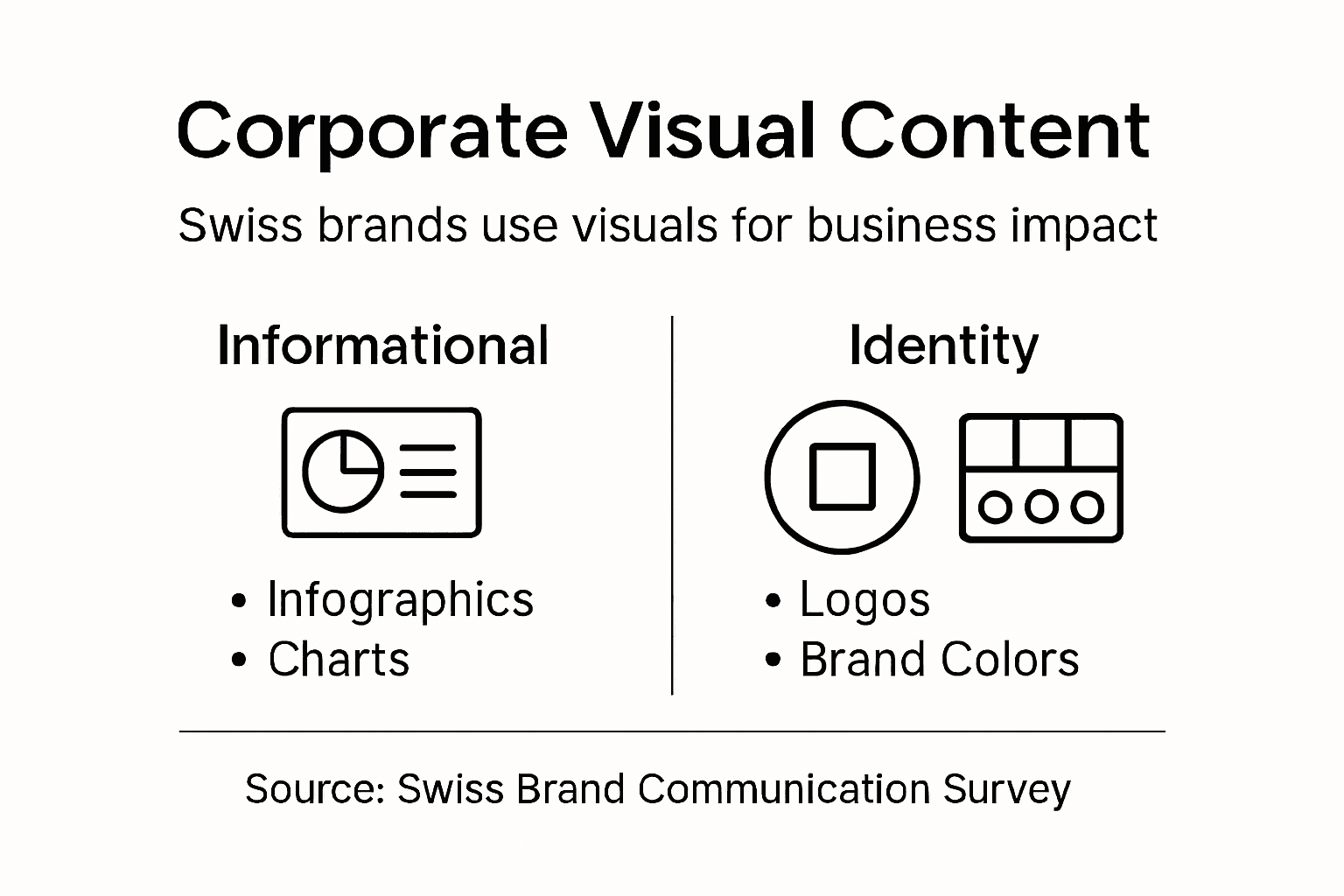
Here’s a summary comparing primary types of corporate visual content and their strategic roles:
Visual Type | Main Business Purpose | Suitable Scenarios |
Informational Visuals | Simplify complex data | Financial reports, proposals |
Brand Identity Visuals | Build recognition and trust | Product launches, branding |
Narrative Visuals | Humanize and engage audience | Recruitment, PR campaigns |
The strategic selection of visual content depends on multiple factors, including target audience, communication objectives, and brand personality. Swiss corporations must approach visual communication as a nuanced art form, carefully matching visual types to specific communication goals. By understanding the experiential qualities of different visual formats, brands can create more compelling and memorable communication strategies.
Pro tip: Develop a comprehensive visual content library that strategically maps different visual types to specific communication objectives, ensuring consistent and purposeful brand messaging.
How Visuals Enhance Audience Engagement
Visual communication transcends traditional messaging by creating powerful, multi-sensory experiences that capture audience attention and drive deeper emotional connections. Multimodal communication strategies demonstrate how integrating visual elements with other communication modes can dramatically increase message impact and audience engagement.
The key mechanisms of visual engagement include:
Cognitive Attraction
Rapid information processing
Enhanced memory retention
Reduced cognitive load
Simplified complex concepts
Emotional Resonance
Immediate visceral responses
Stronger psychological connections
Enhanced empathy generation
Increased brand affinity
Psychological Triggers
Subconscious decision-making influence
Pattern recognition activation
Narrative transportation
Neurological engagement
Psychological engagement occurs through sophisticated visual communication techniques that transform passive viewers into active participants. By strategically designing visual content that speaks directly to audience emotions and cognitive processes, brands can create immersive experiences that transcend traditional marketing approaches.

Swiss brands must recognize visuals as dynamic communication tools that do more than simply convey information. They are powerful instruments for creating meaningful connections, bridging cognitive and emotional gaps, and transforming audience perceptions through carefully crafted visual narratives.
Pro tip: Design visual content with intentional psychological triggers that create authentic, memorable connections beyond surface-level aesthetic appeal.
Client Roles in Effective Visual Production
Effective visual production is fundamentally a collaborative process that demands active and strategic involvement from clients. Client participation in visual development transforms the traditional production model from a unidirectional service to a dynamic, interactive partnership that ensures authentic brand representation.
Key client responsibilities in visual production include:
Strategic Input
Define clear communication objectives
Articulate brand identity nuances
Provide contextual brand insights
Validate conceptual alignment
Creative Collaboration
Share target audience understanding
Offer narrative direction
Review and refine visual concepts
Contribute brand-specific perspectives
Feedback Mechanisms
Provide constructive critique
Ensure strategic consistency
Validate emotional resonance
Confirm communication effectiveness
Brand narrative development requires clients to be more than passive recipients. They must actively engage as co-creators, bringing deep organizational knowledge that translates complex brand stories into compelling visual experiences. This collaborative approach ensures that visual content authentically represents the brand’s core message and strategic intent.
Swiss corporations recognize that visual production is not a transactional service but a strategic communication partnership. By actively participating in the creative process, clients can transform visual content from mere aesthetic representations to powerful communication instruments that drive engagement, perception, and organizational storytelling.
Pro tip: Establish clear communication protocols and collaborative checkpoints to maintain strategic alignment throughout the visual production process.
Risks, Costs, and Common Missteps to Avoid
Visual communication strategies carry significant potential for both breakthrough success and costly failures. Visual communication risks demonstrate that poorly executed visual content can damage brand reputation more quickly than traditional communication methods, making strategic planning and risk mitigation critical for Swiss organizations.
Common risks and potential missteps in visual production include:
Strategic Risks
Cultural misinterpretation
Stereotypical representation
Inappropriate messaging
Inconsistent brand narrative
Financial Risks
High production costs
Ineffective content investments
Resource wastage
Expensive reproduction requirements
Reputational Risks
Audience alienation
Brand credibility erosion
Negative public perception
Reduced audience trust
Technological obsolescence poses another significant challenge for visual communication strategies. Organizations must remain adaptable, continuously evaluating emerging digital trends and production technologies to ensure their visual content remains relevant and engaging. This requires ongoing investment in skills, tools, and creative approaches that align with rapidly evolving audience expectations.
Swiss brands must approach visual communication as a sophisticated, nuanced discipline that demands rigorous planning, cultural sensitivity, and strategic foresight. By understanding potential pitfalls and implementing comprehensive risk assessment protocols, companies can transform potential vulnerabilities into opportunities for meaningful audience connection.
The table below outlines key risks of visual communication and proactive measures to mitigate them:
Risk Category | Potential Impact | Prevention Strategy |
Strategic | Damaged audience relevance | Involve diverse review teams |
Financial | Overspending, low ROI | Set clear content priorities |
Reputational | Loss of brand credibility | Pre-test visuals with stakeholders |
Pro tip: Implement a multi-stage review process that includes diverse stakeholder perspectives to catch potential cultural, strategic, and representational risks before content production.
Elevate Your Swiss Brand Engagement with Strategic Visual Communication
The article highlights key challenges Swiss brands face in crafting visuals that truly connect. From avoiding cultural misinterpretations to leveraging emotional resonance and cognitive attraction, effective visual communication demands more than pretty images. It requires strategic collaboration, nuanced storytelling, and a deep understanding of audience psychology. Tulip Films is uniquely positioned to help you overcome these obstacles by transforming your corporate message into immersive audiovisual experiences that engage and inspire.
Unlock the power of visuals to build recognition, trust, and emotional resonance with your audience. Our expertise in producing personalized corporate videos, promotional ads, and event coverage ensures your brand story is told authentically and strategically. Collaborate with professionals who prioritize your vision and provide quick, high-quality results to keep your communication dynamic and relevant in today’s fast-paced market.
Looking to harness complex visual language as a strategic branding tool? Visit Tulip Films to explore how tailored audiovisual content can elevate your corporate narrative. Discover our portfolio and start planning a free consultation to create visuals that resonate beyond aesthetics.

Take the next step in your brand’s visual journey with Tulip Films. Connect now to craft compelling videos that turn viewers into loyal customers and make every message count.
Frequently Asked Questions
What is visual communication, and why is it important for brands?
Visual communication is the process of conveying information and meaning through imagery, graphics, and visual representations. It is important for brands because it transcends language barriers, engages audiences emotionally, and enhances information retention, making marketing efforts more effective.
How can Swiss brands enhance audience engagement through visuals?
Swiss brands can enhance engagement by using visuals that elicit emotional responses, simplify complex information, and resonate with their target audience. Incorporating cognitive triggers and storytelling techniques in visual content can also strengthen audience connections.
What types of visuals are most effective for corporate communication?
Effective types of visuals for corporate communication include informational visuals like infographics, brand identity visuals such as logos, and narrative visuals like storytelling videos. Each serves a different purpose, from simplifying data to fostering emotional engagement with the audience.
What risks should brands consider when using visual communication?
Brands should consider strategic risks such as cultural misinterpretation and inconsistent messaging, financial risks like high production costs, and reputational risks that could alienate audiences. Planning and risk mitigation strategies are essential to avoid these pitfalls.
Recommended
