Professional Voiceover Recording for Swiss Corporate Videos

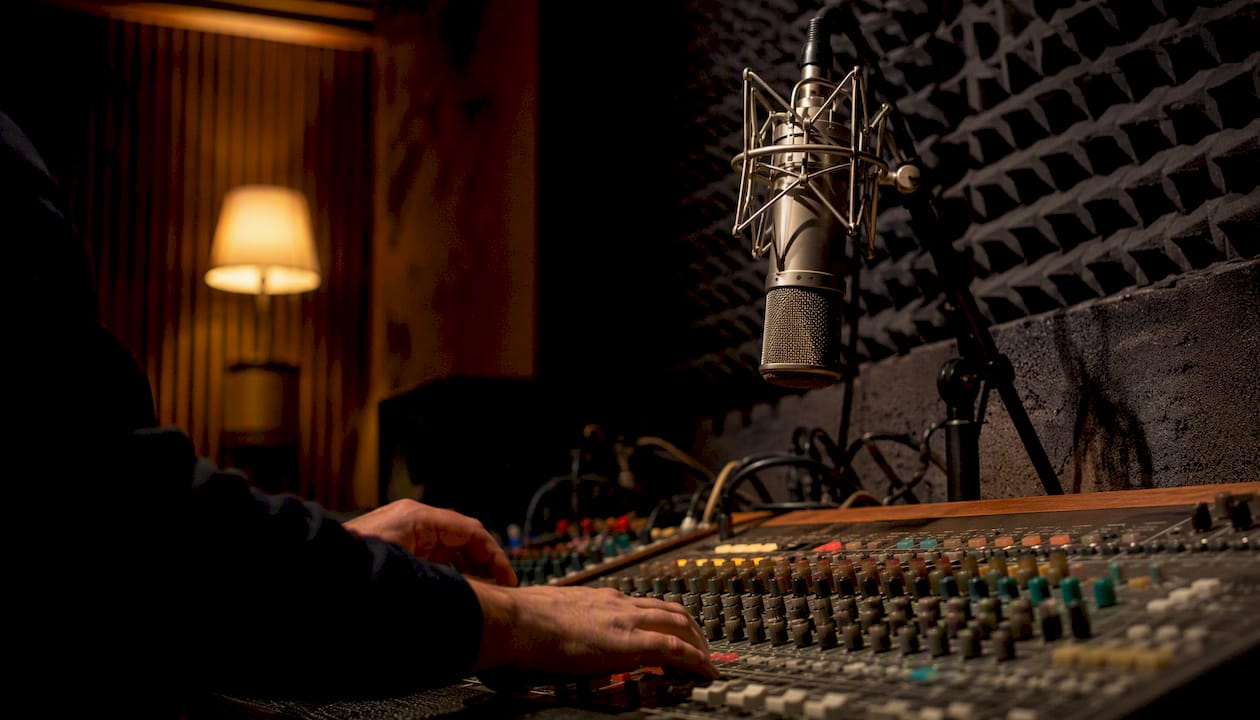
Yes, a professional studio can record and deliver broadcast-ready voiceover tracks for your corporate, promotional, real estate, or event video. The next step is simple: lock your script, decide on language and dialect, then contact a provider. If your project involves corporate or promotional video production, Tulipfilms handles the full cycle in-house.
Here is what a complete professional voiceover order delivers:
Casting — selection of a native-speaker voice actor matched to your brand tone
Directed recording — a session producer guides the talent through takes and pacing
Editing and mixing — clean cuts, breath removal, level balancing, and music integration
Final masters — broadcast and web formats delivered to your technical specs
Key Takeaways
Professional voiceover production for Swiss corporate videos requires the right language specification, broadcast-grade technical delivery, and a provider with in-house post-production and native-speaker casting.
Point | Details |
Specify language and dialect precisely | Swiss Standard German, Swiss French, or Swiss Italian each require native in-country talent for credible results. |
Request broadcast-ready file specs | WAV 48kHz/24-bit at EBU R128 loudness is the standard for video post-production and broadcast delivery. |
Choose a provider with in-house post | Casting, direction, editing, and mastering under one roof reduces handoff errors and speeds delivery. |
Clarify usage rights before booking | Territory, media type, and campaign duration all affect talent fees and licensing costs. |
Tulipfilms for Swiss voiceover projects | Tulipfilms delivers native casting, directed sessions, and full post-production with express turnaround options. |
Table of Contents
What does professional voiceover recording actually include?
Which language or dialect should you specify for Swiss projects?
How does the workflow run, and can you participate remotely?
What drives the cost of voiceover production in Switzerland?
An editorial perspective on how voiceover projects actually succeed
Tulipfilms handles your voiceover project from script to final master
What does professional voiceover recording actually include?
Recording a voiceover is not just pressing record. A full-service studio covers eight distinct stages, and each one affects the final quality.
Voice Hansa describes a workflow that runs from casting through mixing and post-production, with a voice marketplace and fast audition delivery supporting multi-language projects. The core roles involved are a voice director (who shapes performance and pacing), a recording engineer (who manages signal chain and acoustics), and a post-producer (who handles editing, sound design, and mastering). Your single point of contact coordinates all three.
Why does each stage matter for corporate output? Casting determines whether the voice matches your brand personality. Direction catches mispronunciations and flat reads before they reach your editor. Post-production removes room noise, normalizes levels, and ensures the track sits cleanly under music or sound effects. Skipping any step produces a track that sounds fine in isolation but falls apart in the final cut.
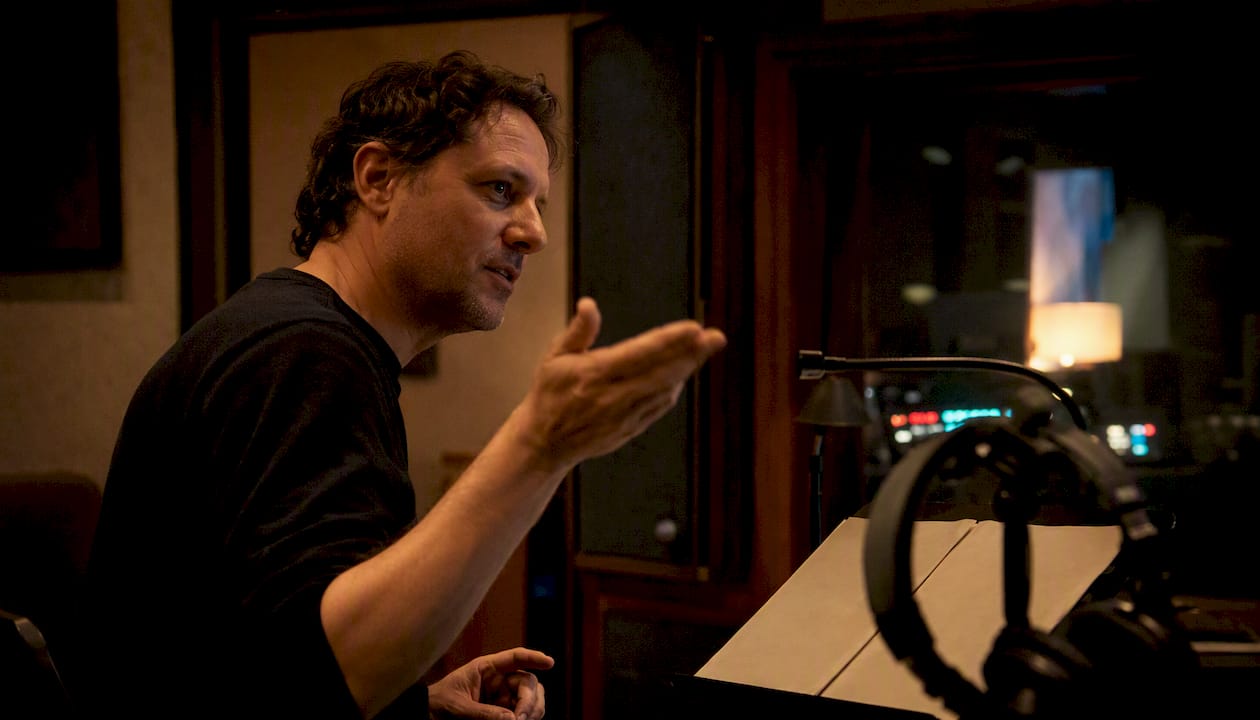
Pro Tip: Before the session, write a one-paragraph brand voice brief: preferred pace (measured vs. energetic), tone (authoritative vs. warm), and any words the talent must stress. Studios that receive this brief in advance cut revision rounds significantly.
Which language or dialect should you specify for Swiss projects?
Switzerland has four national languages, and the wrong choice for your audience is one of the most common briefing mistakes.
Swiss Standard German (Schweizer Hochdeutsch) is the correct choice for corporate narration targeting German-speaking Switzerland. It differs subtly from German Standard German in rhythm and intonation. Providers such as MT Recordings maintain specialized Swiss Standard German talent recorded in-country for exactly this reason.
Swiss German dialects (Zurich, Bernese, Basle, etc.) suit social media content, regional campaigns, or any context where local warmth matters more than formal clarity. They are rarely appropriate for broadcast or e-learning.
French for the Suisse romande audience should use a neutral Swiss French register, not Parisian French, which can feel tonally off to local viewers.
Italian for Svizzera italiana follows similar logic: Swiss Italian talent avoids the regional markers of Milan or Rome.
English is the right call for multinational internal communications, international investor videos, or global ad campaigns. Studios offering content consulting and scripting support for corporate English narration are available in Switzerland.
One practical rule: always provide a pronunciation guide for proper nouns, product names, place names, and any technical terms. A talent reading “Zürich” with a German accent instead of the local Swiss inflection is a small detail that local viewers notice immediately.
How does the workflow run, and can you participate remotely?
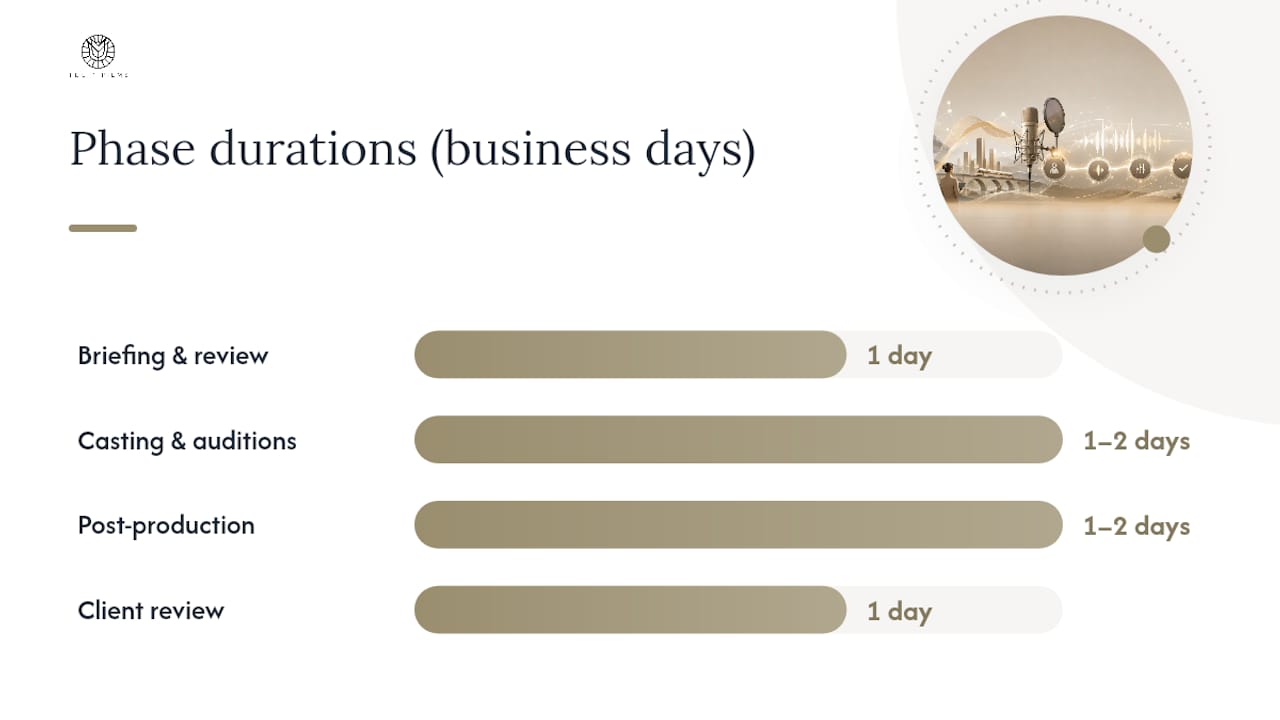
A standard voiceover project moves through six phases. Babilon notes that clients can join sessions remotely and that single-point coordination is common practice across Swiss studios.
Typical phase durations:
Phase | What happens | Typical duration |
Briefing and script review | Provider reviews script, flags timing issues, confirms specs | 1 business day |
Casting and auditions | Talent shortlist prepared; client selects voice | 1–2 business days |
Session scheduling | Studio time booked; remote link sent if needed | Same day |
Recording | Directed session, multiple takes and pacing variants | 2–4 hours |
Post-production | Editing, mixing, mastering | 1–2 business days |
Client review and delivery | Revisions applied; final masters sent | 1 business day |
Remote direction works through tools like Session Link Pro, Cleanfeed, ipDTL, or Source-Connect. You join a browser or desktop link, hear the session in real time, and give live notes to the director. For most corporate projects, one remote session replaces any need to travel to the studio.
Express jobs compress this timeline. Promance publishes transparent online estimates with standard delivery with typical turnaround times of a few business days and paid express options that speed up the project noticeably.
What technical specs and file formats should you request?
Getting the specs wrong at the delivery stage means your editor has to request re-exports, which costs time. Ask for these by default:
WAV 48kHz/24-bit — the standard for video post-production; drops cleanly into Premiere Pro, DaVinci Resolve, or Final Cut Pro
WAV 96kHz — only needed for high-end broadcast or archival masters
MP3 320kbps — for quick client review and web streaming
Uncompressed master — the final approved mix, no further processing applied
Audio Professional AG lists picture-synced voice-over, mix, and final dispatch of masters as standard film studio services, confirming that broadcast-ready delivery is an expected deliverable, not an upgrade.
Format | Typical use | Recommended settings |
WAV 48kHz/24-bit | Video edit and broadcast delivery | Stereo or mono, EBU R128 loudness standard |
WAV 96kHz | Archival or high-end broadcast | Mono, unprocessed master |
MP3 320kbps | Client review, web streaming | Stereo, normalized |
Stems + room tone | Editor flexibility, re-versioning | Delivered alongside final mix |
Also ask whether the provider delivers both the edited master and the raw unedited takes. Promance notes that some Swiss providers include both at no extra cost for standard projects, which gives your editor options without a re-record.
Pro Tip: Request two pacing variations of the read — one timed to your video cut, one slightly shorter. Editors frequently need a few seconds of flexibility when syncing voice to picture, and a second take costs almost nothing at session time but saves a re-booking later.
What drives the cost of voiceover production in Switzerland?
Pricing in the Swiss market takes a few different shapes. Online platforms offer fixed transparent estimates for straightforward corporate reads. Broadcast campaigns typically require bespoke quotes. Studio day rates apply when you need extended sessions or multiple languages recorded back to back.
The main cost drivers:
Talent profile — a well-known voice actor with broadcast credits costs more than a newer talent; both can be appropriate depending on the project
Language and dialect rarity — Swiss Italian and Romansh voices command a premium because the talent pool is smaller
Usage rights — a buyout for a three-year national campaign costs more than a one-year regional web license; always specify territory, duration, and media type upfront
Post-production complexity — a clean narration track is cheaper to mix than a full sound design job with music, effects, and multiple stems
Rush fees — express delivery typically adds a percentage to the base rate
For a short promotional video (60–90 seconds), a realistic Swiss market budget covers casting, a directed session, editing, and delivery in one or two formats. An e-learning module with multiple chapters and two languages will cost proportionally more, mainly because of talent time and post-production hours.
How do you choose the right provider?
Ask these questions before signing anything:
Can you share a portfolio of corporate or promotional voiceover work?
Do you record in Switzerland or with vetted local partners?
Which remote participation tools do you support?
Who is my single point of contact from briefing to delivery?
What is your revision policy, and how many rounds are included?
Trust signals to confirm: native-speaker casting, director-led sessions, in-house post-production, sample masters on request, and transparent pricing with itemized breakdowns. Hastings Switzerland is one example of a full-service audio postproduction studio that combines casting, recording, sound design, and mixing under one roof while maintaining a voice database and partner network for multi-language projects.
Red flags: no native-language samples available, vague or missing licensing terms, no stated revision policy, and post-production outsourced to unnamed third parties with no quality oversight.
What should you prepare before placing an order?
Use this checklist to speed up quoting and cut revision rounds:
Final script (or a locked draft) — word count determines session length and talent rate
Pronunciation guide — list every proper noun, brand name, product term, and place name with phonetic spelling
Target language and dialect — be specific (Swiss Standard German, not just “German”)
Brand voice reference — a link to an existing video or a named voice actor whose style matches your brief
Technical specs — target loudness standard (EBU R128 for broadcast, or platform-specific), file format, and delivery destination
Desired delivery date — flag if you need express turnaround
Usage and license details — territory, media type, campaign duration
Billing and procurement contact — speeds the contract and invoice process
The minimum you need to get a quote is items 1, 3, and 6. Everything else reduces back-and-forth once the project starts.
An editorial perspective on how voiceover projects actually succeed
The briefing document is where most corporate voiceover projects either succeed or stall. Studios can cast the right voice, run a clean session, and deliver broadcast-ready files in five business days. What they cannot do is reverse-engineer your brand tone from a vague email. The clients who get the best results send a one-page brief that covers voice character, pronunciation notes, and a reference clip. That single document eliminates the most common revision request, which is almost always “the tone feels slightly off.” Specify the tone before the session, not after.
Tulipfilms handles your voiceover project from script to final master
Tulipfilms offers Swiss businesses a complete voiceover production service: native-speaker casting across Swiss Standard German, French, Italian, and English; director-led studio recording with remote participation via Session Link or Cleanfeed; and full post-production including editing, mixing, and mastering to broadcast or web specs.
[
Standard turnaround for a corporate voiceover project is five business days. Express options are available for tighter deadlines. Whether your project is a promotional video or a full corporate production, you can review past work in the Tulipfilms portfolio and request a quote directly. Reach out with your script and language requirements, and you will receive a clear estimate within one business day.
Sources
Recommended
