What Is Video Scripting and Its Role in Swiss Marketing


Every Swiss marketing manager knows that producing a standout video is never just about what gets said on camera. Without a detailed video script blueprint, even the most creative ideas fall apart, leading to scattered scenes and mixed messaging. Mastering video scripting means you control every visual, line of dialogue, and technical cue that keeps promotional campaigns on budget and on message. Discover how thoughtful scripting streamlines production and ensures your brand story hits its mark every time.
Table of Contents
Key Takeaways
Point | Details |
Define Your Video Objective | Establish your video’s goal before scripting to guide tone, language, and pacing effectively. |
Know Your Audience | Craft your script considering the audience’s preferences for professionalism and clarity, avoiding jargon and fluff. |
Plan for Visual Elements | Ensure your script complements visual storytelling; describe actions clearly to create coherence between audio and visuals. |
Understand Legal Compliance | Familiarize yourself with Swiss advertising laws to avoid legal issues, including regulations about misleading claims and data protection. |
Defining Video Scripting in Production
A video script functions as far more than dialogue written on a page. It is a comprehensive blueprint that outlines every visual element, auditory component, and technical direction that shapes your final video product. For Swiss marketing managers overseeing promotional campaigns, understanding this distinction is critical. When you hand a script to your production team, they receive not just words to speak, but a detailed roadmap covering camera angles, scene descriptions, character actions, timing cues, and sound requirements.
The script serves as your production’s operating manual. A video script outlines dialogue, action, settings, camera angles, and sound cues, organizing all content in a way that guides your director, camera operators, and talent seamlessly through each scene. This organization prevents costly confusion on set. Without clear documentation, production teams waste hours discussing interpretation, debating pacing, or revisiting scenes because directions were ambiguous. Your script eliminates that friction by establishing expectations upfront.

What separates an effective script from a mediocre one comes down to specificity. A weak script might read: “An executive discusses the company’s growth.” A strong script reads: “MARGARET sits at her desk, slightly turned toward camera, holding a tablet. She looks up from the screen. She speaks directly to camera with measured confidence. Background shows floor-to-ceiling windows overlooking Zurich.” The second version gives your cinematographer precise framing requirements, your lighting technician clear placement for key lights, and your talent an understanding of tone and physical positioning.
For Swiss corporate videos and marketing content, scripts coordinate multiple stakeholders and ensure messaging consistency. Your script controls narrative flow, establishes emotional tone, manages timing so content fits into 30-second ads or 3-minute explainer videos, and clarifies exactly what production resources you need. This level of detail directly impacts your budget. When you know precisely which locations you need, how many actors, what props are required, and how many shooting days the script demands, you can estimate costs accurately rather than discovering mid-production that your ambitious vision requires budget you don’t have.
Pro tip: Write your script with production constraints in mind. If you have a limited shooting schedule, avoid scenes requiring multiple location changes or complex lighting setups that slow production down.
Types of Video Scripts for Corporate Use
Not all scripts serve the same purpose. Different types of scripts exist depending on the medium and purpose, and for your Swiss marketing campaigns, understanding which script type fits your objective is the difference between effective content and wasted production budget. Corporate environments demand specific script structures tailored to your business goals, audience expectations, and delivery platform. A training script functions completely differently from a sales pitch script or an internal communications video. Each demands its own formatting, pacing, and technical requirements.
The most common script type you will encounter is the explainer script. This script format works particularly well for marketing managers introducing new products, services, or processes to your audience. Explainer scripts typically run between 60 and 180 seconds and combine clear narration with visual demonstrations or animations. They follow a simple structure: problem, solution, and call to action. Another critical type is the training script, designed to educate employees on procedures, software systems, or compliance requirements. Training scripts require precision in terminology and often include pauses for comprehension or interactive elements. Then there is the testimonial or case study script, where you document client success stories or employee narratives. This format emphasizes authenticity and emotional connection, making it powerful for building brand credibility with prospects evaluating your company.
Sales and promotional scripts form another essential category. These scripts aim to convert viewers into customers by highlighting value propositions and creating urgency. They often follow persuasive storytelling techniques and include multiple calls to action throughout. Internal communication scripts differ fundamentally because they target your own workforce. These scripts may cover company announcements, leadership messages, or cultural initiatives. They prioritize clarity, transparency, and alignment with your organizational messaging. When addressing script and messaging problems in corporate films, production teams often discover that scripts written for one purpose fail when repurposed for another, so defining your core objective upfront shapes every scripting decision.
Understanding your script type also determines your production timeline and resource allocation. A testimonial script might require minimal crew and one or two shooting days. A training script with multiple modules could demand weeks of production. A broadcast quality promotional script for your Swiss market might require professional voice talent, location scouting, and post-production color grading. The clearer you are about which script type you need, the more accurately your production partner can quote timelines and costs.
Here’s a summary of major types of video scripts used by Swiss corporate marketing managers:
Script Type | Main Objective | Typical Features | Resource Needs |
Explainer | Educate on product/services | Problem, solution, call to action | Short shoots, simple visuals |
Training | Teach procedures or compliance | Precise language, pauses, modules | Multiple shoot days |
Testimonial | Build credibility | Authentic stories, interviews | Minimal crew, few locations |
Promotional/Sales | Drive conversions | Persuasive story, urgency, CTA | High-quality production |
Internal Comm. | Inform workforce | Clarity, transparency, alignment | Simple, direct approach |
Pro tip: Before you start scripting, identify which type serves your immediate business need, then write with that format in mind rather than trying to adapt one script type to serve multiple purposes.
Key Elements for Effective Video Scripting
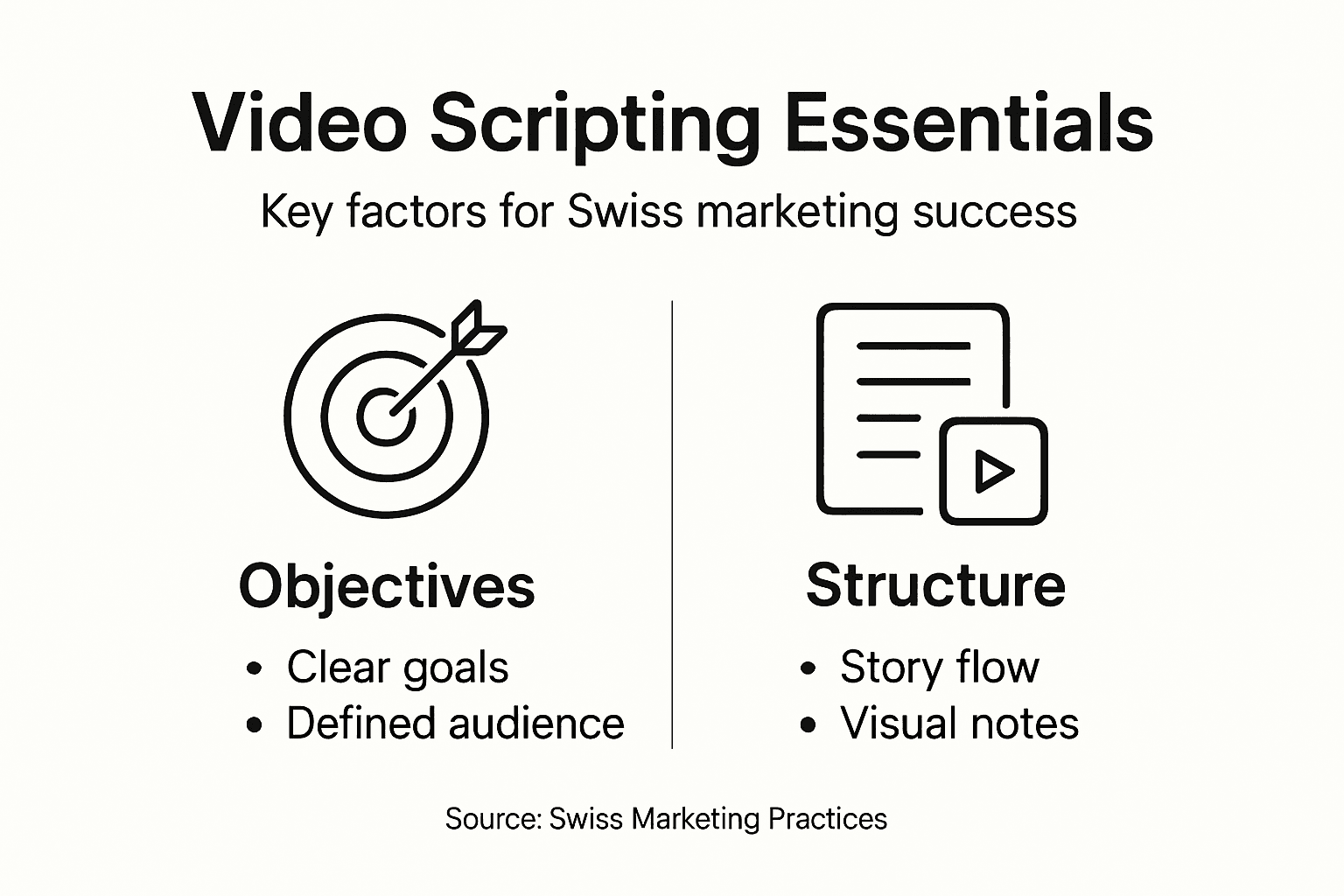
Writing a script that actually works requires more than sitting down and typing dialogue. You need a strategic approach that balances clarity, engagement, and production practicality. The foundation starts with defining your video objective before you write a single word. Ask yourself what you want viewers to do after watching your video. Should they schedule a consultation? Understand a new process? Feel motivated about your company culture? Your objective shapes everything that follows, from tone to pacing to the specific language you choose. Without this clarity, scripts meander and fail to deliver results.
Once you know your objective, focus on understanding your exact audience. Swiss corporate audiences expect professionalism and efficiency. They have limited attention spans and appreciate directness. Keeping scripts concise and engaging through clear planning means respecting their time by removing fluff and avoiding generic corporate jargon that sounds hollow. Use conversational language that feels natural when spoken aloud. Write short, punchy sentences rather than complex structures that require repeated listening to comprehend. Avoid humor that might age poorly or distract from your core message. Avoid clichés that signal you have not put thought into what makes your company distinct. Your script should sound like a smart colleague explaining something important, not like a robot reading from a manual.
Another critical element involves visual planning within your script. Your words exist only to complement what viewers see on screen. If your script describes an action, your camera and editing must show that action. If you mention a statistic, graphics should visualize it. Too many scripts ignore this relationship and result in talking heads who recite facts while nothing on screen reinforces those facts. As you write, constantly ask: what visual would prove this point? This approach to scripting creates coherence between what audiences hear and what they see.
Structure matters significantly. Storytelling in video production transforms corporate messaging from bland announcements into narratives that stick with viewers. Begin with a hook that captures attention within the first three seconds. Build tension or curiosity. Introduce your solution or key message. End with a clear call to action or takeaway. This three act structure works because human brains are wired to follow stories. Finally, always read your script aloud before production begins. Hearing the words reveals awkward phrasing, unintended repetition, and pacing issues that your eyes miss on the page. Production teams appreciate scripts that flow naturally when performed, and your actors will thank you for writing lines that sound like actual human speech.
Pro tip: Record yourself reading your draft script aloud, then listen back with fresh ears the next day, noting any phrases that sound unnatural or sentences that need breaking into shorter chunks for better delivery.
Legal and Compliance Issues in Switzerland
When you produce marketing videos in Switzerland, you operate within a specific legal framework that shapes what you can and cannot say on screen. Understanding these regulations is not optional. Violating Swiss advertising law can result in fines, forced content removal, or legal action against your company. The good news is that compliance is achievable when you understand the rules upfront and build them into your scripting process.
Swiss advertising law centers on the Federal Act against Unfair Competition (UCA), which governs all marketing and advertising activities within the country. The UCA regulates transparency and prohibits misleading claims in marketing content. This means your video scripts cannot make exaggerated product claims, hide material information, or mislead viewers about pricing, performance, or product features. If you claim your software increases productivity by 300 percent, you must have substantiated evidence backing that claim. Comparative advertising is permitted under Swiss law, but only when comparisons are factual and not designed to disparage competitors unfairly. Your scripts must avoid emotional manipulation tactics that exploit consumer vulnerabilities. The UCA applies whether you are running a 15-second social media ad or a 5-minute product demonstration video.
Beyond the UCA, Swiss regulations also address specific marketing channels. Email marketing campaigns require explicit consent from recipients. Telemarketing scripts cannot call private individuals without prior consent. Sweepstakes and contests mentioned in your videos must follow strict rules about prize disclosure and odds. Data protection laws require that any video collecting personal information from viewers comply with Swiss privacy standards. If you are marketing regulated products like pharmaceuticals, alcohol, or financial services, sector-specific restrictions apply that may limit what claims you can make in your script. For example, pharmaceutical marketing videos face stricter substantiation requirements than general consumer products.
Compliance enforcement involves multiple layers. Civil courts hear disputes when businesses believe competitors violated the UCA through deceptive advertising. Criminal authorities prosecute serious violations. Self-regulatory bodies like the Swiss Fair Competition Commission provide guidance and can sanction members for non-compliance. Your production partner should be familiar with these requirements, but ultimately, you as the marketing manager bear responsibility for ensuring your script content complies with Swiss law. Before finalizing your script, have legal counsel review claims about product benefits, comparative statements, and data collection practices. Building compliance into your scripting phase costs far less than managing legal consequences after your video launches.
Pro tip: Document the evidence supporting any performance claims in your video script before production begins, ensuring your legal team approves the substantiation level required under Swiss advertising standards.
Common Pitfalls and How to Avoid Them
You can have the best intentions and still produce a video that falls flat. Most scripting failures trace back to predictable mistakes that derail your messaging and waste your production budget. The encouraging part is that these pitfalls are entirely preventable when you recognize them early and adjust your approach accordingly.
The most damaging pitfall is skipping pre-production planning. Marketing managers sometimes feel pressure to move quickly, so they rush into shooting without a solid script, storyboard, or clear production timeline. This creates chaos on set. Crew members waste time debating what scenes to shoot, actors repeat takes because directions keep changing, and lighting setups take longer than anticipated. Detailed planning with storyboards and scripts prevents this entirely. Invest time upfront mapping out every scene, every camera angle, and every piece of dialogue. A well-developed script becomes your production roadmap that keeps everyone aligned. Your storyboard visualizes exactly what each scene should look like. This planning phase feels like extra work initially, but it compresses your actual production timeline and prevents costly reshoots.
Another frequent mistake involves underestimating audio quality. Managers sometimes obsess over visuals while treating audio as an afterthought. Bad audio destroys even visually beautiful videos. If viewers cannot hear dialogue clearly, they abandon the video. If background noise overwhelms the main message, your script fails to land. Invest in professional microphones rather than relying on camera audio. Use proper microphone placement techniques. Record in quiet environments or use soundproofing materials. Have someone dedicated to audio monitoring throughout your shoot. During post-production, work with an audio engineer to mix levels, remove noise, and ensure dialogue sits properly in the mix. Your script might be brilliant, but poor audio ensures nobody hears it properly.
Script related errors also stem from weak continuity management. If a character wears a blue tie in Scene 3 but a red tie in Scene 4, which was actually filmed first, viewers notice the inconsistency and lose trust in your content. Maintain detailed shot lists tracking actor positioning, clothing, props, and background elements between scenes. Assign someone as continuity manager during filming who documents exactly how each scene looks. If you need to shoot pickup scenes later, continuity documentation ensures consistency.
Many scripts also fail because they ignore composition principles during the scripting phase. Write your script considering how scenes will be framed. Will your talent be centered or positioned using the rule of thirds? Will background elements support or distract from your message? Poor framing makes scenes feel amateurish regardless of how strong your script is. As you write, visualize the frame and describe camera positioning that creates visual interest.
Below is a quick reference for common video scripting pitfalls and their potential business impacts:
Pitfall | Impact on Production | Impact on Messaging |
Skipping pre-planning | Delays, budget overruns | Unclear scenes, misalignment |
Poor audio planning | Ineffective communication | Viewers abandon video |
Weak continuity | Inconsistent visuals | Reduced viewer trust |
Ignoring composition | Amateur-looking results | Message loses professional tone |
Pro tip: Create a production checklist from your script that covers pre-production planning, audio requirements, continuity details, and composition notes so nothing gets overlooked during the shoot.
Elevate Your Swiss Marketing with Expert Video Scripting and Production
A well-crafted video script is essential for clear communication and efficient production, especially when targeting Swiss corporate audiences who value professionalism and precision. At Tulip Films, we understand the challenges marketing managers face, from creating persuasive promotional scripts to ensuring legal compliance under Swiss advertising regulations. Our personalized approach ensures every script aligns with your objectives while anticipating production needs to save you time and avoid costly mistakes.
Why settle for vague directions and rushed shoots? Choose a partner who values:
Detailed pre-production planning that honors your vision and timeline
High-quality audiovisual content that enhances your message with compelling visuals and clear audio
Compliance with Swiss marketing laws to safeguard your brand’s reputation
Ready to transform your video scripting challenges into seamless production success Ask us about our bespoke video production services designed specifically for Swiss businesses Visit Tulip Films to explore how we bring your story to life with precision and impact Book your free consultation now and start crafting a script that truly works for your marketing goals Learn more about the role of storytelling in video production and get professional guidance on resolving script and messaging problems in corporate films to ensure your next video delivers results
Frequently Asked Questions
What is the purpose of a video script in marketing?
A video script serves as a detailed blueprint that outlines dialogue, visuals, and technical directions, ensuring clarity and coherence in the production process while guiding the team to achieve the desired video goals.
How does specificity in scripting improve video quality?
Specificity in scripting provides clear directions regarding visuals, actions, and audio, which helps avoid confusion during production, minimizes revisions, and results in a higher quality final product.
What are the common types of video scripts used in corporate marketing?
Common types of video scripts include explainer scripts for product introductions, training scripts for employee education, testimonial scripts for building credibility, promotional scripts to drive conversions, and internal communication scripts for conveying messages to staff.
How can legal regulations impact video scripting?
Legal regulations, such as advertising laws, ensure that marketing videos do not include misleading claims or false information. Incorporating compliance into the scripting process helps prevent legal repercussions and ensures the content adheres to standards.
Recommended
