Why Video Swiss Digital Transformation Stories Win


TL;DR:
Swiss organizations are increasingly using video to strategically communicate transformation efforts, building trust and accelerating adoption. By embedding video into structured change frameworks, aligning with federal priorities, and focusing on operational intelligence, companies enhance stakeholder engagement and achieve measurable results. Prioritizing multilingual, owner-linked content and structured use cases maximizes video’s impact as an essential change management infrastructure.
Swiss business leaders are rethinking how they communicate transformation, and video is at the center of that shift. The question of why video drives Swiss digital transformation stories is not a marketing question. It is a strategic one. When organizations attempt complex, multi-year technology shifts, words in a slide deck rarely move people. Video does. It makes abstract change concrete, names the people behind the change, and gives stakeholders something they can actually trust and act on. This article explains why video storytelling has become one of the most underutilized yet high-impact tools in the Swiss transformation playbook.
Table of Contents
Key takeaways
Point | Details |
Video builds adoption, not just awareness | Transformation video works when it is tied to structured adoption mechanisms like named owners and training programs. |
Federal alignment strengthens narratives | Stories anchored in the Digital Switzerland Strategy 2026 earn more stakeholder trust and executive buy-in. |
Operational video creates real-time value | Beyond storytelling, video intelligence generates actionable data that improves safety, compliance, and efficiency. |
Swiss video investment is rising | 40% of teams plan to increase video spend in 2026, with engagement metrics replacing simple view counts. |
Multilingual video is a Swiss requirement | Serving German, French, and Italian audiences with localized video content is not optional in Switzerland. |
Why video swiss digital transformation stories matter now
Swiss organizations are operating under a specific and binding national framework. The Digital Switzerland Strategy 2026 sets the federal agenda, centering on three priorities: digital sovereignty, Switzerland’s role as a digital host state, and the introduction of the national e-ID. These are not aspirational goals. They carry regulatory weight and shape how public institutions, financial firms, and industrial companies justify transformation investments.
Here is what that means for video storytelling in practice:
Digital sovereignty requires organizations to explain complex infrastructure decisions to boards, regulators, and employees who are not technical. Video makes those decisions legible.
The digital host state theme positions Switzerland as a neutral, trusted steward of international data. Video that communicates your organization’s alignment with those values builds credibility with foreign partners and domestic regulators alike.
The e-ID rollout represents a transformation touchpoint affecting every citizen-facing service. Organizations launching e-ID integrations need internal alignment fast, and video is the fastest way to build it.
Responsible, sustainable transformation is a stated federal value. Video stories that show deliberate, phased decision-making signal exactly that kind of governance culture to stakeholders.
When your transformation narrative aligns with this strategy, it does more than tell a company story. It signals institutional maturity. Executives, boards, and regulators respond to that signal. Video is the medium that carries it most effectively.
The strategic role of video in change management
Most companies treat video as something they produce after a transformation milestone. Record a testimonial, post it on LinkedIn, move on. That model misses the real power of video in change management.
Consider how Swisscom approached the Früh Verpackungstechnik transformation. They did not produce a single polished video at the end of a project. They built a five-step playbook and embedded video throughout, featuring named transformation leaders at each stage. That choice was not aesthetic. It was strategic. Named leaders create accountability. They give employees someone to trust. They communicate that this transformation has real ownership, not just a project code.

The results were visible in how the organization moved. Früh Verpackungstechnik found that video accelerated decisions and helped build the agile culture the transformation required. Video made the milestones tangible. It showed what progress actually looked like rather than describing it in abstract terms.
There is a clear sequence that explains how video creates this effect:
Visualize the milestone. Show the actual system, the actual team, and the actual result. Concrete visuals replace vague claims.
Name the change leader. Put a person on camera who explains the decision and owns the outcome. This creates trust.
Distribute before the meeting. Send the video before a town hall or all-hands session so employees arrive with context, not confusion.
Translate it. In Switzerland, a German-only video excludes your Vaud and Ticino teams. Multilingual delivery is operational, not optional.
Pair it with a playbook. Video alone does not drive adoption. A named owner plus a training resource plus a video creates a system that sustains change.
Pro Tip: Feature at least one named change leader in every transformation video you produce. A recognized face with a title and a clear responsibility converts a company announcement into a credible commitment.
For Swiss businesses looking to understand what makes this approach effective in practice, exploring visual storytelling best practices for corporate contexts offers a solid foundation.
Operational video as a strategic data source
Storytelling in digital transformation is only one dimension of video’s value. The other dimension is operational, and it is growing fast.
Axis Communications has documented how companies in logistics and industrial sectors are shifting from retrospective video review to proactive, real-time video intelligence. The distinction matters enormously. A camera that records what happened is a record-keeping tool. A camera that generates continuous, actionable data streams is a transformation asset.
Retrospective video use | Proactive video intelligence |
Reviews incidents after they occur | Detects anomalies as they happen |
Used for compliance documentation | Drives real-time safety interventions |
Passive infrastructure asset | Active data source integrated with operations |
Evaluated monthly or quarterly | Assessed continuously with automated alerts |
The business outcomes from this shift are measurable. Companies using video intelligence in their logistics operations report improvements in health and safety compliance, reductions in incident response time, and better customer experience through faster issue resolution. Axis Communications emphasizes that the case executives want to see is not about camera installation. It is about the impact on operational decisions and outcomes: how many incidents were prevented, how much time was saved, how much risk was reduced.
This reframes the conversation for Swiss industrial leaders. If you are managing a warehouse, a pharmaceutical supply chain, or a manufacturing floor, video is not a security cost. It is a transformation investment with trackable returns.
Pro Tip: When building the business case for operational video, lead with the decision it changes, not the technology it deploys. Show an executive what a specific intervention prevented, not what resolution the camera captures.
Data-driven benchmarks for video investment
The numbers behind video investment are shifting in a direction that Swiss leaders should pay attention to. Wistia’s 2026 State of Video report, cited by HubSpot, shows that 40% of video teams plan to increase their budgets this year. Engagement metrics, particularly for webinars and educational content, are growing in priority as organizations move past raw view counts toward measuring actual learning and behavior change.
For Swiss businesses, the budget reality is specific. Video production costs in Switzerland traditionally range from CHF 3,000 to CHF 10,000 per video per language. For a three-language organization covering German, French, and Italian, that math compounds quickly. This is not a reason to avoid video. It is a reason to prioritize use cases carefully and produce content that earns a durable return.
The highest-return video categories for transformation contexts include:
Executive communications explaining strategic direction and key decisions
Employee onboarding and change adoption videos tied to specific tools or workflows
Milestone documentaries that record what a transformation achieved and how
Webinar recordings repurposed into shorter, chapter-based learning assets
Customer-facing videos that demonstrate new digital capabilities or service changes
The pattern that Swiss video engagement research consistently supports is clear: short, specific videos tied to a defined behavior change outperform long, comprehensive ones. A three-minute video explaining exactly how employees submit a request through a new ERP system will be watched. A twenty-minute overview of the full transformation project will not.
Practical guidance for Swiss leaders
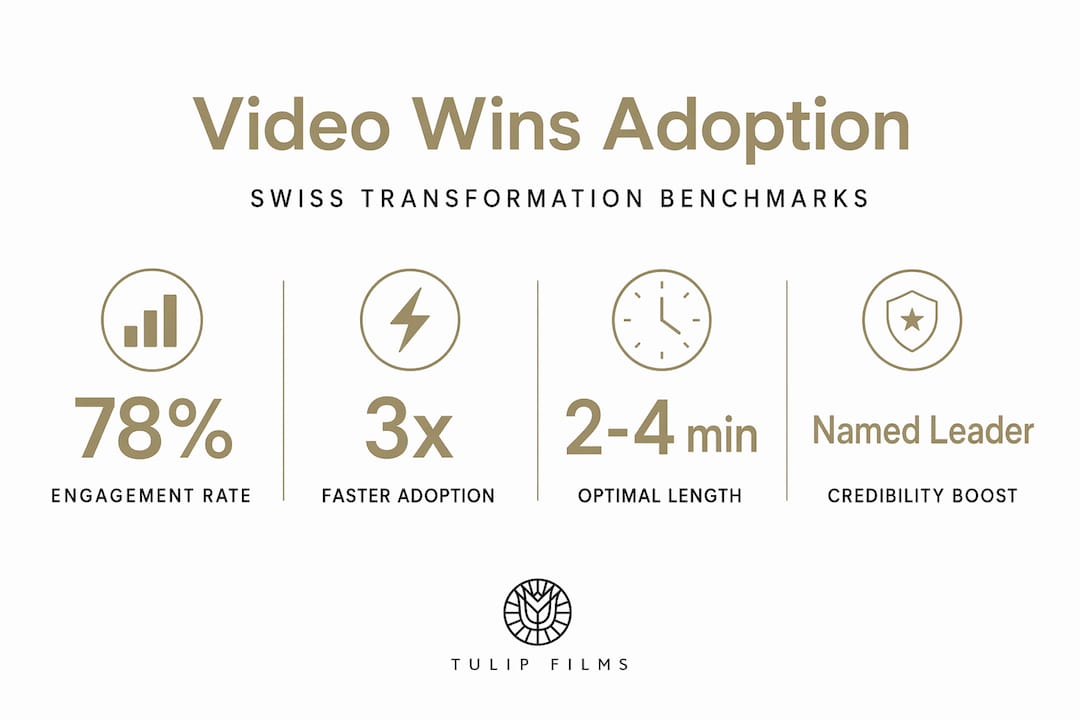
Getting video right in a Swiss transformation context requires a few decisions that most frameworks overlook.
Start with a repeatable use case, not a flagship production. SwissCaution’s approach to digital adoption demonstrates this clearly. Their strategy focused on concrete pilots first, scaling only after proving the model, with video stories reflecting that step-by-step learning rather than projecting an ambitious end state. That approach builds organizational confidence. It also gives you content that evolves as your transformation evolves.
Embed adoption mechanisms into the video itself. A video that ends with “for more information, contact HR” has already lost its audience. Instead, direct viewers to a specific training module, a named contact with a direct email, or a short playbook. Swiss companies that combine video with structured adoption tools see higher confidence and faster adoption than those treating video as standalone communication.
Address linguistic diversity as a strategic priority, not a post-production task. Script your content with multilingual delivery in mind from the start. A video conceived in German and then translated often reads as an afterthought to French-speaking audiences in Romandy. That perception undermines exactly the trust you are trying to build.
Finally, link your video to a visible owner. Not a brand. Not a department. A person with a name, a role, and an accountable message. That single decision changes how your audience receives the video entirely.
My take: video is an adoption tool, not a content category
I have worked with Swiss organizations that produce genuinely good videos and still wonder why adoption rates on their transformation programs remain low. The pattern I have seen most often is that they treat video as the end of a communication process rather than the beginning of an adoption process.
The uncomfortable truth is that a well-produced transformation video changes nothing on its own. What changes behavior is video embedded inside a system. A named owner. A training path. A follow-up mechanism. When I look at the Swisscom and Früh Verpackungstechnik example, the video was not the strategy. It was the accelerant inside a broader change framework.
What I have also learned is that alignment with Switzerland’s federal digital priorities is not just a talking point. Organizations that explicitly connect their transformation narrative to digital sovereignty or the e-ID framework find that stakeholders at every level engage more seriously with the content. That alignment communicates institutional credibility. It says we are not doing this for competitive reasons alone. We are doing it because it is the right direction for the country and for our organization.
If I could give Swiss leaders one reframe, it is this: stop thinking of video as content you produce and start thinking of it as infrastructure you deploy. The ROI looks very different from that perspective.
— Pieter
How Tulipfilms helps Swiss businesses tell transformation stories
For business leaders ready to act on what this article covers, the gap between strategy and execution usually comes down to production quality and multilingual capability. Tulipfilms addresses both directly.
[
Tulipfilms is a Swiss-based video production company with a corporate and brand video portfolio built specifically for organizations navigating digital transformation communication. The team works in multiple languages, designs production schedules that fit organizational timelines, and focuses on what executives actually need: video that moves stakeholders, builds trust, and documents measurable progress. Whether you need a CEO message tied to your e-ID rollout, a milestone documentary for your board, or a series of employee-facing adoption videos, Tulipfilms brings both the production craft and the strategic understanding of the Swiss market. Explore video production pricing and packages or book a free consultation to discuss your specific transformation narrative.
FAQ
Why is video more effective than text for transformation communication?
Video communicates context, emotion, and credibility simultaneously. A named leader explaining a change on camera builds more trust than the same message written in a memo, because viewers can assess tone, commitment, and clarity in real time.
How does video support digital transformation adoption in Swiss companies?
Swiss companies like Swisscom pair video with structured playbooks and named transformation owners, creating a system where video acts as the entry point to a broader adoption process rather than a standalone announcement.
What does the Digital Switzerland Strategy 2026 mean for video storytelling?
The Digital Switzerland Strategy 2026 focuses on digital sovereignty, e-ID, and responsible transformation. Organizations that align their video narratives with these priorities earn stronger stakeholder trust from regulators, partners, and employees.
How much should Swiss businesses budget for transformation video?
Traditional Swiss video production costs range from CHF 3,000 to CHF 10,000 per video per language. Prioritize high-frequency, high-impact use cases first and scale incrementally to manage costs while maximizing adoption impact.
What makes an operational video story credible to executives?
Effective operational video storytelling focuses on the decisions that video intelligence enabled and the measurable outcomes that followed, such as incident reduction or compliance improvement, rather than on the technology itself.
Recommended
