How corporate rebranding videos transform Swiss brands


TL;DR:
Effective corporate rebranding videos serve as strategic tools to align organizations, reassure stakeholders, and showcase genuine evolution beyond surface appearances.
They follow a narrative arc, combining transparency, visual identity, and authentic voices to communicate the “why,” “what,” and “future” of the rebrand, fostering emotional connection and internal consistency.
Corporate rebranding videos are frequently dismissed as expensive marketing exercises or surface-level visual refreshes. That assumption is wrong, and it costs companies real money. A well-executed rebranding video is a strategic tool, not a marketing splash that can realign entire organizations, win back wavering customers, and signal genuine evolution to partners and media alike. For marketing managers and brand strategists at Swiss corporations, understanding what separates a powerful rebranding video from a forgettable one is not just useful knowledge. It is a competitive advantage that shapes how your market perceives every move you make going forward.
Table of Contents
Key Takeaways
Point | Details |
Strategic video impact | Corporate rebranding videos drive alignment and engagement when linked to clear brand strategy. |
Avoid common pitfalls | Successful videos connect new identity to heritage and customer needs, not just visuals. |
Structure matters | The narrative should transparently communicate the why, how, and what’s next of the rebrand. |
Plan before launching | Rapid production is possible, but only succeeds with well-defined strategy and disciplined messaging. |
Defining a corporate rebranding video
Not every company video qualifies as a rebranding video. A promotional clip, a product launch, or a culture video all serve narrow purposes. A rebranding video is something broader and more consequential.
“A corporate rebranding video is a strategic video production used to announce and explain a company’s rebranding efforts, signaling change in identity, vision, and market position.”
In practical terms, this means the video must accomplish several things simultaneously. It needs to explain the “why” behind the change, not just showcase new colors or a redesigned logo. It needs to speak to internal teams who may feel uncertain, external customers who need reassurance, and prospective partners who are watching to see whether the shift reflects genuine leadership or corporate window dressing.
Understanding the role of video in brand identity helps clarify why this medium outperforms written announcements or static visuals. Video combines voice, image, music, and pacing in a way that text simply cannot replicate. It creates emotional resonance quickly and holds attention across multiple audience types at once.
The core components of an effective rebranding video typically include:
Mission statement: Why the company exists and how that mission has evolved
Vision: Where the brand is heading and what it will stand for in three to five years
Visual identity: A careful reveal of new logos, color systems, and tone of voice
Customer value: A clear articulation of what this change means for the people you serve
Rationale: An honest explanation of why the change was necessary
What distinguishes a rebranding video from a standard company video is the combination of transparency and strategic communication. You are not selling a product. You are inviting audiences into a story of transformation and asking them to trust the direction.
Why corporate rebranding videos matter: Key benefits
With a working definition in place, it is worth examining why Swiss corporations are increasingly treating rebranding videos as mission-critical investments rather than optional marketing add-ons.
The most obvious advantage is speed. Video communicates complex emotional and strategic ideas faster than any written medium. A 90-second rebranding video can convey heritage, ambition, and cultural shift in a way that a 10-page brand manifesto rarely achieves. That speed matters enormously in fast-moving competitive markets where attention is scarce.
Beyond speed, the emotional dimension of video is irreplaceable. Research consistently shows that audiences retain emotionally resonant content significantly longer than neutral information. When your employees and customers feel something watching your rebranding video, the message sticks.
Internal alignment is another underrated benefit. When a Swiss corporation goes through a rebrand, leadership, middle management, frontline employees, and external partners often receive inconsistent information. A well-crafted rebranding video puts everyone on the same page simultaneously, reducing rumors, resistance, and confusion. This single-message distribution is extraordinarily valuable for large organizations with dispersed teams.
However, the benefits only materialize under specific conditions. As marketing strategist Mark Ritson has argued, videos amplify success if strategy-led, but risk backlash if identity-first without customer anchors. In other words, a beautiful rebranding video built on weak strategic foundations can actually accelerate a brand’s decline. The video amplifies whatever is already true about the rebrand, good or bad.
Companies with strong, research-driven brand narratives see measurable results. Understanding how video in brand building creates compounding returns over time helps explain why leading Swiss corporations are budgeting for this capability even during cost-constrained periods.
Key benefits at a glance:
Faster emotional communication than written formats
Simultaneous alignment of internal and external audiences
Consistent messaging across geographies and departments
Builds credibility with media, investors, and partners
Increases retention of brand change messaging
Pro Tip: Before you brief a production team, map out all your audience segments explicitly. The rebranding video that works for your leadership team may need a slightly different cut for frontline employees and an entirely different version for external media. Planning these variations early reduces production costs significantly.
The brand video creation process works best when audience segmentation informs the storytelling structure from the very first script draft, not as an afterthought.
Inside the corporate rebranding video: Elements and narrative structure
Understanding why these videos matter is only half the equation. The other half is knowing exactly what to put inside them and in what order.
The most effective rebranding videos follow a recognizable narrative arc that balances honesty about the past with excitement about the future. Here is the sequence that works consistently:
Open with context: Acknowledge where the company has been. Heritage is not a burden; it is credibility. Start by honoring what the brand has built before explaining why evolution is necessary.
Introduce the catalyst: What changed in the market, in customer expectations, or in the company’s own thinking? Name it honestly rather than hiding behind vague language about “growth” or “opportunity.”
Reveal the new identity: Introduce visual changes, including logo, color palette, and tone. This should feel earned, not sudden. By the time viewers see the new logo, they should already understand why it exists.
Show the human element: Feature leadership voices, employee perspectives, and if possible, genuine customer reactions. These voices add authenticity that no narrator alone can provide.
State the future promise: Close with a clear articulation of what the brand stands for going forward and what viewers can expect from the relationship.
Call to action: Tell audiences what to do next, whether that means visiting a new website, attending an event, or simply following along.
Element | Purpose | Common mistake |
Heritage acknowledgment | Builds credibility and continuity | Skipping it entirely |
Change catalyst | Provides honest rationale | Using vague corporate language |
Visual reveal | Shows new identity | Revealing too early without context |
Human voices | Creates authenticity | Using only executive narration |
Future promise | Inspires confidence | Making it abstract or unmeasurable |
Call to action | Directs next steps | Leaving audiences with no clear path |
The importance of narrative integrity cannot be overstated. When Jaguar launched its rebranding video, the backlash stemmed from erasing heritage and disconnecting the new identity from any product reality, leaving audiences confused rather than inspired. The visual execution was bold, but the narrative was hollow. That combination is dangerous.
Effective video storytelling in branding requires every visual choice to reinforce the narrative, not compete with it. Colors, music tempo, voiceover tone, and on-screen text should all point in the same direction emotionally.
Pro Tip: Write your rebranding video script before you brief the creative team on visual concepts. When story comes first, visuals serve it naturally. When visuals come first, the story often gets retrofitted, and audiences can feel the disconnect.
Reviewing an effective video storytelling guide before entering pre-production can save weeks of revision and prevent the most common structural errors. And if you want to apply these principles directly to Swiss market expectations, exploring branding with video step by step provides locally grounded frameworks that account for Swiss audience sensibilities and business culture.
Common pitfalls and best practices for Swiss corporations
Having explored video structure, it is equally important to understand where Swiss corporations consistently go wrong and how to avoid these mistakes before they become expensive problems.
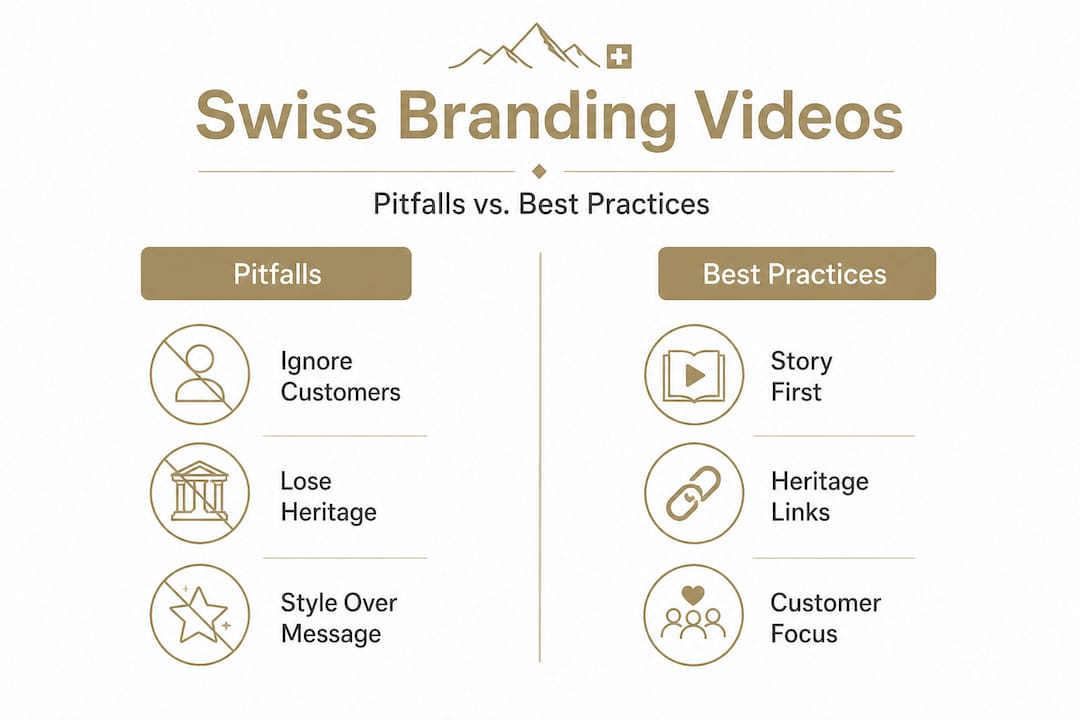
Pitfall 1: Ignoring customer perspective
The most damaging rebranding videos are those built entirely from the inside out. Leadership decides on a new direction, the marketing team produces a video, and customers receive it without any connection to their own experience or needs. This is the pattern that triggers backlash. Research shows that rapid rebrands can succeed in as little as 11 days with clear direction, but identity-first videos without customer anchors consistently create confusion.

Pitfall 2: Abandoning heritage without explanation
Swiss corporations often carry significant legacy value. A brand that has operated for 50 years in financial services or manufacturing has accumulated trust that deserves respect in any rebranding communication. Erasing that heritage without acknowledging it signals to long-term stakeholders that their loyalty was not valued.
Pitfall 3: Prioritizing aesthetic over message
A visually stunning video with no clear strategic message is marketing noise. Beauty does not compensate for confusion. Every visual choice must support the central story.
Best practices that consistently produce results:
Ground the video in customer research. Survey customers, review feedback, and understand what the brand currently means to them before deciding what it should mean.
Include genuine leadership narration. A CEO or senior leader speaking candidly carries far more authority than a professional voice actor reading a script.
Show the new identity in context. Rather than revealing a new logo in isolation, show it living in the real world: on packaging, on signage, in digital environments.
Plan distribution before production. Decide how the video will reach employees, customers, partners, and media before you finalize the script. Distribution context shapes messaging priorities.
Test with a small internal audience first. Before releasing publicly, screen the video with a diverse internal group and gather honest reactions. This low-cost step has prevented costly public missteps for many brands.
Approach | Outcome |
Customer-anchored strategy | Higher retention, positive reception |
Identity-first without research | Confusion, backlash, media criticism |
Heritage-inclusive narrative | Trust maintained across audiences |
Visual-only, no story | Short-term attention, no lasting impact |
Leadership voices included | Authenticity, internal alignment |
Understanding strong storytelling in branding practices helps Swiss corporations move from surface-level production to strategic communication. And exploring proven branding video ideas can spark the kind of creative thinking that makes a rebranding video genuinely memorable rather than merely professional.
What most experts miss about corporate rebranding videos
Most advice about rebranding videos follows a predictable checklist format. Include leadership. Show the new logo. Explain the vision. These are correct but incomplete. The real reason most rebranding videos underperform is not that they miss a checklist item. It is that they treat the video as a delivery mechanism rather than a conversation starter.
A rebranding video is not a press release with moving images. It is an invitation to join a new chapter. When Swiss corporations produce these videos as one-way broadcasts, they miss the most powerful outcome available to them: genuine two-way engagement. The best rebranding videos generate questions, discussions, and responses. They create openings for leadership to connect directly with employees and customers. They spark dialogue rather than close it.
As Mark Ritson consistently argues, most rebrands are “expensive nonsense” unless grounded in strategy and genuine market research. The video component of a rebrand inherits this problem and magnifies it. A strategy-weak rebrand captured on film is simply a more expensive version of the original mistake.
What we see at Tulip Films is that the strongest outcomes come when clients treat the video production process as a strategic interrogation. The questions a good production team asks during briefing, such as why this change, why now, and what does your audience actually think, often surface assumptions that need to be challenged before the camera rolls.
Swiss corporations should use the rebranding video process itself as a diagnostic tool. If your team cannot articulate a clear, honest answer to “why are we rebranding?” in language that customers would recognize and respect, the video will not save you. Strategy comes first, always.
Understanding the full video in corporate branding landscape means accepting that production quality matters far less than strategic clarity. A well-filmed video built on a confused brief will underperform a modestly produced video built on honest, research-backed messaging every single time.
Start your corporate rebranding journey with expert video production
Knowing the theory is valuable. Translating it into a video that actually moves your audiences requires experienced hands and a proven process.
[

At Tulip Films, we work with Swiss corporations at every stage of the rebranding video process, from initial strategy briefings through scripting, production, and final distribution planning. Our corporate video production portfolio showcases the range of rebranding and brand-building projects we have delivered across Swiss industries, giving you a concrete sense of what is possible within your timeline and budget. If you are ready to explore what a strategy-driven rebranding video could do for your organization, our video production services include a free initial consultation designed to clarify your needs before any commitment is made. The conversation costs nothing. The clarity it provides is genuinely valuable.
Frequently asked questions
What makes a corporate rebranding video different from a standard company video?
A corporate rebranding video specifically announces brand identity changes to align internal teams and engage external audiences, while standard company videos typically serve narrower promotional or informational purposes.
How fast can a corporate rebranding video be produced?
With clear strategic direction, production timelines can be as short as 11 days for rapid rebrands, though most projects benefit from longer timelines that allow for thorough audience research and stakeholder input.
What should Swiss corporations avoid when creating a rebranding video?
Avoid erasing brand heritage without explanation and disconnecting the new identity from products or customer realities, as Jaguar’s video backlash demonstrated clearly.
Are rebranding videos only for external audiences?
No. These videos are equally critical for internal audiences, helping leadership and employees align behind the new vision and reducing uncertainty during periods of change.
Recommended
