What is brand engagement? Strategies for Swiss marketers


TL;DR:
Brand engagement is the deeper emotional, cognitive, and behavioral connection between a brand and its audience, not just simple awareness. Swiss brands need authentic storytelling, internal alignment, and multilingual local relevance to build trust and sustainable relationships through video content. Effective measurement involves nuanced metrics like engagement rate, sentiment, and business impact, emphasizing quality over vanity metrics.
Swiss brands collectively spend billions of francs on digital marketing every year, yet many struggle to move their audiences beyond a passive scroll. Brand engagement is the strength and depth of the relationship between a brand and its audiences, and that definition alone should give marketers pause. Awareness campaigns get impressions; engagement campaigns get relationships. This guide clarifies exactly what brand engagement means, separates it from common misconceptions, and gives you a concrete video-led playbook designed specifically for the Swiss market in 2026.
Table of Contents
Key Takeaways
Point | Details |
Brand engagement runs deep | It’s about emotional, cognitive, and behavioral relationships that build loyalty and advocacy. |
Meaningful metrics matter | Track engagement rates, sentiment, and business results instead of relying on surface-level numbers. |
Swiss audiences prefer authenticity | Localized, mobile-first, and multilingual video content delivers the highest engagement in Switzerland. |
Internal alignment is vital | Employees who live the brand create trust and fuel stronger external engagement. |
Video content powers action | Video drives higher engagement and conversion—choose the right format for your marketing goals. |
Defining brand engagement: Beyond awareness
Many confuse brand engagement with simple awareness. Let’s get precise about what it really means.
Recognition means someone can name your brand when prompted. Engagement means they feel something about it, act on it, and come back for more. Those are fundamentally different outcomes, and they require fundamentally different strategies.
Brand engagement encompasses emotional, cognitive, and behavioral connections between a brand and its audiences. Emotionally, people feel aligned with your values. Cognitively, they understand and believe in what you stand for. Behaviorally, they interact, advocate, and return. Miss any one of those three pillars and your engagement numbers will always feel hollow.
Brand engagement operates across external and internal dimensions and is built through consistent experiences across every touchpoint. External engagement involves customers, prospects, and the wider public. Internal engagement involves your employees, sales teams, and stakeholders. Both matter equally. A customer-facing campaign built on a foundation of disengaged employees will underperform every time.
Key components of a strong brand engagement foundation include:
Emotional resonance: Your content makes people feel something genuine, not just informed.
Consistent messaging: Your tone, visuals, and values stay coherent across social, web, and support channels.
Multilingual accessibility: In Switzerland, brands that communicate in German, French, Italian, and Romansh signal real respect for their audiences.
Authentic storytelling: Audiences in Switzerland are skeptical of polished corporate speak. Real stories outperform scripted narratives.
“Engagement is not a transaction. It is an ongoing relationship that compounds over time when nurtured consistently.”
The role of video in brand building is particularly powerful here, because video combines emotional, cognitive, and behavioral triggers in a single format. A well-crafted 60-second video can do what three pages of copy cannot: make someone feel something and remember it.
Brand engagement metrics: What really matters
Once you understand what brand engagement is, the next challenge is knowing how to measure it effectively.
The temptation is to grab the easiest number available, usually impressions or follower count, and call it a day. That shortcut misleads more than it informs. The metrics that actually reflect engagement are more nuanced and, frankly, more useful for budget decisions.
Key metrics include engagement rate, mentions, interactions, reach, sentiment, NPS, share of voice, and business impacts like repeat purchases and CLV. Each one tells a different part of the story. Engagement rate (ER) measures interaction divided by reach or followers. Net Promoter Score (NPS) measures how likely someone is to recommend you. Customer Lifetime Value (CLV) connects engagement directly to revenue.

Here is how the major platforms compare in 2026:
Platform | Median engagement rate | Video performance boost |
TikTok | 4.25% | Very high |
2.8% to 2.94% | High | |
0.48% to 2% | Moderate to high | |
0.15% to 1.4% | Moderate | |
X (Twitter) | 0.12% to 1.11% | Low to moderate |
According to 2026 social media benchmarks, TikTok leads at a median of 4.25%, while Instagram sits between 0.48% and 2% depending on account size and content type. Video consistently drives higher engagement rates across every platform listed.
Statistic to note: Nano-influencers (accounts with 1,000 to 10,000 followers) regularly achieve engagement rates between 3% and 7%, while mega-influencers with millions of followers often fall below 2%. Bigger audiences dilute the signal.
Pro Tip: Track at least three metric categories simultaneously: interaction metrics (ER, comments, shares), perception metrics (NPS, sentiment analysis), and business metrics (repeat purchases, CLV). Any single metric viewed alone will give you a distorted picture.
Vanity metrics like raw impressions are not worthless, but they should never stand alone. Use them as a reach indicator, not an engagement indicator. If your impression count rises but your ER drops, you are reaching more people who care less. That is the opposite of progress.
To learn how to specifically boost engagement in brand videos, it helps to diagnose which part of your content funnel is losing people before investing in more production.
Brand vs. customer engagement: Understanding the nuances
It’s easy to mix up brand and customer engagement, but the distinction is critical for impactful campaigns.
Think of brand engagement as the why and customer engagement as the what. Brand engagement lives in values, identity, and emotional alignment. Customer engagement lives in actions: clicking, purchasing, reviewing, and referring. Both are valuable, but they require different tactics and different measurements.
Brand engagement is emotional and psychological, while customer engagement is behavioral. C-suites across Switzerland increasingly demand proof for engagement efforts, which means brand marketers must translate emotional outcomes into business language. “People love us” is not a budget justification. “Our NPS increased 12 points and repeat purchases rose 18%” is.
Practical distinctions to keep in mind:
Brand engagement indicators: Sentiment scores, brand affinity surveys, employee advocacy rates, organic social mentions.
Customer engagement indicators: Email open rates, purchase frequency, app session length, review volume.
Where they overlap: A loyal customer who also shares your values and advocates for you unprompted sits at the intersection of both.
“Winning at brand engagement without internal alignment is like building on sand. Eventually the foundation shifts.”
High follower counts can actually dilute ER, and internal misalignment can undermine external trust just as quickly. If your marketing team promises one thing and your customer service team delivers another, no amount of clever video content will save your engagement numbers.
Pro Tip: Map your audience journey and identify whether you have a brand problem (people don’t connect with your values) or a customer problem (people don’t take action). The solution to each looks very different in a video brief.
Understanding why video boosts engagement across both dimensions helps clarify why video production should sit at the center of your 2026 engagement strategy. It is the only format that simultaneously communicates values (brand) and drives action (customer) at scale.
Top strategies to enhance brand engagement with video in Switzerland
Translating engagement theory into Swiss-market impact requires the right strategies, especially with video.
Switzerland presents unique conditions for brand engagement. You are operating across at least two language communities in most campaigns, with audiences that value precision, authenticity, and local relevance above flash. Generic international campaigns often underperform here because they miss those signals entirely.
Here are the most effective strategies for Swiss marketers in 2026:
Listen before you broadcast. Use social monitoring tools to track mentions, sentiment shifts, and audience questions in German, French, and Italian. Effective methodologies start with listening, responding to mentions, and understanding what your audience actually wants before you produce content.
Prioritize short-form video for awareness. A 15 to 30-second video on TikTok or Instagram Reels introduces your brand to new audiences quickly. Keep it visually tight, caption it in the relevant language, and make the first two seconds non-negotiable in terms of visual hook.
Use long-form video for conversion. Once someone knows who you are, a 2 to 5-minute brand documentary or product explanation video deepens the relationship and drives intent. Short-form excels at awareness; long-form drives conversion. Both have essential roles in your content mix.
Incorporate user-generated content (UGC). Encourage real customers to share their experiences with your brand on video. UGC performs credibly because it is unfiltered, and Swiss audiences respond to that honesty.
Run polls and interactive formats. Instagram Stories polls, LinkedIn question posts, and YouTube community tabs turn passive viewers into active participants.
Personalize with first-party data and AI. Use what you know about your audience segments to tailor video thumbnails, captions, and even video cuts to specific communities within Switzerland.
Localize linguistically and culturally. A video that works beautifully in Zurich may feel tone-deaf in Geneva. Invest in proper multilingual localization, not just subtitles.
Video type | Primary goal | Ideal length | Best platform |
Short social clip | Awareness | 15 to 30 seconds | TikTok, Instagram Reels |
Brand story video | Emotional connection | 90 to 180 seconds | YouTube, LinkedIn |
Product explainer | Consideration | 2 to 4 minutes | Website, YouTube |
Testimonial video | Trust building | 60 to 120 seconds | LinkedIn, website |
Event recap | Community building | 2 to 5 minutes | All platforms |
Pro Tip: Don’t produce all video formats at once. Start with one short-form awareness video and one deeper brand story video. Measure which drives more meaningful engagement (comments, shares, DMs), then invest further in the format that earns real responses.
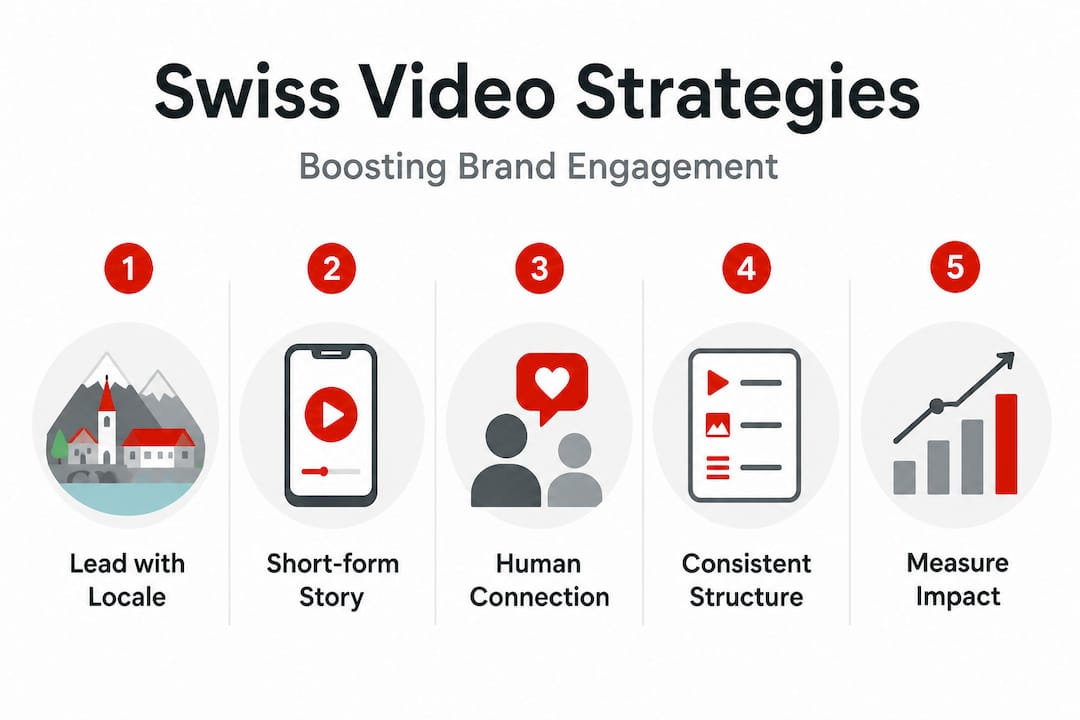
For tips on engaging video content built specifically for Swiss brands, the key is to lead with locale. Open with a recognizable Swiss context, a mountain backdrop, a Geneva street, a Basel market, and your audience immediately leans in. Pair that with brand connection through video techniques that anchor your story in human moments rather than product features.
Strong video storytelling follows a consistent structure: a relatable problem, a human protagonist, a turning point enabled by your brand, and an honest resolution. That arc works across every industry and every Swiss language region.
The uncomfortable truth: Why brand engagement is earned, not engineered
Now that tactical advice is laid out, it’s important to reflect on what really drives brand engagement at its core.
We see it regularly. A Swiss brand invests in a slick video campaign, follows every trending tactic, posts on schedule across five platforms, and still ends up with flat engagement numbers and confused leadership. The instinct is to blame the algorithm. The real issue is usually internal.
Internal alignment is as important as external tactics, and misaligned employees erode external trust faster than any bad ad campaign ever could. Your customer service team, your salespeople, your operations staff, all of them are brand ambassadors whether you’ve trained them that way or not. When internal culture contradicts external messaging, audiences feel it even if they can’t name exactly why.
Here is what we’ve observed consistently in the Swiss market: copy-paste engagement tactics lifted from American or UK playbooks tend to backfire. Swiss audiences are not more difficult. They are more discerning. They notice when a brand is performing engagement rather than living it. A campaign that shouts “we care about sustainability” while your supply chain tells a different story will be called out, quietly and decisively, through declining NPS scores and disappearing repeat customers.
The brands that build genuinely strong engagement over time share one thing: they start from the inside. They define their values clearly, communicate those values to their own teams first, and then let their video content be a reflection of something real rather than an aspiration for something they haven’t yet become.
Authentic storytelling is not a content format. It is a commitment. A founder who speaks honestly on camera about a company setback will generate more lasting trust than a thousand polished product videos. That kind of client engagement through video does not happen by accident. It happens when brands are brave enough to show their human side.
The goal is not spikes in weekly metrics. The goal is compounding trust that translates into advocacy, loyalty, and sustainable growth over years. That kind of engagement cannot be engineered. It has to be earned, one honest story at a time.
Take your brand’s engagement further with Swiss video expertise
If your next step is to put these strategies into practice with a trusted Swiss partner, here’s where to start.
Understanding the theory of brand engagement is one thing. Translating it into video content that actually moves Swiss audiences is another challenge entirely, and it’s where strategy meets craft.
[

Tulip Films specializes in exactly that intersection. As a Swiss-based video production company, we build content around your brand’s real story, your voice, your market, your language communities. Whether you need short-form social content, a brand documentary, or a full suite of multilingual campaign videos, you can explore the full range of completed projects in the Tulip Films video portfolio. Transparent video production pricing makes it easy to plan your investment without surprises. Book a free consultation and bring your brand’s engagement strategy to life.
Frequently asked questions
What is the difference between brand engagement and customer engagement?
Brand engagement is about emotional and psychological connection with your brand’s values and identity, while customer engagement centers on explicit behavioral actions like purchases, reviews, and referrals. Brand is emotional; customer is behavioral, and both dimensions need dedicated measurement.
What is a healthy engagement rate for Swiss brands on social media in 2026?
A rate between 1% and 5% is a solid benchmark across most platforms, with TikTok at 4.25% and LinkedIn around 2.9% sitting at the higher end. Video formats consistently outperform static image posts on every platform.
How can Swiss brands increase brand engagement through video content?
Focus on authentic, multilingual, mobile-first video that reflects real Swiss contexts and stories. Use short-form video for awareness and longer storytelling formats for deepening connection and driving conversion.
Why do high-follower accounts often have lower engagement rates?
As follower counts grow, the percentage of followers who interact with any given post naturally shrinks. Higher follower count dilutes ER, which is why nano-influencers with 1,000 to 10,000 followers regularly outperform mega-accounts in terms of meaningful interaction.
Are vanity metrics like impressions still valuable for assessing brand engagement?
Impressions signal reach but tell you nothing about depth of connection. Always combine impressions with NPS and sentiment analysis to get an accurate picture of whether your content is building real relationships or just filling feeds.
Recommended
