How to script a promotional video: 35% better engagement


You pour budget into promotional videos, but they fall flat. Your message gets lost, viewers click away, and engagement stays disappointingly low. The problem isn’t your brand or your audience. It’s your script. Most marketing managers skip structured scripting, rushing straight to production with vague ideas instead of clear, audience-focused messages. This guide walks you through a proven scripting process that transforms unclear concepts into concise, engaging promotional videos that drive results.
Table of Contents
Key takeaways
| Point | Details | |-------|---------|| | Define objectives and audience before writing | Clear targeting improves engagement by up to 35% and guides every scripting decision. | | Structure scripts with intro, core message, single CTA | Segmented content boosts audience comprehension by 35% compared to unstructured approaches. | | Keep videos under 90 seconds | Shorter videos achieve 50% higher completion rates and stronger viewer retention. | | Avoid jargon and iterate drafts | Plain language and feedback loops reduce scripting errors by 50% and improve final quality. | | Choose scripting style based on campaign goals | Traditional, narrative, or testimonial approaches each offer distinct tradeoffs in complexity and engagement. |
Pre-scripting prerequisites
Before you write a single word, ground your script in solid preparation. Skipping this stage leads to unfocused messages and wasted production effort.
Start by defining specific marketing objectives. Are you launching a product, building brand awareness, or driving website traffic? Each goal shapes your script’s focus and tone. Without clear objectives, you’ll struggle to measure success or guide your creative decisions effectively.
Next, conduct thorough audience research. Understand your target viewers’ demographics, preferences, pain points, and motivations. Swiss audiences value precision, quality, and cultural relevance. Knowing these details helps you craft messages that resonate locally and avoid generic, forgettable content.
Collect your existing brand guidelines and messaging documents. Review tone, style, visual identity, and core values. Consistency builds trust and recognition. Your script must reflect your brand authentically, not sound like it came from a competitor.
Select scripting tools or templates that aid structured writing. Simple Google Docs work for basic scripts. Specialized tools like Celtx or StudioBinder offer formatting features for more complex projects. Choose what fits your workflow and keeps your team aligned.
Pro Tip: Using a single clear call-to-action increases click-through rates by 20%, so decide your CTA during preparation, not as an afterthought.
Preparation reduces common scripting errors and streamlines production. When objectives, audience insights, and brand guidelines are clear, your script writes faster and performs better. This upfront work saves time, budget, and frustration later.
Essential preparation checklist:
Define measurable marketing objectives
Research audience demographics and pain points
Gather brand guidelines and messaging documents
Choose scripting tools that fit your workflow
Decide on a single, clear call-to-action
Preparation Element | Purpose | Typical Time Investment |
Objective definition | Guides script focus and success metrics | 1-2 hours |
Audience research | Ensures messaging resonates with target viewers | 2-4 hours |
Brand guideline review | Maintains tone and style consistency | 1-2 hours |
Tool selection | Streamlines scriptwriting process | 30 minutes |
For deeper insights on effective promotional video scripting tips, explore proven frameworks that align messaging with audience expectations.
Understanding your audience and aligning your message
Your script only works if it speaks directly to your audience’s needs and context. Generic messaging loses attention fast.
Use your audience research to identify key motivators and challenges relevant to the Swiss market. What problems do your viewers face daily? What solutions do they value most? Shape your script around these insights to create immediate relevance and connection.
Adapt your script’s tone and style to reflect your brand’s identity authentically. A financial services firm needs a different voice than a creative agency. Match your language, pacing, and energy to what your audience expects from your brand. Authenticity builds trust and differentiates you from competitors.

Incorporate both emotional and practical appeals that resonate locally. Swiss audiences appreciate rational benefits backed by evidence, but emotional storytelling strengthens memory and connection. Balance facts with feelings to maximize impact without sacrificing credibility.
Avoid technical jargon and complex language. Clarity beats cleverness every time. If your audience needs a dictionary to understand your message, you’ve lost them. Use simple, direct language that communicates your value instantly.
Align messaging to cultural nuances and avoid stereotypes. Switzerland’s multilingual, multicultural context demands sensitivity. Respect regional differences and preferences. Generic Europe-wide messaging often misses the mark with Swiss viewers who value precision and local relevance.
Pro Tip: Test key message phrases with a small sample of your target audience before finalizing your script to catch cultural missteps early.
Audience alignment essentials:
Identify specific pain points and motivators
Match tone and style to brand identity
Balance emotional storytelling with practical benefits
Use clear, jargon-free language
Respect cultural nuances and regional preferences
For guidance on branding with video for Swiss audiences, explore strategies that build authentic local connections.
Step-by-step scripting process
Now you’re ready to write. Follow this structured sequence to craft an effective promotional video script.
Define objectives and pinpoint your target audience. Revisit your preparation work. Write a one-sentence objective and a brief audience description at the top of your script document. This keeps you focused as you write.
Develop a concise core message aligned with your brand and audience needs. Distill your value proposition into one clear statement. What single idea must viewers remember? Everything else supports this core message.
Structure your script clearly into introduction, core message, and a single clear call-to-action. Video scripts that clearly segment content show 35% better audience comprehension than unstructured approaches. Open with a hook that grabs attention in the first 5 seconds. Present your core message with supporting points. Close with one specific, actionable CTA.
Use storytelling elements such as conflict and resolution to boost emotional engagement and memorability. Introduce a relatable problem your audience faces. Show how your solution resolves it. Stories stick in memory far longer than feature lists.
Keep total script length under 90 seconds to maximize completion and viewer retention. Shorter videos achieve 50% higher completion rates. Write tight. Cut filler. Every sentence must advance your message or support your CTA.
Iterate drafts based on stakeholder feedback to improve clarity, engagement, and brand alignment. Share your script with colleagues, clients, or a sample audience. Gather feedback on clarity, tone, and persuasiveness. Revise accordingly. Multiple drafts are normal and necessary.
Pro Tip: Read your script aloud to catch awkward phrasing and pacing issues before production begins.
Scripting Approach | Complexity | Typical Engagement Boost | Best For |
Traditional promotional | Low | Baseline | Clear product launches, straightforward brand messages |
Narrative-driven | Medium to high | 20-35% higher emotional connection | Brand storytelling, values communication |
Testimonial-based | Medium | 15-25% higher trust | Service credibility, customer success stories |
Scripts that include a single, clear call-to-action increase click-through rates by 20%, so resist the temptation to add multiple CTAs. Focus drives action.
For additional insights on brand video scripting methods and video storytelling guide, explore frameworks that enhance engagement and memorability.
Common mistakes and how to fix them
Even experienced marketers fall into predictable scripting traps. Avoid these errors to maximize your video’s impact.
Avoid jargon and overly complex language. Industry terms may sound impressive internally, but they confuse viewers and kill engagement. Replace technical language with simple, clear words. If a term is unavoidable, define it briefly the first time it appears.
Limit your video script to one clear call-to-action. Multiple CTAs split focus and reduce conversion rates. Decide the single most important action you want viewers to take. Make it specific, easy, and obvious.
Ensure consistency in tone and style to reflect brand authenticity. Inconsistent messaging confuses viewers and erodes trust. Review your script against brand guidelines before finalizing. Every word should sound like it comes from your brand, not a generic template.
Incorporate iterative feedback loops to catch and correct errors early. Scripts without review cycles contain more mistakes and weaker messaging. Share drafts with stakeholders, gather input, and revise. This process reduces script mistakes by up to 50% and improves final quality significantly.
Keep script length within recommended limits to maintain viewer attention and completion rates. Long videos lose viewers fast. Aim for 60 to 90 seconds maximum. If your message requires more time, split it into a series rather than one overlong video.
Pro Tip: Scripts without clear CTAs or with excessive jargon lead to significantly lower engagement and comprehension, so prioritize simplicity and focus during revisions.
Quick fixes for common errors:
Replace jargon with plain language or brief definitions
Cut secondary CTAs and focus on one primary action
Review scripts against brand guidelines before finalizing
Build in at least two feedback rounds with stakeholders
Trim ruthlessly to stay under 90 seconds
For more on how to fix promotional video script mistakes, explore proven revision strategies.
Expected outcomes and measuring success
Once your script is refined and deployed, measuring outcomes confirms your video’s impact and guides future projects.
Typical scripting projects take between 1 to 2 weeks including revisions. Initial drafts usually take 2 to 4 hours. Feedback rounds add another 1 to 2 days. Factor in time for stakeholder approvals and final polish.
Success metrics include engagement rate increases, video completion rates, and click-through rate improvements. Track views, watch time, shares, comments, and CTA clicks. Compare performance against previous campaigns to measure improvement.
Clear objectives and audience targeting can boost engagement by up to 35% compared to generic approaches. This improvement translates directly to more conversions, stronger brand recall, and better ROI on video spend.
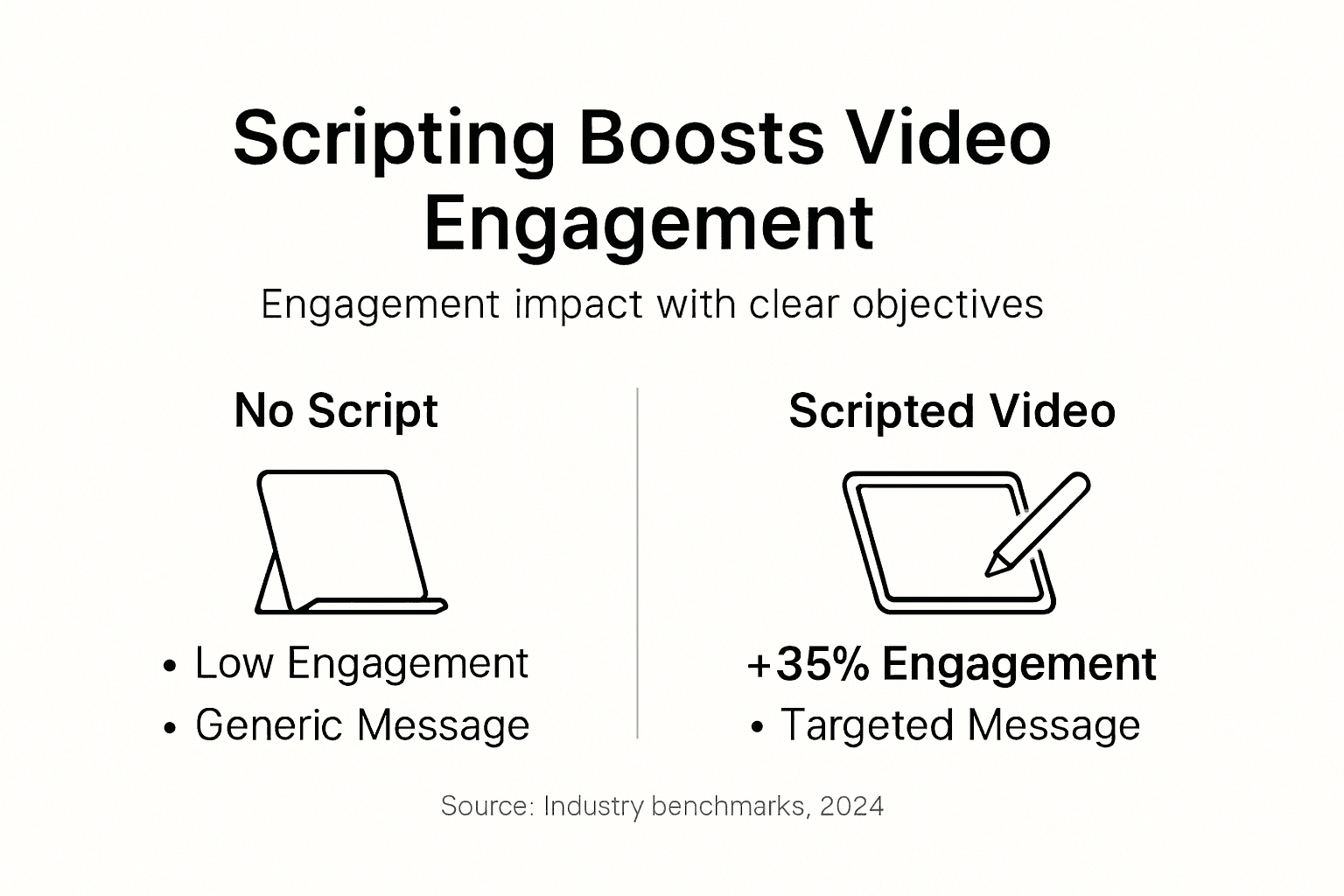
Videos under 90 seconds achieve 50% higher completion rates, driving stronger viewer retention. Shorter scripts keep viewers engaged from start to finish, ensuring your CTA gets seen and acted upon.
Iterative revisions reduce scripting errors by about 50%, improving final quality and reception. Feedback catches unclear messaging, tone inconsistencies, and missed opportunities before production begins. This saves costly reshoots and maximizes your production budget.
Metric | Baseline (No Structured Script) | With Structured Script | Improvement |
Engagement rate | 3-5% | 5-8% | Up to 35% |
Video completion rate | 40-50% | 60-75% | 50% higher |
Click-through rate | 1-2% | 2-3% | 20% higher |
Scripting error rate | 8-12% | 4-6% | 50% reduction |
For strategies on measuring video engagement success, explore analytics frameworks that track ROI effectively.
Alternative scripting approaches and their tradeoffs
Different scripting styles suit different campaign goals. Understanding tradeoffs helps you choose the best method for your situation.
Traditional promotional scripting is straightforward with clear brand messaging and lower complexity. This approach works well for product launches, service explanations, and direct calls to action. Scripting takes less time, but emotional engagement may be moderate compared to narrative approaches.
Narrative-driven scripting adds storytelling elements that increase emotional engagement by about 20% to 35%. You introduce characters, conflict, and resolution to create memorable, shareable content. This method builds deeper audience connections but raises scripting complexity and typically extends timelines by 1 to 2 weeks.
Testimonial scripting leverages real customer stories for authenticity and trust. Viewers respond strongly to peer experiences, boosting credibility by 15% to 25%. However, this approach requires identifying suitable customers, coordinating interviews, and integrating their stories smoothly. Production logistics become more complex.
Choosing a method depends on campaign goals, audience preferences, and available time for scripting. If you need fast turnaround and clear messaging, traditional scripting works best. For brand storytelling and emotional connection, invest in narrative approaches. For credibility and trust, use testimonials.
Approach | Complexity | Engagement Boost | Timeline | Best Use Case |
Traditional promotional | Low | Baseline | 1-2 weeks | Product launches, clear CTAs |
Narrative-driven | Medium-high | 20-35% | 2-4 weeks | Brand storytelling, values |
Testimonial-based | Medium | 15-25% | 2-3 weeks | Service credibility, trust building |
Pro Tip: Combine approaches for maximum impact. Start with a customer testimonial hook, transition to narrative storytelling, and close with a traditional CTA structure.
Method selection factors:
Campaign objectives and desired outcomes
Available time and production resources
Audience preferences and engagement patterns
Brand storytelling needs versus direct response goals
For insights on alternative scripting approaches, explore methods that balance engagement and production feasibility.
Discover expert video scripting and production services
Mastering scripting takes practice, feedback, and iteration. But you don’t have to do it alone.
[
Tulip Films offers comprehensive expertise in scripting and producing professional promotional video production tailored for Swiss businesses. Their portfolio showcases corporate and brand videos designed to maximize audience engagement and ROI. From initial concept to final delivery, their team guides you through every stage with a personalized approach that reflects your brand authentically.
Competitive video production pricing options and professional guidance help optimize your video marketing efforts without exceeding budget. Transparent packages make planning straightforward, so you know exactly what to expect.
Partnering with Tulip Films ensures your video scripts translate into compelling, effective final content. Their scriptwriting expertise combines strategic messaging with visual storytelling, delivering videos that engage audiences and drive measurable results for Swiss marketing managers.
Frequently asked questions about scripting promotional videos
What is the ideal length for a promotional video script?
Aim for 60 to 90 seconds maximum. Videos under 90 seconds achieve 50% higher completion rates, ensuring viewers see your entire message and call-to-action. Shorter scripts force clarity and focus, cutting unnecessary details that dilute your core message.
How can I ensure my script appeals to Swiss audiences specifically?
Conduct audience research focused on Swiss demographics, cultural values, and local preferences. Use clear, jargon-free language and respect regional differences. Incorporate local context and avoid generic Europe-wide messaging that misses Swiss precision and quality expectations.
What are the most common scripting mistakes to avoid?
Avoid jargon, multiple CTAs, inconsistent tone, and excessive length. Scripts without clear structure or audience focus lead to low engagement and poor comprehension. Iterative feedback loops catch these errors early, reducing mistakes by up to 50% and improving final quality significantly.
How often should I revise my script before finalizing?
Plan for at least two to three revision rounds. Initial drafts capture ideas. First revisions refine clarity and structure. Final revisions polish tone and align with brand guidelines. Feedback from stakeholders or sample audiences during each round improves quality and catches errors before production.
Are narrative scripts better than traditional scripts for promotional videos?
It depends on your campaign goals. Narrative scripts boost emotional engagement by 20% to 35% and work well for brand storytelling. Traditional scripts offer faster turnaround and clear messaging for direct response campaigns. Choose based on whether you prioritize emotional connection or straightforward calls-to-action.
Recommended
