Property Video Marketing: Top 10 Formats for 2026

TL;DR:
Property video marketing significantly increases lead generation and buyer engagement. Utilizing AI-generated and professional videos strategically across platforms optimizes marketing efforts and enhances listing appeal. Most agents succeed by batch filming, repurposing content, and matching video length to platform audience preferences.
Property video marketing is the practice of using filmed or AI-generated visual content to showcase real estate listings and attract qualified buyers. Listings with video content generate 4x more leads than those relying on text or static images alone. That gap is widening in 2026 as AI video generation and professional cinematography both become more accessible. Whether you manage a portfolio of rentals or sell luxury homes in Geneva, the right video format determines how fast a property moves. This guide covers the 10 most effective formats, how to film and edit them, and which platforms to prioritize.
1. What is a property video and why does it matter?
A property video is any filmed or digitally generated visual presentation of a real estate listing, from a 15-second Instagram clip to a 12-minute YouTube walkthrough. The term “real estate video” is the standard industry label, but the formats underneath it have multiplied fast. Buyers now expect video before they schedule a showing. Agents who skip it hand the advantage to competitors who do not.

The business case is direct. Video signals credibility to sellers, speeds up buyer decisions, and feeds algorithms on platforms like Instagram and YouTube. A listing without video in 2026 is the equivalent of a listing without photos in 2015.
2. AI-generated photo-to-video presentations
AI video tools convert static listing photos into animated, music-backed presentations in under 10 minutes. Platforms like Pixel Motion use machine learning to add motion, transitions, and voiceover to existing MLS images. AI video production costs roughly 5% of traditional videography. That makes it the right choice for high-volume agents managing dozens of listings per month.
The output is not cinematic. It works best for rental listings, mid-range residential properties, and any listing where speed matters more than visual polish. Use AI video as your baseline, not your ceiling.
Pro Tip: Run AI-generated videos on Facebook and email campaigns first. Save your professional video budget for the platforms where buyers spend the most time, like YouTube and Instagram Reels.
3. Traditional property walkthrough videos
The property walkthrough video is the industry standard for a reason. A trained videographer moves through each room in a deliberate sequence, capturing light, scale, and flow in ways that photos cannot. Buyers watching a walkthrough form spatial impressions that directly reduce hesitation before a showing.
The essential 6-shot template for walkthroughs covers the exterior approach, living areas, kitchen, primary bedroom, bathroom, and outdoor space. Shooting in that order mirrors how a buyer physically experiences a home. Skipping the sequence creates a disjointed viewing experience that loses attention fast.
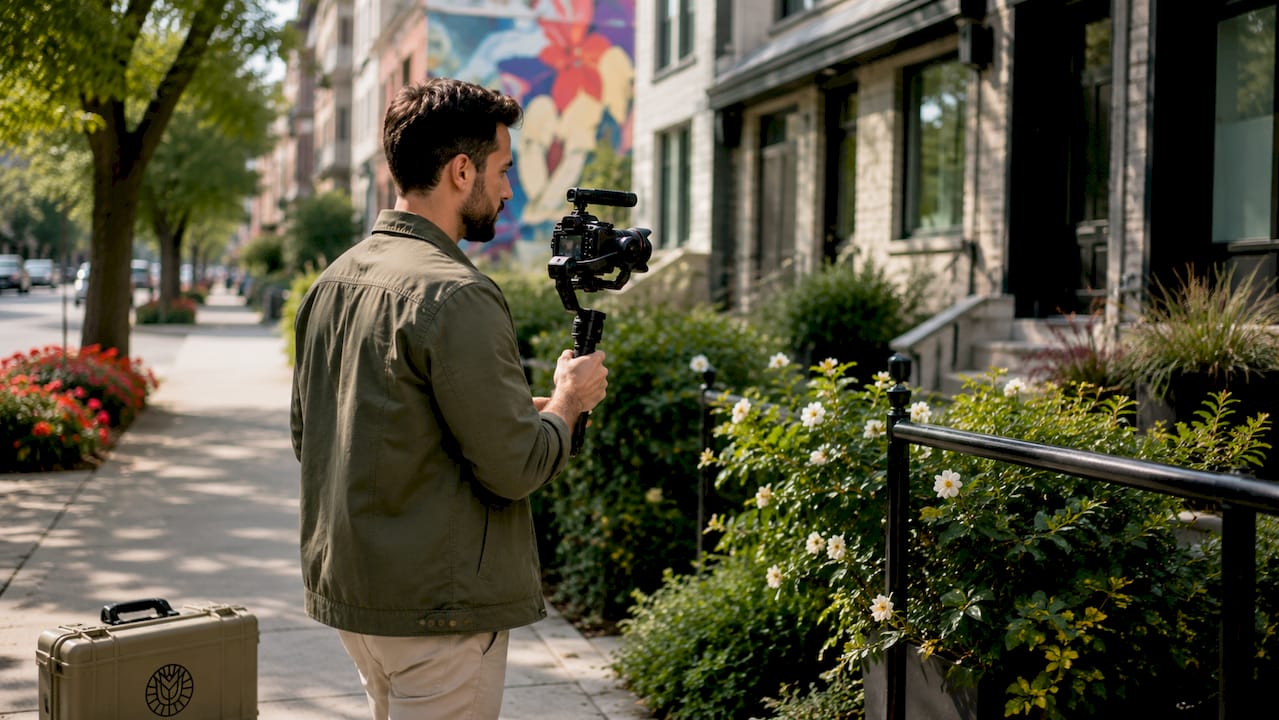
Equipment matters here. A Sony A7C II paired with a gimbal like the DJI RS 3 delivers the smooth, cinematic movement that separates professional content from phone footage. Buyers notice the difference, even if they cannot name it.
4. Drone and aerial footage
Aerial footage communicates what no ground-level camera can: lot size, neighborhood context, proximity to amenities, and the relationship between a property and its surroundings. For rural properties, waterfront homes, and large estates, drone footage is not optional. It is the primary selling tool.
Swiss regulations require drone operators to hold a certified license for commercial flights. Tulipfilms provides licensed aerial video for real estate clients across Switzerland, covering both FPV and standard drone formats. A 60-second aerial clip added to a listing video increases perceived property value in the buyer’s mind before they read a single spec sheet.
5. Short-form social media clips
Short-form clips run 15–30 seconds and are built for Instagram Reels, TikTok, and YouTube Shorts. Optimal short-form videos perform best in that 15–30 second window for completion rates. Completion rate is the signal that tells platform algorithms to push your content to more viewers. A clip that gets watched to the end beats a longer clip that gets scrolled past every time.
The format works best as a teaser. Show the most visually striking feature of the property, add a text overlay with the price and location, and end with a clear call to action. Keep the edit tight and the hook in the first two seconds.
6. Long-form YouTube walkthroughs
YouTube walkthroughs run 7–15 minutes and serve a different buyer than short-form clips. These are buyers who are already serious. They want to see every room, understand the layout, and get a feel for the neighborhood. Long-form walkthroughs in the 7–15 minute range hold engagement best on YouTube.
YouTube also functions as a search engine. A well-titled walkthrough for a Geneva apartment can surface in search results for months after the listing closes, building your channel authority over time. Treat every long-form video as a long-term asset, not a one-time post.
7. Voiceover listing tours
A voiceover tour pairs a walkthrough video with a narrated script that highlights features, dimensions, and neighborhood context. The agent does not appear on camera. That removes the performance pressure that stops many agents from producing video at all.
Video marketing works best when it feels natural and authentic, not scripted and stiff. A conversational voiceover recorded in one or two takes is more effective than a polished script read robotically. Write bullet points, not full sentences, and talk through them naturally.
8. Behind-the-scenes and agent videos
Behind-the-scenes clips show the work behind a listing: staging decisions, pre-shoot prep, or the moment a client gets their keys. Video testimonials and behind-the-scenes content build trust and demonstrate agent value without requiring a formal on-camera presence. These formats perform well on Instagram Stories and LinkedIn.
The goal is not to show off. The goal is to make the buying and selling process feel human and transparent. Buyers who trust the agent before the first call close faster.
9. Neighborhood and local lifestyle videos
A neighborhood video answers the question every buyer asks before they ask about the property: “What is it like to live here?” Film the local coffee shop, the school, the weekend market, and the commute route. Pair it with a short clip of the listing exterior.
This format works especially well for relocating buyers who cannot visit in person. A 90-second neighborhood video can replace three phone calls worth of questions. It also gives you evergreen content that applies to multiple listings in the same area.
10. “This or That” interactive video polls and testimonial clips
Interactive formats like “This or That” polls on Instagram Stories ask viewers to choose between two property features, layouts, or styles. The engagement data tells you what your audience actually wants, which informs future listings and content. Testimonial clips from past clients close the trust loop. A 30-second clip of a satisfied buyer describing their experience is more persuasive than any written review.
Authentic client stories are effective without requiring agents on camera. Film the client at the property, ask two or three open questions, and let them talk. Edit to the best 30 seconds.
AI vs. professional videography: which one should you use?
The choice between AI-generated and professional video is not either/or. The most effective approach uses both, matched to listing type and budget.
Factor | AI-generated video | Professional videography |
Production time | Under 10 minutes | Half day to full day |
Cost | ~5% of professional cost | Full production budget |
Best for | Rentals, volume listings | Luxury, hero properties |
Visual quality | Good, not cinematic | Cinematic |
Customization | Limited | Full creative control |
A dual video strategy uses AI for high-volume, low-budget listings and professional videography for luxury or flagship properties. Top agents use this split to maintain marketing quality across their entire portfolio without burning through their production budget on every listing.
Pro Tip: Use AI video for your first 48 hours of listing promotion on social media. If the property generates strong interest, commission a professional walkthrough to sustain momentum.
Filming and editing best practices for real estate videos
Strong real estate video production starts before you press record. These practices separate content that converts from content that gets scrolled past.
Shoot in the right light. Film interiors in the morning or late afternoon when natural light is softest. Avoid midday sun through windows, which creates harsh contrast.
Use a gimbal. Handheld footage looks amateur. A DJI RS 3 or similar gimbal costs under $400 and immediately raises production quality.
Match music to the property. Music mood selection shapes viewer emotion and pacing. Use cinematic scores for luxury homes, upbeat tracks for family properties, and ambient sound for minimalist or modern spaces.
Add captions to every video. Captions and text overlays significantly increase engagement because most viewers watch without sound on Instagram and TikTok. Text carries the story when audio cannot.
Batch film on one dedicated day. Batch filming one day per week lets agents produce a full week of content in a single session. It reduces scheduling friction and keeps your posting calendar consistent.
The three-phase formula for effective real estate video is Concept, Production, and Promotion. Skipping any phase reduces reach. Most agents invest in production and skip promotion entirely, which is where distribution and algorithm signals are built.
Platform strategy and optimal video length in 2026
Every platform rewards different behavior. Posting the same video everywhere without adapting it is the fastest way to underperform on all of them.
Platform | Ideal length | Format | Primary goal |
Instagram Reels | 15–30 seconds | Vertical 9:16 | Reach and discovery |
TikTok | 15–30 seconds | Vertical 9:16 | Viral reach |
YouTube Shorts | 30–60 seconds | Vertical 9:16 | Channel growth |
YouTube | 7–15 minutes | Horizontal 16:9 | Buyer education |
60–90 seconds | Square or horizontal | Lead generation |
Completion rate is the metric that matters most on short-form platforms. A 20-second clip watched to the end outperforms a 45-second clip abandoned halfway through. Edit ruthlessly. Every second that does not add information or visual interest should be cut.
Pro Tip: Post your short-form clips at 7–9 a.m. or 6–8 p.m. local time on weekdays. Those windows consistently outperform midday posting for real estate content on Instagram and TikTok.
For agents building a real estate video strategy, the platform mix matters as much as the content itself. Start with one platform, master its format, then expand.
Key takeaways
The most effective real estate video strategy pairs AI-generated content for volume listings with professional videography for premium properties, distributed across platforms matched to video length and buyer intent.
Point | Details |
Video drives leads | Listings with video generate 4x more leads than text or image-only listings. |
Use a dual approach | AI video covers volume listings; professional videography handles luxury and hero properties. |
Match length to platform | Short-form clips run 15–30 seconds; YouTube walkthroughs run 7–15 minutes. |
Captions are non-negotiable | Most viewers watch without sound, so text overlays carry the message on social platforms. |
Batch film for consistency | One dedicated filming day per week produces enough content to maintain a full posting calendar. |
Why I think most agents are using video wrong
After working on real estate video production across Switzerland and watching how agents actually use the content we deliver, one pattern stands out. Most agents treat video as a one-time listing asset. They commission a walkthrough, post it once, and move on. That is the wrong mental model entirely.
A well-produced property walkthrough is a content library. The full video goes on YouTube. A 30-second cut goes on Instagram Reels. A neighborhood clip becomes a standalone post. A client testimonial filmed on the same day becomes a trust-building story for LinkedIn. One filming session, done right, produces six to eight pieces of content.
The agents I see winning in 2026 are not the ones with the biggest budgets. They are the ones who batch film, repurpose aggressively, and treat every listing as a content opportunity. They also stopped worrying about being perfect on camera. Authentic, slightly imperfect video outperforms polished but stiff content on every platform I have tracked.
The other thing I would push back on is the idea that AI video is “good enough” for everything. It is not. For a CHF 2 million property in Lausanne or a lakefront estate in Zurich, buyers expect production quality that matches the price point. AI video on a luxury listing signals that the agent did not invest in the property. That is a message you do not want to send.
The dual approach is not a compromise. It is the most rational allocation of your marketing budget across a mixed portfolio.
— Pieter
Ready to produce listing videos that actually convert?
If you are ready to move beyond phone footage and generic slideshows, Tulipfilms produces real estate videos built for Swiss properties and Swiss buyers. From licensed drone footage to full cinematic walkthroughs, every project starts with a free consultation to understand your listing, your timeline, and your audience.
[
Browse the production portfolio to see completed real estate projects, or review transparent production pricing before your first call. Tulipfilms works with independent agents, brokerages, and property developers across Geneva, Lausanne, and Zurich. Fast turnaround, no guesswork on cost.
FAQ
How long should a property video be?
Short-form clips for Instagram and TikTok perform best at 15–30 seconds. YouTube walkthroughs hold buyer attention best in the 7–15 minute range.
What is the difference between AI video and professional videography for real estate?
AI video generates a presentation from existing photos in under 10 minutes at roughly 5% of the cost of professional production. Professional videography delivers cinematic quality suited to luxury listings and high-stakes marketing.
Do I need captions on my real estate videos?
Yes. Most viewers on Instagram and TikTok watch without sound, so captions and text overlays carry the message when audio is off. Skipping captions reduces engagement and reach on both platforms.
What equipment do I need to film a property walkthrough?
A mirrorless camera like the Sony A7C II paired with a gimbal like the DJI RS 3 covers most walkthrough needs. A wide-angle lens and a portable LED panel for dark interiors round out a solid entry-level kit.
How often should real estate agents post video content?
Batch filming one day per week produces enough content for consistent daily or every-other-day posting. Consistency matters more than volume on algorithm-driven platforms.
Recommended
