Role of Animation in Explainer Videos: Boosting Engagement

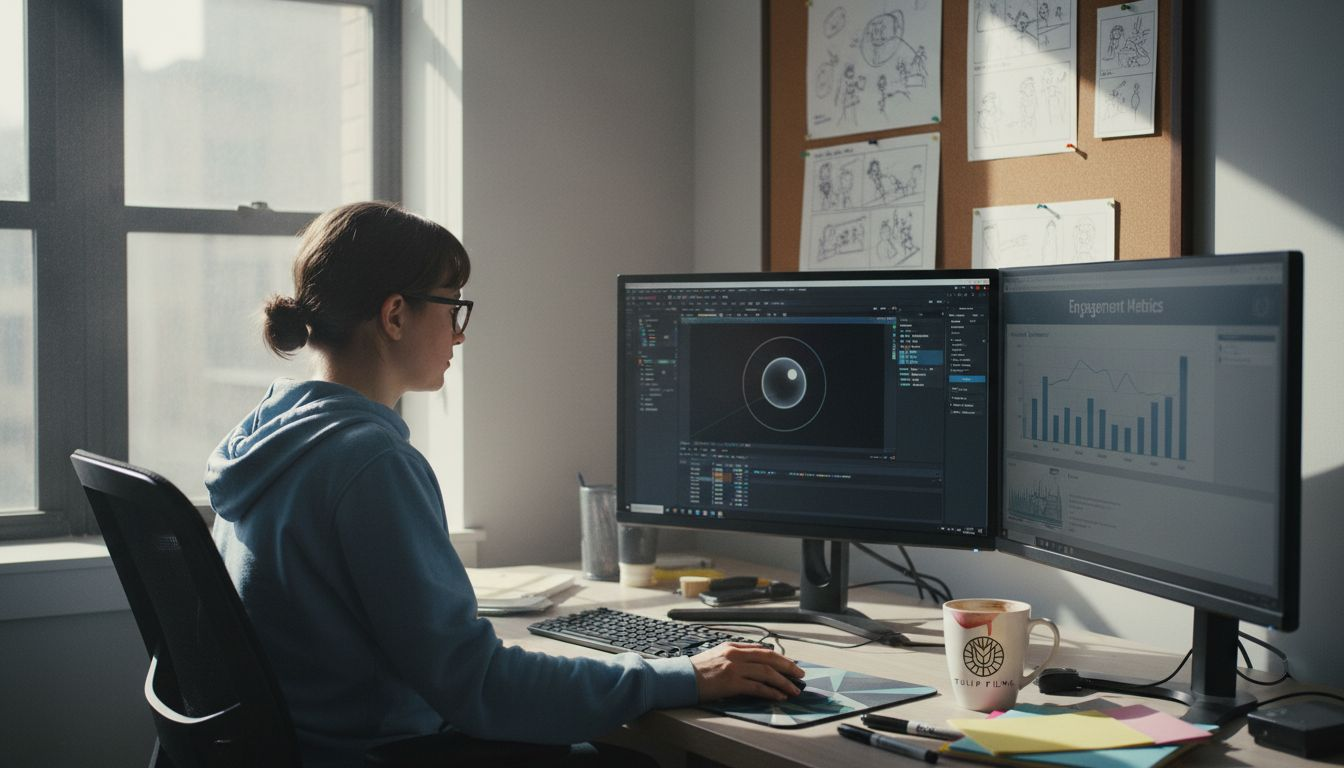
Marketing managers at Swiss SMEs often struggle to explain complex ideas in a way that truly resonates with clients. Animation in explainer videos transforms these challenges into opportunities by serving as a bold visual language that makes abstract concepts clear and relatable. When animated content combines precise storytelling with vibrant graphics, it creates memorable experiences that capture attention and drive real understanding for Swiss audiences.
Table of Contents
Key Takeaways
Point | Details |
Animation Transforms Communication | Animation in explainer videos clarifies complex ideas by using visual storytelling to engage viewers more effectively than static text or live-action. |
Choosing the Right Animation Style | Different animation styles cater to various audiences and objectives, so selecting the appropriate type is crucial to resonate with your target market. |
Synchronizing Visuals and Narration | Effective explainer videos require precise timing between animation and voiceover to enhance understanding and retention of information. |
Avoiding Common Pitfalls | Focus on clarity and pacing to avoid overwhelming viewers with information; ensure the animation supports a coherent narrative that maintains audience engagement. |
Defining Animation in Explainer Videos
Animation in explainer videos refers to the visual movement and transformation of graphic elements that bring complex ideas to life. These aren’t full-length animated films or cartoons—they’re strategic, purposeful sequences designed to clarify specific concepts. Animation serves as the visual language that bridges the gap between abstract information and audience understanding.
Explainer videos employ clear animations combined with voiceovers and storytelling to simplify complex ideas visually and narratively. The animation component is what transforms static information into something dynamic and engaging. Think of it as the difference between reading a lengthy instruction manual versus watching someone demonstrate the process step-by-step.
Why Animation Matters in Explainer Videos
Animation accomplishes several critical functions:
Breaks down abstract concepts into digestible visual sequences
Guides viewer attention to specific elements at precise moments
Creates emotional connection through movement and visual rhythm
Maintains engagement by replacing static text or talking heads
Simplifies relationships between ideas through visual metaphors
Unlike traditional live-action video, animation removes real-world distractions. You control exactly what the audience sees, when they see it, and how long they focus on each element. This precision is invaluable when explaining technical processes or intangible concepts.
Animation Types in Explainer Videos
Different animation styles serve different purposes for your audience:
2D motion graphics: Flat, colorful shapes and text that move across the screen
Whiteboard animation: Hand-drawn illustrations appearing on a white background
Character animation: Animated people or mascots that interact with your message
3D animation: Dimensional objects that can be rotated and explored from multiple angles
Infographic animation: Data and statistics that transform and reveal progressively
Your choice depends on your brand voice, the complexity of your message, and what resonates with your target audience. A Swiss financial services company might prefer clean 2D graphics, while a tech startup could leverage 3D elements to showcase product features.
Animation allows abstract topics to become more digestible by combining visuals and narrative in an engaging, informative format that viewers can easily follow.
Animation also works in tandem with voiceover and pacing. The animation reveals information at precisely the moment your narrator mentions it, creating synchronized understanding. This coordination between audio and visual elements is what separates effective explainer videos from mediocre ones.
When your marketing team creates an explainer video, the animation isn’t decorative—it’s functional. Every movement serves the goal of clarifying your message and moving viewers toward action. Understanding what video storytelling achieves helps you see how animation fits into the bigger narrative.
Pro tip: Start simple when planning your animation. Define the three to four key points you want to communicate, then assign one distinct animation sequence to each point—this prevents overwhelming your audience and keeps their focus laser-sharp on your core message.
Comparing Animation Styles and Techniques
Choosing between animation styles isn’t a one-size-fits-all decision. Each approach brings distinct strengths, costs, and production timelines. Your choice depends on your message complexity, budget, and what your audience expects from your brand.
2D Motion Graphics vs. Whiteboard Animation
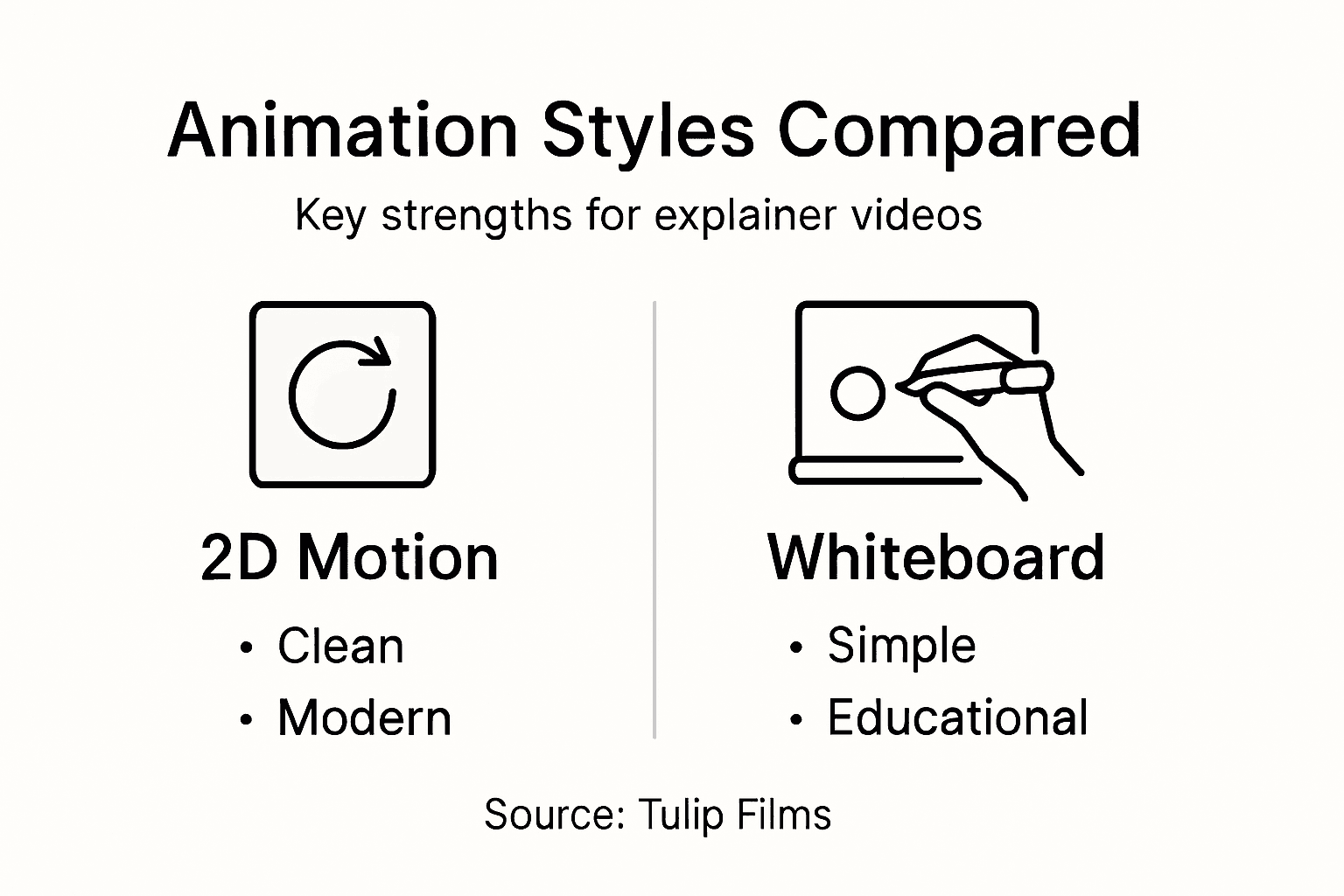
2D motion graphics use colorful shapes, icons, and text that animate smoothly across the screen. This style feels modern and polished, making it ideal for corporate explainers and software demonstrations. Whiteboard animation, by contrast, mimics the hand-drawing process on a white background, creating a personal, approachable feel.
Comparison of key differences:
2D graphics: Professional, versatile, faster production, works for any industry
Whiteboard: Intimate, memorable, slower pacing, better for educational content
Cost: 2D typically costs more upfront but scales easily; whiteboard requires skilled artists
Audience perception: 2D feels corporate; whiteboard feels creative and personal
Swiss B2B companies often favor 2D motion graphics because they convey competence and precision. Startups and educational organizations lean toward whiteboard for its authentic, conversational tone.
Here’s a comparison of animation styles and their optimal business applications:
Animation Style | Best Business Use | Typical Audience | Perceived Brand Effect |
2D Motion Graphics | Software demos, finance | Corporate, B2B | Modern, precise |
Whiteboard Animation | Educational explainer, onboarding | Startups, nonprofits | Approachable, authentic |
Character Animation | Customer service, storytelling | Consumer-facing, SMEs | Relatable, friendly |
3D Animation | Product showcases, tech | Manufacturing, tech | Premium, innovative |
Infographic Animation | Market trends, reporting | Decision-makers, analysts | Data-driven, clear |
Character Animation and 3D Animation
Character animation introduces a mascot or person that guides viewers through your message. This creates familiarity and emotional connection. 3D animation, meanwhile, allows you to rotate objects, zoom into details, and show spatial relationships impossible with 2D.
3D animation excels at:
Displaying product features from multiple angles
Showing internal mechanisms or hidden structures
Creating immersive experiences for complex processes
Building premium brand perception through visual sophistication
Character animation works best when you want personality and relatability. A financial services firm might use a character to explain investment concepts in a non-threatening way. A manufacturing company would use 3D to showcase machinery capabilities.
Infographic Animation and Hybrid Approaches
Infographic animation transforms data into moving visual stories. Numbers animate upward, percentages materialize, and statistics connect dynamically. This style works exceptionally well for reporting results or explaining market trends—exactly what cinematic techniques for visual storytelling achieve when combined with data visualization.
Hybrid approaches combine multiple styles within a single video. You might start with 2D graphics, introduce a character midway, then finish with 3D product visualization. This variation maintains viewer engagement across longer explainers.
The most effective animation choice matches your audience’s expectations while supporting your core message—not the other way around.
Consider your production timeline. 2D and whiteboard animate faster. 3D and character animation require longer development cycles but deliver higher perceived value. Infographic animation falls somewhere in the middle.
Pro tip: Test your top two animation style choices with a small focus group from your target audience before committing to full production—a five-minute preference test prevents costly mid-project pivots and ensures your final video resonates exactly where it matters.
How Animation Enhances Viewer Engagement
Animation transforms passive viewers into active participants. When your audience watches movement, color, and visual metaphors unfold, their brains engage differently than with static text or talking heads. This engagement isn’t random—it’s rooted in how humans process visual information and emotional storytelling.

Movement captures attention in ways still images cannot. Your viewer’s eye naturally follows motion, making it nearly impossible to look away during well-designed animated sequences. In an era where attention spans shrink daily, animation’s ability to boost engagement through dynamic visuals and vibrant graphics becomes invaluable for marketing managers competing for viewer attention.
The Psychology Behind Animation’s Impact
Animated explainer videos work because they tap into fundamental aspects of human cognition:
Visual memory: People retain 65% of information presented visually versus 10% from audio alone
Emotional connection: Movement and character design trigger emotional responses that static content cannot
Reduced cognitive load: Visual narratives break complex ideas into digestible chunks
Active learning: Viewers aren’t passive recipients—they’re following a visual journey
Your Swiss SME clients likely struggle explaining intricate processes. Animation solves this by using metaphor and visual storytelling to make abstract concepts tangible. A software company explaining data encryption suddenly becomes understandable when animation shows data flowing through protective layers.
Maintaining Attention and Reducing Drop-Off
Animation enhances learner engagement by breaking down complex topics into visually appealing narratives that reduce cognitive overload. When viewers feel less overwhelmed, they watch longer and absorb more.
Dropout rates plummet when animation paces information correctly:
Synchronized audio and visuals: Voiceover matches animation timing, preventing viewer confusion
Varied visual elements: Different animation styles within one video prevent monotony
Clear progression: Viewers understand where they are in the narrative arc
Strategic pacing: Information appears exactly when narration introduces it
This synchronization means viewers don’t need to rewind or puzzle over what they just saw. The animation and narration work as one cohesive unit.
Building Memorability Through Animation
Animated explainer videos create memorable experiences because storytelling, characters, and sound design work together to embed concepts in memory. A character navigating through a problem, finding a solution, and celebrating that victory sticks with viewers far longer than a bulleted list ever could.
Animation doesn’t just show what happens—it helps viewers feel why it matters, transforming information into experience.
Your marketing messaging becomes more persuasive when wrapped in animation. The same value proposition communicated through text feels generic. That same proposition demonstrated through animation feels compelling and worth sharing.
Pro tip: Measure engagement by tracking average view duration and drop-off points in your analytics—if viewers consistently abandon your video at the same moment, that’s where your animation or pacing needs adjustment, not where your message fails.
Tailoring Visuals to Swiss Brand Identity
Swiss brands are known for precision, quality, and understated elegance. Your explainer video animation must reflect these values, not contradict them. Generic animation templates fail because they ignore the cultural and aesthetic expectations of your Swiss audience.
Animation offers what live-action cannot: complete customization. You control every color, every shape, every movement to align perfectly with your brand guidelines. This precision matters enormously when your brand reputation depends on consistency and refinement.
Color Palettes and Design Language
Swiss design tradition emphasizes clarity, minimalism, and functional beauty. Your animation should embody these principles rather than fight against them. This means avoiding flashy gradients, excessive shadows, or cluttered visual elements that feel contrary to Swiss aesthetic sensibilities.
Key customization elements for Swiss brands:
Brand colors: Animation enables precise matching of your exact brand palette without deviation
Typography: Clean, geometric fonts that reflect Swiss design tradition
Whitespace: Generous negative space that feels intentional, not empty
Visual hierarchy: Clear distinction between primary and secondary information
Geometric shapes: Circles, squares, and grids reflecting Swiss grid-based design
A Swiss financial services company shouldn’t animate with playful, rounded shapes. A Swiss tech manufacturer shouldn’t use soft, organic curves. Match your animation style to what your audience expects from your industry sector.
For quick reference, here are key Swiss branding elements to include in explainer video animation:
Brand Element | Importance for Swiss Audience | Example Customization |
Color Palette | Ensures visual consistency | Exact brand red or blue |
Typography | Reflects precision values | Geometric sans serif font |
Whitespace | Communicates clarity | Ample margins, clean layout |
Local Context | Connects culturally | Swiss business settings |
Integrating Cultural Nuances and Local Relevance
Animation style, color palette, characters, and tone should align with target audience expectations and brand identity. For Swiss audiences, this means respecting regional preferences and cultural values.
Consider these cultural alignment strategies:
Professional tone: Swiss audiences expect professionalism—avoid casual or overly friendly animation styles
Multilingual considerations: Plan animation that works across German, French, and Italian voiceovers
Local scenarios: Show Swiss contexts, landscapes, or business environments your audience recognizes
Efficiency focus: Animation pacing reflects Swiss values of respect for time and directness
Quality craftsmanship: Animation details should feel carefully considered, not rushed
Your animation becomes a brand ambassador. Every frame reinforces whether your company understands Swiss market expectations. A sloppy, inconsistent animation tells viewers you didn’t invest enough care in your message.
Brand Consistency Across All Channels
Your explainer video animation must match your website design, social media aesthetics, and printed materials. Animation preserves brand consistency across all marketing materials while engaging viewers with relevant, relatable content.
When animation matches your broader brand ecosystem, viewers recognize and trust your company more. Inconsistent visuals create cognitive friction—your audience notices the disconnect, even if they cannot name it.
Customized animation doesn’t just look better; it performs better because it resonates authentically with viewers who recognize their own cultural values reflected back at them.
Pro tip: Create an animation style guide before production begins—document your approved color codes, approved font families, approved shape styles, and approved movement speeds—this prevents costly revisions and ensures every animation project reinforces, rather than dilutes, your brand identity.
Common Pitfalls in Animated Explainer Videos
Most failed explainer videos share common mistakes. Knowing what goes wrong helps you avoid expensive production detours and wasted marketing budgets. These pitfalls affect engagement, comprehension, and ultimately whether your message converts viewers into customers.
The biggest mistake is assuming animation alone carries your message. Animation is a tool, not magic. Without solid strategy behind it, even beautiful animation fails to engage or persuade your audience.
Information Overload and Poor Pacing
Overloading viewers with too much information is a primary factor in animation failure. Your 90-second explainer cannot cover everything your product does. Trying to cram too much kills comprehension and viewer patience.
Common pacing mistakes include:
Too much content: Explaining five features when two would resonate stronger
Rushed timing: Information appears faster than viewers can process it
No breathing room: Every second crammed with visuals and narration
Complex sequences: Animation that takes 15 seconds to explain a simple concept
Lack of repetition: Key points mentioned once without visual reinforcement
Swiss audiences especially expect efficiency. Respect their time by eliminating anything that doesn’t directly support your core message. Every second must earn its place.
Weak Storytelling and Unclear Messaging
Unclear messaging and lack of compelling story disengage viewers immediately. Your animation must support a narrative arc—problem, solution, benefit. Without this structure, viewers feel lost regardless of animation quality.
Missing story elements include:
No clear problem statement at the beginning
Solution appears without context or justification
No emotional connection to why this matters
Confusing transitions between ideas
Ending that feels abrupt rather than conclusive
Your storyboard should be rock-solid before animation begins. Effective storyboarding prevents costly revisions during the expensive animation phase.
Animation That Distracts Rather Than Clarifies
Animation that distracts or confuses rather than clarifies defeats the entire purpose. Animations should emphasize key points, not distract from them. Excessive movement, jarring transitions, or flashy effects pull attention away from your message.
Distraction happens through:
Unnecessary movement or spinning objects
Clashing colors that strain the eye
Animation that doesn’t match audio timing
Background elements that compete for attention
Transitions so elaborate viewers miss content between them
Animation should feel invisible—viewers should focus on your message, not admire the animation itself.
Script and Voiceover Misalignment
Poor scripting and voiceover that doesn’t complement visuals creates disconnect. Your narration must arrive precisely when animation reveals the corresponding visual. When narration and animation misalign, viewers get confused about what they should be watching.
Also verify animation and visuals align with your brand and audience expectations. Visuals that feel off-brand or inappropriate for your audience undermine trust immediately.
Pro tip: Create a frame-by-frame script before animation begins—write exactly what animation should show, when it should appear, and what voiceover text pairs with each frame—this synchronizes audio and visuals perfectly and prevents expensive rework.
Elevate Your Message With Purposeful Animation
Understanding how animation boosts engagement in explainer videos is just the first step. Many Swiss businesses face the challenge of turning complex ideas into clear, captivating stories that resonate deeply with their audience. From avoiding information overload to synchronizing animation perfectly with voiceover narrative, these pain points demand a tailored, strategic approach to video production.
At Tulip Films, we specialize in creating custom animated explainer videos that not only simplify your message but also reflect your brand’s precision and professionalism. With our personalized service designed for Swiss companies, we help you craft animations that keep viewers engaged, reduce cognitive load, and align perfectly with your corporate identity. Discover how matching your animation style to your audience’s expectations can make your communication efficient and memorable.
Unlock the full potential of animation for your brand today.
[
Ready to transform your complex ideas into engaging visual stories that drive results? Visit Tulip Films to explore our portfolio and book your free consultation now. Let us help you deliver clarity, connection, and impact through expert video production tailored to your needs.
Learn more about what video storytelling achieves and see why precision in every animated detail matters. Your audience deserves an explainer video that works as hard as you do.
Frequently Asked Questions
What is the role of animation in explainer videos?
Animation in explainer videos serves as a visual language that simplifies complex ideas, clarifies concepts, and engages viewers through dynamic visuals and storytelling.
How does animation enhance viewer engagement in explainer videos?
Animation captures viewers’ attention through movement and color, making complex topics easier to understand and reducing cognitive overload, ultimately leading to longer watch times and better retention of information.
What are the different types of animation used in explainer videos?
Common animation types include 2D motion graphics, whiteboard animation, character animation, 3D animation, and infographic animation, each suited for different content and audience preferences.
How can I avoid common pitfalls when creating animated explainer videos?
To avoid pitfalls, ensure you have a clear, concise script and storyboard, avoid information overload, maintain good pacing, and make sure that animation complements the message instead of distracting from it.
Recommended
