Complete Guide to the Role of Visuals in Advertising


People remember up to 80 percent of what they see, compared to just 20 percent of what they read. In a world flooded with brands and messages, grabbing attention is tougher than ever. Visual choices—like colors, images, and layout—shape how audiences feel, think, and decide within seconds. Discover the science behind powerful advertising visuals and how they can build trust, spark emotion, and set brands apart in crowded markets.
Key Takeaways
Point | Details |
Importance of Visual Communication | Visual communication utilizes images and graphics to convey messages efficiently and emotionally, improving audience engagement in marketing. |
Three Types of Advertising Images | Effective advertising employs product-centric, lifestyle, and abstract images to create emotional connections and provoke curiosity. |
Psychological Influences on Perception | Visual simplicity, color psychology, and human connection enhance message retention and emotional engagement in audiences. |
Common Visual Mistakes | Avoid incongruent messaging, complexity, and lack of emotional connection to maintain trust and clarity in advertising visuals. |
Table of Contents
Visual communication represents the strategic use of images, graphics, and design elements to convey messages rapidly and emotionally. According to research from Sciendo, visual communication enables faster information processing and plays a crucial role in connecting with audiences across marketing and PR landscapes.
At its core, visual rhetoric involves carefully crafting messages through intentional visual choices. Wikipedia’s research on visual rhetoric reveals that visual communication isn’t just about aesthetics - it’s a complex language involving multiple layers of meaning:
Color: Triggers emotional responses
Layout: Guides viewer’s attention
Imagery: Communicates symbolic and cultural meanings
Effective visual communication leverages three key sign types:
Iconic signs: Direct representations of objects
Indexical signs: Visual cues implying deeper connections
Symbolic signs: Abstract representations requiring cultural understanding
These elements combine to create powerful narratives that transcend traditional text-based communication, allowing brands to connect with audiences more immediately and emotionally. Read more about visual storytelling techniques to dive deeper into this fascinating communication strategy.
Advertising campaigns leverage diverse visual strategies to capture audience attention and communicate powerful messages. According to research from Scholiva, three primary types of advertisement images dominate the marketing landscape:
Product-Centric Images: Focus on intricate product details and features
Lifestyle/Contextual Images: Showcase products in real-world scenarios, evoking emotional connections
Abstract/Conceptual Imagery: Utilize shapes, colors, and design to provoke curiosity and deeper thinking
Here’s a comparison of the main types of advertising visuals and their key features:

| Visual Type | Core Focus | Emotional Impact |
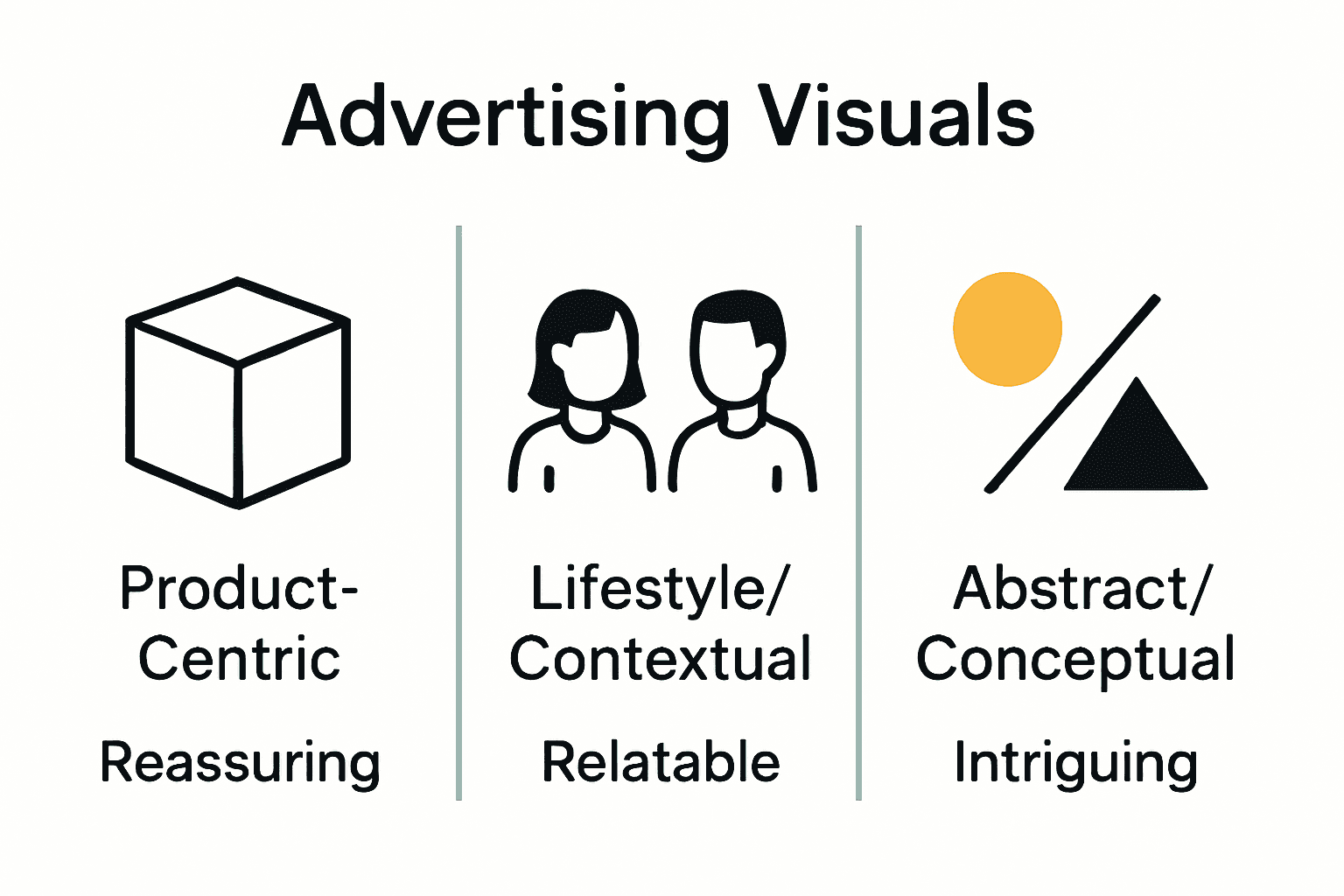
|---------------------------|------------------------------|----------------------| | Product-Centric Images | Product details & features | Highlights benefits | | Lifestyle/Contextual | Real-life scenarios | Builds connection | | Abstract/Conceptual | Shapes, color & design | Sparks curiosity |
Research from Study Smarter reveals that effective advertising visuals are complex communication tools encompassing multiple elements:
Images: Visual narratives that tell stories
Colors: Emotional triggers and brand identity signals
Graphics: Simplified representations of complex concepts
Typography: Communicative design that shapes message perception
Layout: Strategic arrangement guiding viewer’s visual journey
These visual components work synergistically to transcend language barriers, create memorable brand experiences, and connect with audiences on an intuitive, emotional level.
Learn more about developing compelling visual branding strategies to transform your advertising approach.
Visual perception plays a critical role in how audiences process and respond to advertising messages. According to groundbreaking research from Frontiers in Psychology, the effectiveness of advertising fundamentally depends on capturing and maintaining visual attention long enough to encode information into memory and trigger deeper cognitive responses.
Key psychological triggers that influence audience perception include:
Visual Simplicity: Reduces cognitive load and increases message comprehension
Color Psychology: Strategically evokes specific emotional responses
Human Connection: Faces and eye contact create immediate emotional engagement
Research from Reflect Digital highlights three powerful mechanisms through which visuals shape audience behavior:
Cognitive Processing: Simple visuals facilitate faster information absorption
Emotional Triggering: Colors and imagery directly influence decision-making
Subconscious Connection: Human faces establish immediate psychological rapport
These mechanisms work together to transform passive viewers into active participants, guiding them from initial attention to potential action. Explore our guide on visual storytelling techniques to understand how to craft truly compelling visual narratives that resonate deeply with your target audience.
Visual storytelling for Swiss brands demands a nuanced approach that blends cultural authenticity with strategic communication. According to research from Tourism Management Studies, visual metaphors offer powerful tools for communicating complex ideas and brand values through strategic imagery.
Key strategies for compelling visual narratives include:
Cultural Relevance: Craft visuals that resonate with Swiss audiences
Emotional Authenticity: Use imagery that reflects genuine brand experiences
Conceptual Clarity: Translate abstract values into concrete visual representations
Swiss businesses can draw inspiration from rich historical visual communication resources. The AdZyklopädie archives provide an extensive collection of advertising materials from German-speaking Europe, offering insights into regional visual styles and storytelling techniques:
Historical Context: Understand regional visual communication trends
Competitive Analysis: Study successful campaign approaches
Design Evolution: Track visual storytelling development
By combining innovative visual metaphors with deep cultural understanding, Swiss brands can create narratives that transcend traditional advertising. Discover advanced corporate storytelling techniques to elevate your brand’s visual communication strategy and connect more meaningfully with your audience.
Creating effective advertising visuals requires strategic thinking and avoiding common pitfalls. According to Study Smarter, one of the most critical mistakes is developing visual complexity that reduces audience trust and memorability.
Key visual mistakes that can undermine advertising effectiveness include:
Incongruent Messaging: Misalignment between visual and textual content
Overcomplicated Design: Graphics that confuse rather than clarify
Lack of Emotional Connection: Visuals that fail to evoke genuine feeling
Research from Reflect Digital highlights three primary reasons why visual advertisements lose their impact:
Information Overload: Too many elements dilute the core message
Emotional Disconnection: Absence of human or relatable elements
Conceptual Ambiguity: Unclear visual narratives that confuse viewers
Navigating these challenges requires a disciplined approach to visual communication. Explore our guide on visual storytelling strategies to learn how to craft compelling, clear, and emotionally resonant advertising visuals that truly connect with your audience.
Bring Your Brand Story to Life with Vivid Visuals
Are you struggling to capture attention and spark genuine emotion with your advertising visuals? The article highlighted how visual complexity and emotional disconnect can undermine even the most strategic campaigns. If you want to turn passive viewers into engaged customers, you need visual storytelling that goes beyond simple imagery. At Tulip Films, our Swiss-based video specialists help brands like yours craft authentic and effective narratives that connect immediately. We use proven approaches from color theory to cultural relevance, delivering personalized video solutions tailored to your audience and communication goals.

Experience how powerful visuals can transform your next campaign. Visit www.tulipfilms.ch to view our portfolio and discover how we combine visual simplicity, emotional triggers, and memorable storytelling. Ready to elevate your advertising strategy? Contact us for a free consultation and let us show you how engaging video content can help your brand make a lasting impression today.
Frequently Asked Questions
What is visual communication in advertising?
Visual communication in advertising refers to the strategic use of images, graphics, and design elements to convey messages effectively and evoke emotional responses from audiences.
How do colors impact visual advertising?
Colors in visual advertising can trigger emotional responses and influence consumer behavior, making them a vital element in effective communications and brand identity.
What are the types of advertisement images commonly used?
The three primary types of advertisement images are product-centric images, which focus on product details; lifestyle/contextual images, showcasing products in real-world scenarios; and abstract/conceptual imagery, utilizing shapes and colors to provoke thought and curiosity.
How can I avoid common mistakes in visual advertising?
To avoid common mistakes in visual advertising, focus on ensuring congruent messaging between visuals and text, simplifying design to avoid confusion, and using emotionally engaging elements to foster a connection with viewers.
Recommended
