Mastering Your Video Storytelling Workflow for 2025

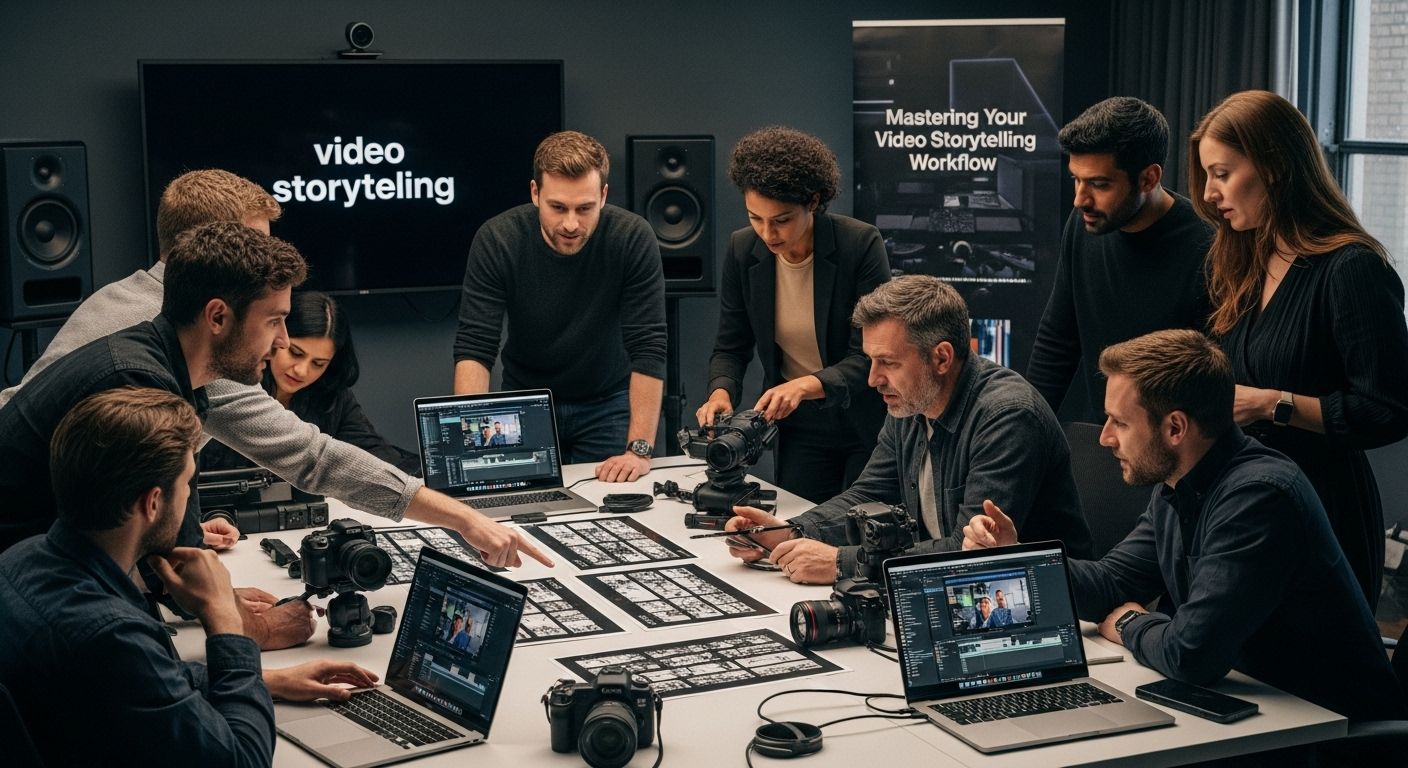
Video storytelling feels like a creative wild west and yet clear objectives are the law that separates compelling narratives from chaos. Most creators pour hours into shooting and editing without realizing that research shows defining your objectives can increase your project’s chances of success by up to 40 percent. The real surprise? Your story’s strength hinges less on flashy visuals and more on having every team member laser-focused on one measurable result from day one.
Table of Contents
Quick Summary
Key Point | Explanation |
1. Define Precise Objectives | Establishing clear objectives guides your video’s narrative and creative decisions effectively. |
2. Create a Detailed Storyboard | A well-crafted storyboard visualizes your narrative, aligning the team and simplifying production. |
3. Assemble a Collaborative Team | Select team members with diverse skills who are fully invested in realizing the storytelling vision. |
4. Execute Filming with Precision | Maintain technical discipline while allowing creative flexibility; be prepared for unexpected moments on set. |
5. Monitor Engagement Metrics | Analyze viewer interaction and feedback to refine future video strategies and enhance your storytelling effectiveness. |
Step 1: Define Your Story Objectives
Successful video storytelling begins with crystal clear objectives. Before you pick up a camera or start editing, you need a precise understanding of what your video aims to achieve. Your story objectives will act as the strategic compass guiding every creative decision in your video storytelling workflow.
Starting with a strategic narrative framework means drilling down into specific, measurable goals. Are you trying to inspire emotional connection? Educate your audience about a complex topic? Generate leads for your business? Showcase a brand’s unique personality? Each objective demands a different storytelling approach.
To effectively define your story objectives, begin by asking yourself critical questions. What specific action do you want viewers to take after watching your video? What key message must be communicated? Who is your target audience, and what emotional or intellectual response are you seeking to provoke?
According to research from ERIC, identifying clear objectives helps ensure your video project remains purposeful and achievable. This means transforming vague intentions into concrete, measurable outcomes. For instance, instead of saying “I want to create an engaging video,” specify: “I want to increase website conversions by 15% through a compelling customer testimonial narrative.”
Your objectives should be specific enough to guide production but flexible enough to allow creative interpretation. Document these objectives in a clear, concise format that your entire production team can reference. Consider creating a one-page brief that outlines:
Primary storytelling goal
Target audience profile
Desired emotional response
Specific measurable outcomes
Remember that well-defined objectives transform your video from a generic piece of content into a strategic communication tool. They provide direction, focus creative energy, and create a benchmark against which you can measure success.
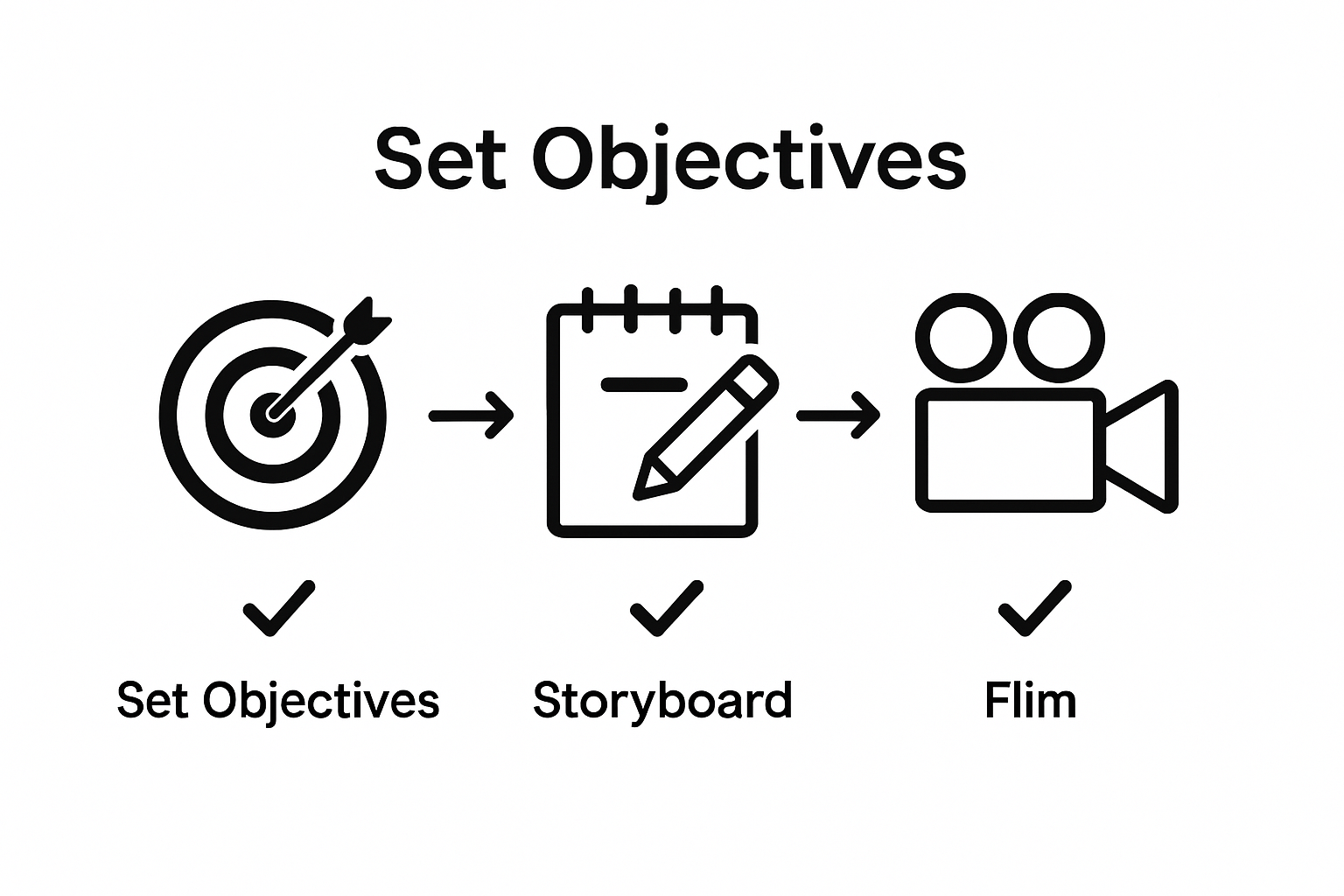
By investing time in this initial planning stage, you set the foundation for a powerful, purposeful video storytelling experience.
Step 2: Develop a Detailed Storyboard
A storyboard transforms your story objectives into a visual roadmap, serving as the critical blueprint for your entire video storytelling workflow. Think of it as your project’s visual script, breaking down complex narrative sequences into clear, digestible frames that guide every aspect of production.
Creating a comprehensive storyboard requires more than basic sketching. You will craft a sequential visual representation that captures each critical moment, camera angle, transition, and emotional beat of your story. Professional storyboards communicate not just what happens, but how it should feel. This means including annotations about lighting, camera movement, emotional tone, and potential visual metaphors.
Start by selecting your storyboarding tools. While traditional methods involve paper and pencil, digital tools like Storyboarder or Canva offer more flexibility. These platforms allow you to quickly draft, revise, and share your visual narrative with team members or clients.
To help you compare commonly used storyboarding tools discussed in the article, here is a quick overview of their main features and advantages.
Tool | Platform Type | Key Features | Advantages |
Storyboarder | Digital/Desktop | Easy sketching, frame sequencing, export options | Fast iteration, collaborative, user-friendly interface |
Canva | Web-based | Drag-and-drop interface, templates, shareable links | Accessible, visually polished, suitable for teams |
Paper & Pencil | Traditional/Analog | Freeform drawing, no tech required | Flexible, quick for rough sketches, low barrier |
According to research from the Society of Motion Picture and Television Engineers, effective storyboards reduce production complexity by up to 40% by providing clear visual communication before actual shooting begins. Your storyboard should include:
Key scene compositions
Precise camera movements
Emotional progression of each sequence
Potential dialogue or voiceover indicators
Rough timing for each frame
Each frame in your storyboard should answer fundamental storytelling questions.
What visual information is being communicated? How does this frame connect to the previous and next moments? What emotional response are you engineering?
Consider your storyboard a living document. Expect to iterate and refine multiple times as you discover more nuanced ways to communicate your narrative. The goal is not photographic perfection but clear narrative intention. Sketch quickly, focus on communication, and remain open to creative evolution throughout the process.
Successful storyboarding means translating abstract story objectives into concrete visual language. Your storyboard becomes the shared vision that aligns your entire creative team, ensuring everyone understands the narrative journey before a single frame is shot.
Step 3: Assemble Your Production Team
Building the right production team is like casting a complex theatrical performance where every member plays a crucial role in bringing your video storytelling vision to life. Your team composition can make or break the entire project, transforming a good concept into an extraordinary visual narrative.
Strategic team assembly begins with understanding the specialized roles required for your specific video project. You will need professionals who not only possess technical skills but also share a collaborative spirit and deep understanding of your narrative objectives. This means looking beyond traditional job titles and seeking creative professionals who can adapt, communicate, and contribute meaningfully to the storytelling process.
According to research from Yale University’s Poorvu Center, comprehensive pre-production planning involves carefully scheduling team meetings and aligning collective goals. Start by identifying core roles such as director, cinematographer, sound designer, editor, and production coordinator. Each team member should bring a unique perspective while maintaining a unified commitment to your story’s core message.
Consider the chemistry and collaborative potential of your team. Technical skills matter, but so does the ability to communicate effectively and pivot creatively under pressure. Look for professionals who demonstrate flexibility, creative problem solving, and a genuine passion for storytelling. Diverse skill sets and complementary talents create a more dynamic production environment.
Your team selection process should include comprehensive interviews, portfolio reviews, and collaborative workshops. These interactions help you assess not just individual capabilities but also how potential team members might interact and support each other during the production.
During team assembly, be transparent about project expectations, timeline, and creative vision. Learn more about refining your post-production workflow to ensure seamless collaboration from initial concept to final edit.
Verify your team’s readiness by conducting a preliminary creative alignment meeting. Successful team assembly means having professionals who are not just skilled, but deeply invested in transforming your story from concept to compelling visual experience. Your goal is creating a collaborative unit that can translate abstract narrative objectives into a powerful, engaging video.
Step 4: Execute the Filming Process
The filming process is where your meticulously crafted storyboard transforms from conceptual blueprint into living, breathing visual narrative. Successful execution demands precision, adaptability, and unwavering commitment to your storytelling vision. Every moment on set represents an opportunity to capture authentic emotion and compelling visual sequences that will drive your narrative forward.
Prepare your set with military-like discipline. Before cameras roll, conduct a comprehensive equipment check ensuring every technical element functions perfectly. This means verifying camera settings, lighting configurations, sound recording equipment, and backup systems. Professional videographers know that equipment reliability is the foundation of smooth production.
According to research from Rochester Institute of Technology, pre-production checklists and structured execution dramatically improve filming outcomes. Communicate clearly with your team, establishing precise communication protocols and contingency plans for potential challenges. Anticipate and plan for variables that might disrupt your shooting schedule.
Your filming strategy should balance technical precision with creative spontaneity. While your storyboard provides a structured guide, remain open to unexpected moments of genuine emotion or improvisation that might elevate your narrative. Explore documentary-style filming techniques to understand how authenticity can transform your storytelling approach.
Key production discipline involves maintaining a consistent yet flexible shooting rhythm. This means:
Adhering to planned shot lists
Managing time efficiently
Capturing multiple takes of critical scenes
Maintaining high energy and positive team dynamics
Document your filming process meticulously. Take detailed notes about each shot, record technical specifications, and capture behind-the-scenes moments that might inform your post-production workflow. These documentation practices serve as valuable references and can provide insights for future projects.
Verify your filming execution by reviewing daily footage, ensuring alignment with your original narrative objectives. A successful filming process means you have captured the raw visual and emotional elements that will become your final video story. Your goal is transforming carefully planned sequences into a compelling, authentic visual experience that resonates with your intended audience.
Step 5: Edit and Finalize Your Video
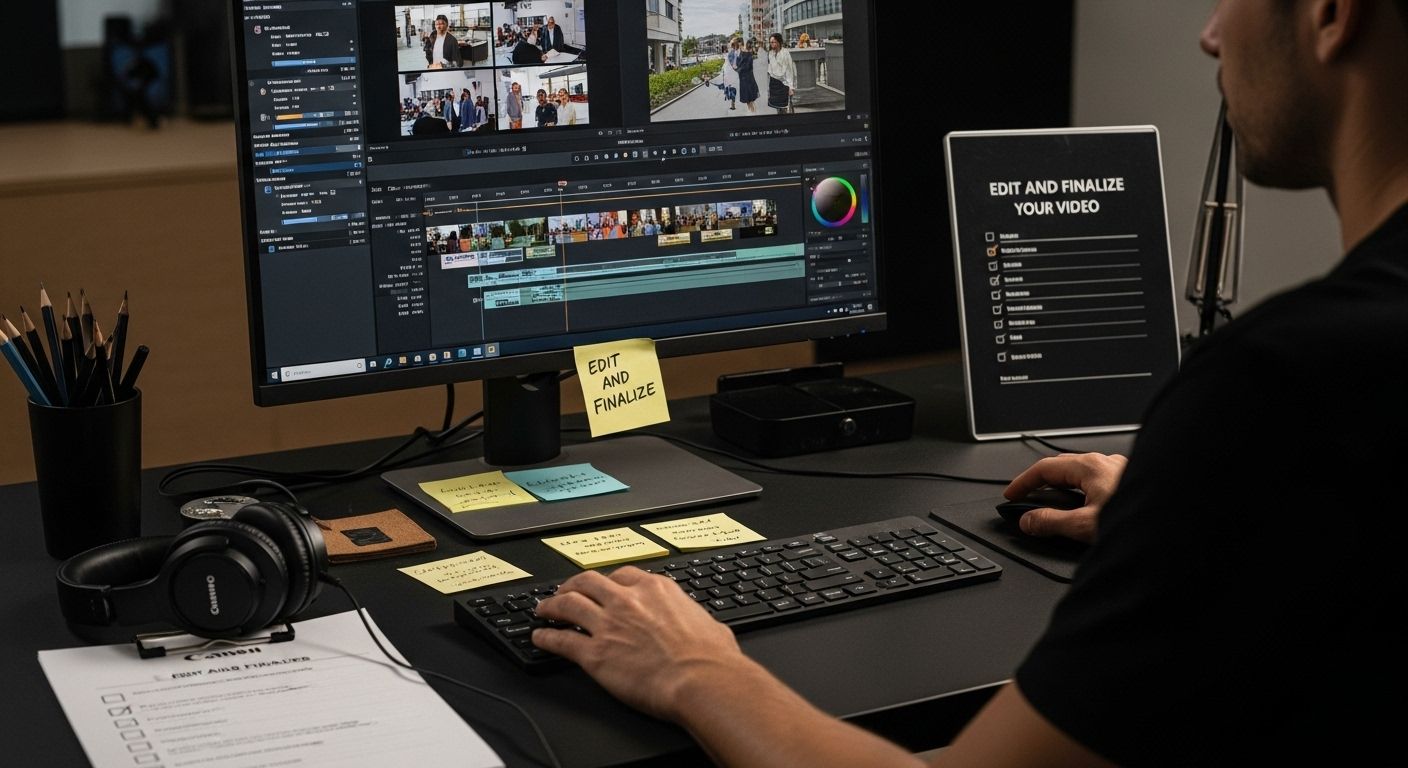
Editing transforms raw footage into a compelling narrative, representing the critical moment where your video storytelling vision becomes reality. This stage is where technical precision meets creative storytelling, demanding both meticulous technical skills and intuitive artistic judgment.
Begin your editing process by establishing a comprehensive and organized digital workspace. Professional editors know that efficient file management determines smooth post-production workflow. Create dedicated folders for raw footage, audio files, graphics, and exported versions. Properly labeled and structured files prevent confusion and save countless hours during the editing process.
According to research from Georgia Institute of Technology, your editing approach should balance technical execution with narrative flow. Start by creating a rough cut that captures the essential story structure. Review your initial assembly critically, focusing on pacing, emotional progression, and narrative clarity. Your goal is crafting a cohesive visual experience that maintains viewer engagement from start to finish.
Color grading and audio mixing are not afterthoughts but integral storytelling tools. Each color correction and sound adjustment contributes to the emotional landscape of your video. Experiment with subtle color palettes that enhance your narrative mood, and carefully balance audio elements to create a rich, immersive experience.
Consider these critical editing considerations:
Maintain narrative momentum
Preserve emotional authenticity
Eliminate unnecessary or repetitive sequences
Ensure technical quality across all visual and audio elements
Learn more about refining your post-production techniques to elevate your editing skills. Professional editing requires both technical proficiency and creative intuition, transforming individual shots into a unified storytelling experience.
Verify your edit by conducting multiple review sessions. Watch the video with fresh eyes at different times, preferably with trusted colleagues who can provide objective feedback. A successful edit means your video communicates its intended message clearly, maintains viewer interest, and delivers a memorable visual narrative that resonates with your target audience.
Below is a checklist table summarizing key verification and completion criteria for the editing and finalizing stage, helping ensure your video meets professional standards before moving on to distribution.
Task | Purpose | Completion Criteria |
Organize digital workspace | Streamline editing process | All files labeled and structured in folders |
Assemble rough cut | Establish basic narrative | Story flows logically with proper pacing |
Review narrative flow | Enhance viewer engagement | Emotional progression and clarity achieved |
Color grade and mix audio | Create immersive experience | Visual and audio tones consistently support mood |
Eliminate unnecessary sequences | Tighten final edit | Only essential scenes included, no filler |
Conduct multiple review sessions | Objective quality checks | Feedback gathered and revisions made |
Step 6: Distribute and Monitor Engagement
Distribution and engagement tracking represent the culmination of your video storytelling journey, transforming your carefully crafted narrative from a creative project into a measurable communication strategy. Effective distribution is not about broadcasting widely, but strategically connecting with your intended audience.
Choose distribution channels that align precisely with your original storytelling objectives. Each platform offers unique audience dynamics and engagement metrics. Social media platforms like YouTube and Vimeo provide robust analytics, while professional networks like LinkedIn might offer more targeted professional reach. Consider the specific behaviors and preferences of your target demographic when selecting distribution platforms.
According to research from Johns Hopkins Institute for Clinical and Translational Research, storytelling engagement depends significantly on strategic dissemination. Develop a comprehensive distribution plan that includes multiple touchpoints. This might involve embedding your video on your website, sharing across social media platforms, distributing through email newsletters, and potentially using paid advertising to extend your reach.
Engagement monitoring requires a multi-dimensional approach. Track not just view counts, but deeper metrics like watch duration, audience retention rates, click-through rates, and qualitative feedback. Tools like Google Analytics, YouTube Studio, and platform-specific insights can provide granular data about how viewers interact with your video.
Consider these critical engagement tracking elements:
Viewer watch time percentages
Audience demographic breakdown
Geographic distribution of viewers
Interaction rates (likes, shares, comments)
Conversion metrics related to your original storytelling objectives
Prepare to iterate based on your engagement data. Explore advanced post-production analysis techniques to refine future storytelling strategies. Professional video creators understand that distribution is not a one-time event but an ongoing process of understanding and adapting to audience preferences.
Verify your distribution success by establishing clear, measurable benchmarks before release. A successful distribution strategy means your video not only reaches its intended audience but also generates meaningful interaction, driving your original storytelling objectives forward.
Ready to Take Control of Your Video Storytelling Workflow?
Are you struggling to bring your video vision to life because your team lacks a clear process or your projects lose focus after creative brainstorming? This article showed how smart story objectives, strong collaboration, and detailed planning help avoid wasted effort, missed deadlines, and disappointing results. At Tulip Films, we deliver personalized video production solutions for Swiss businesses that need more than just beautiful images—they need results. Our team uses proven workflows for pre-production, storyboarding, on-set execution, and post-production to ensure your narrative makes a real impact.

Stop letting disorganization hold your brand back. Visit www.tulipfilms.ch today to see how our expert methods can streamline your next project. Ready for a workflow that delivers clarity, confidence, and audience engagement? Book your free consultation or contact our professional team to get started.
Frequently Asked Questions
What are the key steps in video storytelling workflow for 2025?
Successful video storytelling involves a six-step workflow: define your story objectives, develop a detailed storyboard, assemble your production team, execute the filming process, edit and finalize your video, and distribute while monitoring engagement.
How can I effectively define my video storytelling objectives?
Begin by asking critical questions such as the specific action you want viewers to take, the key message to communicate, and the emotional response you aim to provoke. Document these objectives clearly for your production team.
What should I include in my storyboard to enhance my video production?
Your storyboard should include key scene compositions, camera movements, emotional progressions, potential dialogue or voiceovers, and timing for each frame. This visual roadmap guides all aspects of production.
How do I track engagement after distributing my video?
Monitor metrics like watch duration, audience retention rates, and interaction rates (likes, shares, comments). Tools like Google Analytics and platform-specific insights can help you understand viewer interactions and refine future storytelling strategies.
Recommended
