Role of Video Tours in Sales Success for Geneva Agents

Nearly 80 percent of property buyers now prefer listings with high-quality video tours, making traditional photos look outdated in a competitive Geneva market. American innovation has set a new standard for immersive property showcasing, reshaping the way clients connect with homes before even stepping inside. This guide unpacks how advanced video tour solutions help Geneva real estate agents build trust, create emotional appeal, and drive faster, more engaged sales.
Table of Contents
Key Takeaways
Point | Details |
Importance of Video Tours | Video tours enhance property showcasing, offering immersive experiences that surpass traditional photography. |
Selecting Tour Formats | Different video formats cater to various property types and buyer preferences; choose one that highlights unique features. |
Impact on Buyer Decisions | Video tours help reduce buyer uncertainty and enable emotional connections, crucial for high-value investments. |
Investment Considerations | Treat video production as a strategic investment; ensure high quality and integration into a comprehensive marketing strategy. |
Defining Video Tours in Real Estate Sales
Real estate video tours represent a sophisticated digital marketing approach that transforms property showcasing by offering potential buyers immersive, remote property experiences. These dynamic multimedia presentations go far beyond traditional photography, enabling viewers to virtually explore properties through comprehensive, professionally produced video content. Research indicates that video tours have transitioned from being a novel marketing technique to a standard practice in modern real estate sales strategies.
A video tour typically involves a professionally recorded walkthrough of a property, capturing interior and exterior spaces using high-definition cameras, strategic filming techniques, and sometimes advanced technologies like drone footage or 3D rendering. Unlike static images, these tours provide potential buyers with a comprehensive understanding of a property’s layout, spatial relationships, and unique characteristics. They simulate an in-person viewing experience, allowing clients to assess properties remotely with unprecedented detail and engagement.
The effectiveness of video tours varies depending on several key factors, including property type, market conditions, and the technical quality of the production. According to academic research, these virtual experiences help address information asymmetry in real estate transactions by providing transparent, comprehensive property representations. For Geneva real estate agents, this means creating video content that not only showcases physical spaces but also communicates the emotional potential and lifestyle opportunities inherent in each property.
Pro tip: Invest in professional video production that highlights a property’s unique selling points and creates an emotional connection with potential buyers, rather than simply documenting rooms.
Comparing Video Tour Types and Formats
Real estate professionals today have multiple video tour formats at their disposal, each offering unique advantages for property marketing. Comprehensive research on virtual tour technologies reveals several distinct approaches to digital property visualization. These formats range from basic linear walkthroughs to advanced interactive experiences that provide potential buyers with increasingly sophisticated property exploration tools.
The primary video tour formats include 360-degree panoramic tours, linear video walkthroughs, and interactive 3D model tours. Linear video tours follow a predetermined path through a property, offering a structured viewing experience guided by the videographer. In contrast, 360-degree tours allow viewers to control their perspective, rotating and examining spaces from multiple angles. Interactive 3D model tours represent the most advanced format, enabling potential buyers to navigate through digital representations of properties with unprecedented freedom and detail.
Technological capabilities significantly impact the effectiveness of these tour formats. Academic research comparing video tour technologies suggests that more interactive formats tend to increase user engagement and provide a more comprehensive property understanding. For Geneva real estate agents, selecting the appropriate video tour format depends on factors like property complexity, target market preferences, and available production resources. Some luxury properties might benefit from fully interactive 3D tours, while smaller apartments might be more effectively showcased through carefully crafted linear video walkthroughs.
Pro tip: Choose a video tour format that matches your specific property’s unique characteristics and highlights its most compelling visual features.
Here’s a clear comparison of popular real estate video tour formats:
Tour Format | User Experience | Technical Requirements | Best Used For |
Linear Video Walkthrough | Guided property tour | HD camera, basic editing | Small homes, simple layouts |
360° Panoramic Tour | View controls, rotate | Specialized 360° camera | Larger spaces, open layouts |
Interactive 3D Model Tour | Full navigation, detail | 3D rendering, advanced software | Luxury properties, unique spaces |
How Video Tours Influence Buyer Decisions
Groundbreaking research from the University of Texas reveals that video tours dramatically transform the property buying decision-making process by providing potential buyers with unprecedented insights into real estate offerings. These digital visualization tools have become critical mechanisms for reducing uncertainty and enabling more confident purchasing choices, particularly in markets like Geneva where buyers seek comprehensive property information before making significant investments.
The psychological impact of video tours on buyer decision-making is profound. By offering immersive, multi-angle perspectives, these digital experiences allow potential buyers to emotionally connect with a property before physical visitation. This connection is especially powerful for out-of-town buyers or those with limited time for traditional property viewings. Buyers can now explore spatial relationships, assess property conditions, and visualize themselves living in a space through detailed video representations that static images could never communicate.
Case studies in real estate marketing demonstrate that video tours significantly accelerate the decision-making process. They provide transparent, comprehensive property information that builds buyer trust and reduces perceived risk. For Geneva real estate agents, this means creating video content that not only showcases physical spaces but also tells a compelling story about lifestyle, neighborhood potential, and unique property characteristics. The most effective video tours go beyond mere documentation, crafting narrative experiences that resonate with potential buyers’ aspirations and practical needs.
Pro tip: Create video tours that balance technical details with emotional storytelling, helping potential buyers imagine their future life in the property.
Production Process and Best Practices Explained
Professional virtual tour production requires a systematic approach that transforms raw property footage into compelling visual narratives. The production process for Geneva real estate agents involves multiple critical stages, beginning with meticulous pre-production planning and extending through sophisticated digital rendering techniques. Each step demands precision, technical expertise, and a deep understanding of visual storytelling that can effectively showcase a property’s unique characteristics.
The fundamental production workflow typically encompasses three primary phases: pre-production, shooting, and post-production. During pre-production, agents and videographers collaborate to develop a strategic shooting plan that highlights the property’s most attractive features. This involves detailed property assessment, lighting evaluation, and creating a comprehensive shot list that ensures every significant space and architectural detail receives appropriate visual treatment. Professional videographers use high-resolution cameras, specialized lenses, and stabilization equipment to capture smooth, immersive footage that provides potential buyers with an authentic property experience.
Post-production represents the critical phase where raw footage is transformed into a polished, engaging video tour. Industry best practices recommend careful color grading, seamless transitions, and strategic digital enhancements that maintain visual authenticity. Real estate professionals in Geneva must focus on creating tours that are not just technically proficient but emotionally compelling. This means selecting the right background music, incorporating informative text overlays, and editing the video to create a narrative flow that guides viewers through the property in a logical, engaging manner.
Pro tip: Invest in professional video production that balances technical precision with storytelling, ensuring your property tours communicate both factual details and emotional potential.
The following table summarizes key stages in a professional real estate video tour production process:
Production Stage | Main Activities | Importance for Marketing |
Pre-production | Planning shots, lighting assessment | Ensures strategic storytelling |
Shooting | Filming footage, drone shots | Captures property authenticity |
Post-production | Editing, enhancements, narration | Creates engaging final product |
Costs, ROI, and Common Pitfalls for Agents
Comprehensive research on virtual tour investments reveals that real estate agents must carefully evaluate the financial implications of implementing video tour strategies. The initial production costs can range from several hundred to several thousand dollars, depending on the property’s complexity, size, and desired production quality. Geneva real estate professionals must view these expenses not as pure overhead, but as strategic marketing investments designed to accelerate sales and potentially increase property valuation.
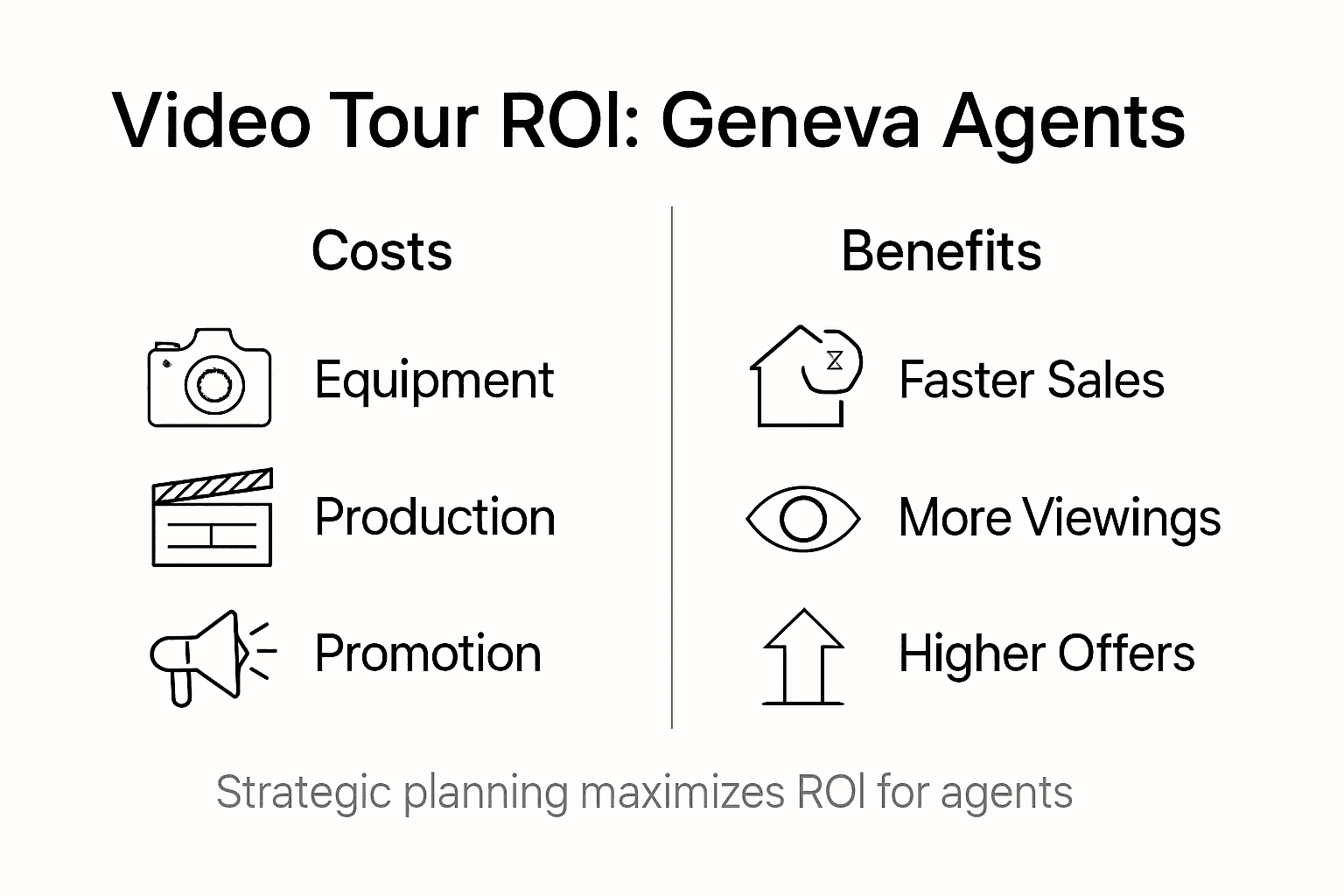
The return on investment for video tours is nuanced and depends on multiple factors. Agents targeting specific market segments like luxury properties or challenging-to-show listings can experience significant benefits. Professionally produced video tours can reduce time on market, attract more potential buyers, and create competitive differentiation. However, industry experts caution that simply creating a video tour does not guarantee success. The production must be high-quality, strategically crafted, and integrated into a comprehensive marketing approach to maximize potential returns.
Common pitfalls for real estate agents include over-investing in video production without a clear strategy, producing low-quality tours that damage property perception, and failing to update content regularly. Successful agents understand that video tours are dynamic marketing tools requiring continuous refinement. They invest in professional production, maintain content relevance, and use video tours as part of a holistic marketing strategy that includes traditional and digital channels. The most effective approaches combine technical excellence with storytelling that helps potential buyers emotionally connect with a property.
Pro tip: Treat video tour production as a strategic investment, allocating budget for professional-quality content that genuinely enhances property marketing effectiveness.
Elevate Your Geneva Real Estate Listings with Expert Video Tours
Real estate agents face the challenge of capturing buyer attention and conveying the full story of a property remotely. The article highlights that video tours must blend technical precision with emotional storytelling to drive faster sales and build trust. Creating immersive, high-quality video content that highlights every unique feature and lifestyle appeal is critical to overcoming information gaps and accelerating buyer decisions.
At Tulip Films, we specialize in tailored real estate video production that transforms listings into compelling visual narratives. Our Swiss-based team understands the Geneva market and focuses on delivering fast, professional service with a personalized approach. Whether you need a linear walkthrough, 360-degree panoramic tour, or interactive content, we craft videos that connect emotionally and elevate your marketing strategy.
Bring your property listings to life today by exploring our portfolio and discovering how we can help you capture buyer attention with stunning video tours.
Ready to enhance your real estate marketing with engaging video tours Get started now with a free consultation at Tulip Films. Learn how our expertise in audiovisual storytelling creates sales success for Geneva agents. Visit Tulip Films homepage and see examples of our work that impact buyer decisions.
Frequently Asked Questions
What are real estate video tours?
Real estate video tours are multimedia presentations that offer potential buyers immersive, remote experiences of properties through professionally produced video content.
How do video tours influence buyer decisions?
Video tours provide potential buyers with detailed visual information, helping them emotionally connect with a property and making the decision-making process more informed and confident.
What types of video tours are available for showcasing properties?
Common video tour formats include linear video walkthroughs, 360-degree panoramic tours, and interactive 3D model tours, each offering different levels of viewer engagement and interactivity.
What are the costs associated with producing a video tour?
The costs for video tours can range from several hundred to several thousand dollars, depending on factors like the property’s complexity, size, and the quality of production desired.
Recommended
